## The Whole Story in 10 Minutes
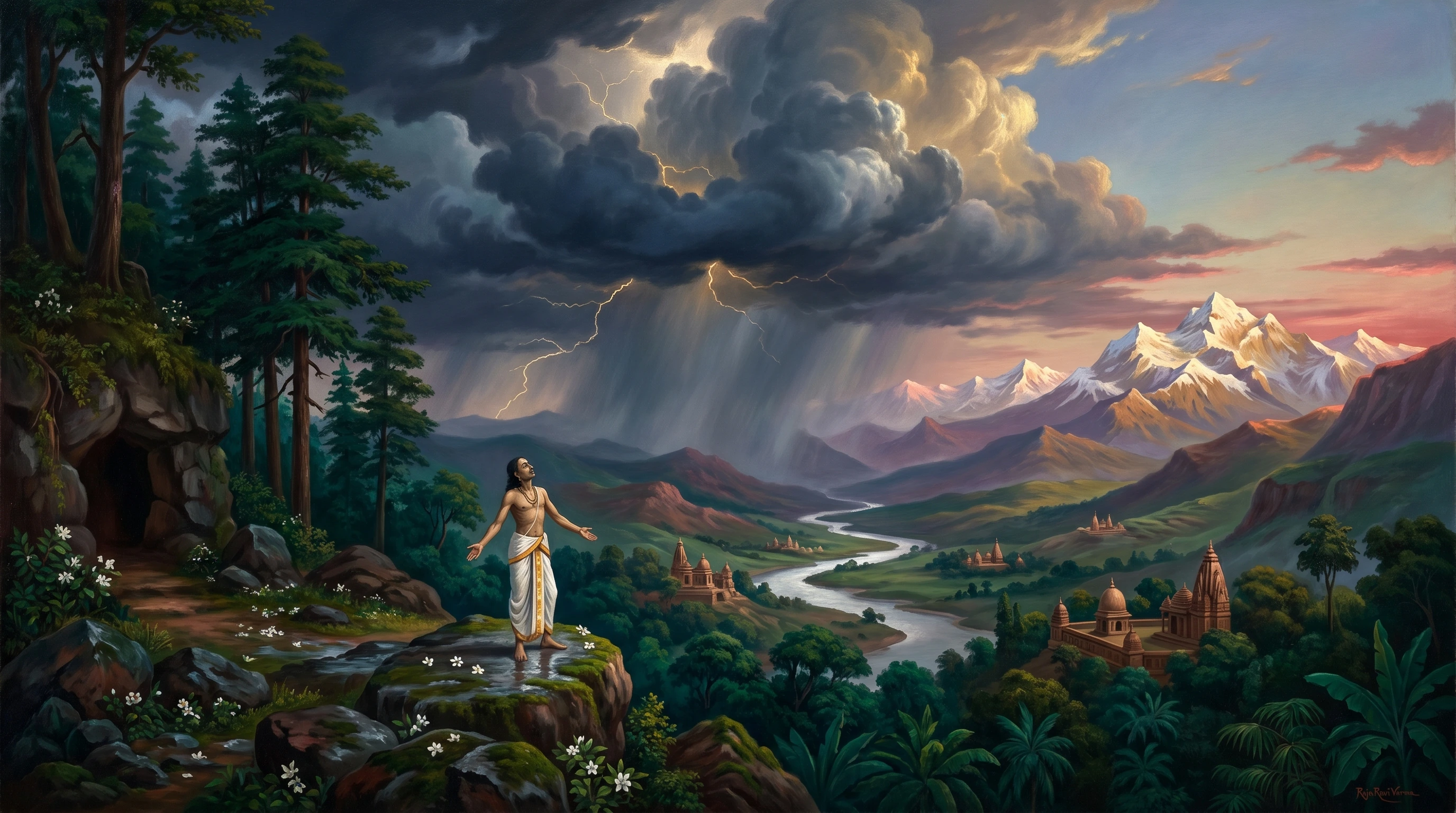
There is a mountain in central India called Ramagiri. It is wet in the monsoon. It is green in the monsoon. And once, fifteen hundred years ago, in the imagination of the poet Kalidasa, a banished demigod stood on its peak and counted the days until his exile would end.
He was a yaksha — a minor immortal, a servant in the household of Kubera, lord of wealth, whose city Alaka sits on a terrace above the clouds, in the high Himalayas, beside the white mountain Kailasa where Shiva meditates. The yaksha had been newly married. He was in love. He was so in love that, one morning, he forgot to gather the lotuses for Kubera's worship. A small offense. An offense of distraction. The kind a young husband commits.
Kubera was not lenient. The yaksha was sent away from Alaka for one year. Banished to the south. Forbidden to see his wife. Forbidden to send a message. Forbidden to do anything but wait.
He took up his exile on Ramagiri Mountain. There were hermits there. There were dripping ferns. There was a small cave he could sleep in. Eight months passed. He grew thin. The gold bracelet his wife had fastened on his wrist on the morning of his departure began to slip — first to his knuckles, then almost off — because there was no longer enough flesh on him to hold it.
And then it was Ashada. The first month of rains. And a cloud lifted out of the south.
"You," he said. "The first one. You are not water alone. You are a wandering thing — and your road runs north, and my road runs north, and we are going the same way."
This is the moment the poem turns on. A man who knows perfectly well that a cloud is only vapor — only the lifted breath of the southern sea — looks at a cloud and decides, because love has confused him, that this cloud can carry a message. He gathers fresh white kutaja blossoms — the first flowers of the rains — and lays them out, the way a host lays out flowers for an honored guest.
"Cloud. I know what you are. You are not a mind. You are not a person. You are vapor — water on its way up to be water again. But my wife is in Alaka, and I cannot go, and you are going. Carry her my message. Only a word. Tell her I am alive."
And then — because the cloud cannot speak, and because the poet's whole project is to put the geography of half of India inside a single lover's mouth — the yaksha begins to describe the road.
Lift yourself out of these cedars. Climb. Cross the high plateau of Mala — where farmer-women, dust-streaked and grateful, will lift their faces. Beyond Mala the Mango Peak, pale and ripe with fruit, and the river Reva breaking white against the dark stone of the Vindhya range, like painted streaks along an elephant's hide. Cranes will fly alongside in long lines. A peacock will dance on a temple wall.
Then Ujjain. Stop in Ujjain. Stay. The poet does not say "stay" — the poet pleads. There is a temple there, to Shiva as Mahakaleshwar, the Lord of Time. The drums will sound. Conch-shells will lift. The dancing-girls of the temple, their hair still wet from the river, will offer fresh red lotuses at the lingam. Lamps will float on the Sipra. Let the silver underside catch the lamp-light. Let the temple wives, looking up between verses of the hymn, mistake the cloud for a darker sky come down to listen.
The cloud, in his telling, becomes a pilgrim. It bows at Devagiri, where Skanda — Shiva's war-god son, born of fire in a thicket of reeds — keeps his watch. The cloud cools its dark belly in the Ganga where she descends at Kanakhala — the river falling from the high white rock of Himalaya in long terraces of white foam, fold over fold, exactly like a flight of stairs let down from heaven for the children of men to climb. It passes over Brahmavarta, the ancient land where the first hymns were composed. It climbs.
And then — the white wall. Mount Kailasa. Pale as a tusk freshly cut from ivory, summits like lotuses lifted into the sky, so still it looks like the laughter of a god turned to stone. Pause there. Beyond Kailasa, Alaka — domes of gold catching the late sun, white marble walls behind them, rainbows traced across the air. The city built to resemble the cloud himself.
The yaksha falls silent for a moment. Then his voice changes. It becomes private. It becomes the voice of a man describing the only person who matters to him.
Find the rainbow gate. Beyond it, a garden. In the garden a lotus pool and a small hill of polished sandstone — no taller than her shoulder — that she and I built together in our first year. Hedges of golden plantain ring it. Three moss-stone steps wind to its top. We used to climb it. We used to pretend it was a mountain.
Past the garden, the house. Past the door, the inner courtyard. Past the courtyard, the chamber. There you will find her. But cloud — you will not need a description. You will know her by what she does in my absence.
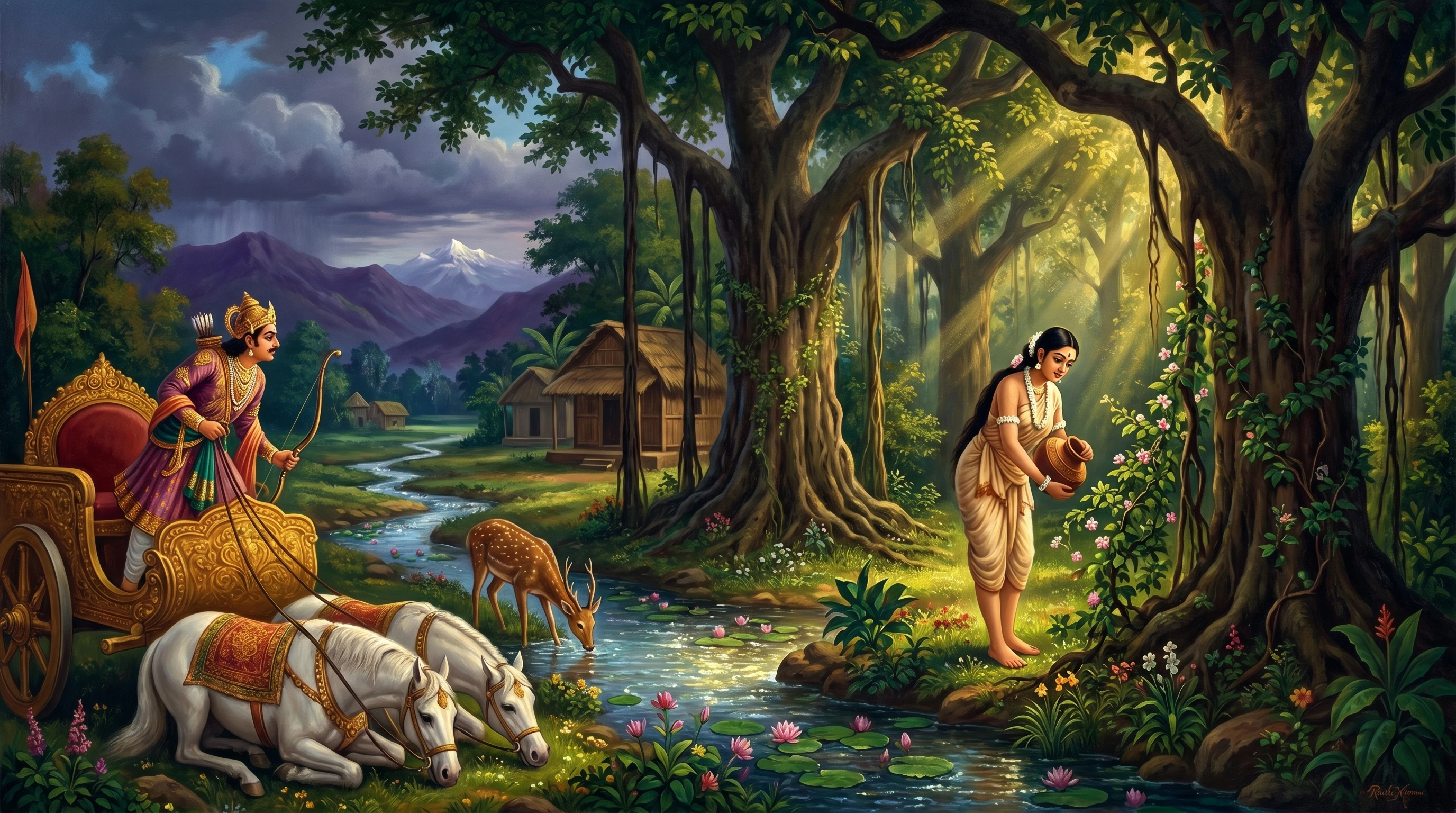
She is the woman who has stopped wearing ornaments. Her bracelets she has set aside. Her eyes, once lined with collyrium, are bare. Her hair, once oiled and braided with jasmine, hangs in one plain plait. Her body is so thin the necklace lies flat against the bones of her throat.
You will find her doing one of three things. She will be teaching the parrot in its cage to repeat my name, and the parrot will be slow, and she will be patient. Or she will be at the lute, trying to play a song we once sang together, and she will lose the tune, and her fingers will fall silent on the strings. Or she will be painting a portrait of me on a small wooden tablet, and the tears will come, and the colours will run, and she will start again.
She is counting. Every evening she counts. She places one flower aside for every month of separation completed, and four flowers remain on the tray, waiting. She will be looking at those four flowers when you arrive.
And then she will sleep — on one side. She has trained herself for these eight months to take up only half the bed. Her braid is tight. Her hand is under her cheek. Beside her a half-burned oil lamp leans in its brass saucer; she has not trimmed it. Withered jasmine on a tray — white once, brittle yellow now — kept because I was the one who tucked them behind her ear.
Do not enter quickly. Hold yourself motionless outside the lattice. Wait. Grant her three hours — only three — of pure unbroken stillness, the way a kind musician waits for the previous note to fade before he plays the next. Then, softly, let her dream that the rain has come. Let the air change. Let her wake.
The whole poem leans toward this one sentence — the message he wants the cloud to speak, on his behalf, after a thousand miles of road. Tell her — your husband on Ramagiri is alive. The exile is almost over. Four more months — only four — and the rains will pass and the curse will end and I will come home. Do not break with longing. Do not. I count the days as a bracelet counts the wrist that has grown too thin to hold it. I love her. I love her still.
The cloud, in the poem, does not answer. The cloud is only weather. It has its own road. It rises out of Ramagiri. It crosses Mala. It crosses the Vindhya. It rests on the Mango Peak. It lingers above Ujjain at evening. It bows at Kailasa. It descends, at last, into Alaka.
Whether it carries the message — whether the wife receives it — Kalidasa does not say. The poem ends, exactly, on the wish.
This is what love is, the poem says. Love is the moment when a man who knows perfectly well that a cloud cannot carry words — looks at a cloud — and gives it his words anyway. Because the geography of all of India between his peak and her bedchamber is shorter than the silence of those eight months. And because, sometimes, that is all you can do.
0
An Exiled Yaksha’s Message to His Wife
Overview
An Exiled Yaksha’s Message to His Wife
सङ्क्षिप्तकथा
The complete arc of Kalidasa's Meghaduta in one sitting: the yaksha exiled to Ramagiri, the first monsoon cloud, the route north to Alaka, the wife's chamber, and the single message love compels a man to send through weather.