## The Whole Story in 10 Minutes
There was a king named Dushyanta. He ruled from the city of Hastinapura, in the north of India, in an age before the empire of the Mauryas, when the line of Bharata still held the throne. He was a good king. He was a great archer. And one morning, during the spring, he went out hunting.
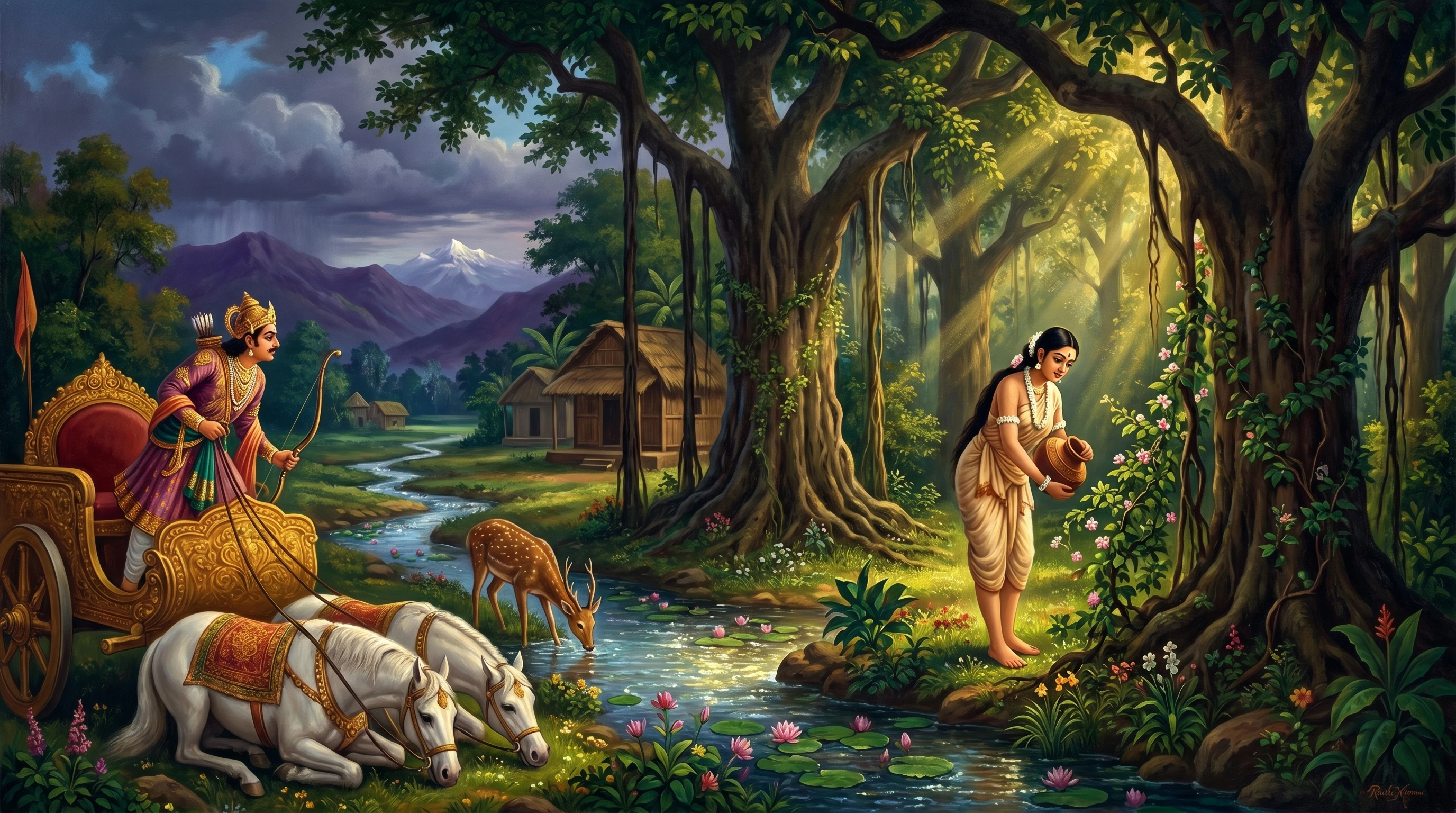
His chariot, drawn by two white horses, pursued a black antelope through the forest. The arrow was on the bowstring. The chariot was closing. The antelope ran for its life. Then a hermit stepped out of the trees and lifted his hand.
"King — lower your bow. This deer belongs to the hermitage of the sage Kanva. We feed it. We have raised it. To kill what is offered protection is no glory for a king."
Dushyanta lowered the bow. He was a king who understood respect. He stepped down from the chariot, set the bow aside, and asked permission to enter the hermitage. Permission was granted. The sage himself was away. His foster-daughter would be in the grove.
She was watering plants. Her name was Shakuntala. She was the daughter of the apsara Menaka and the sage Vishvamitra — abandoned at birth, raised by birds, then by Sage Kanva. Cream bark-cloth at her shoulder. A dark braid woven with white jasmine. Two friends with her, laughing softly. The king stepped behind a flowering vine to watch.
He did not approach her at once. He listened. He watched her care for a tender vine she called her sister. He watched a bee chase her, and her friends laugh, and her bashful pretense of fear. And when at last he stepped out of the leaves and they realized he was the king — there was a moment, a held moment, where Shakuntala lifted her eyes and looked at him. "…my lord," she said. She did not say more. She did not need to.
Dushyanta stayed in the hermitage that evening, and the next, and the next. He invented errands. He found reasons. And one evening, by the bank of the river, in the formal manner permitted to nobility — the Gandharva marriage, marriage by mutual consent of two free hearts, witnessed only by the sky — they were married.
"I cannot take you to my palace yet," he said. "There is a matter of state. The capital calls. I will send for you, with full honour, within the month. Until then — take this." He took from his finger a signet ring. Heavy gold. The royal seal cut into a single great stone. He placed it on her palm. "Show this at the gates of Hastinapura. There will be no question of who you are. I will come for you. And if I cannot come, this will bring you to me."
He left at dawn. And that — should have been the end of the trouble, and the beginning of a long happiness. But the gods of this play had something else in mind.
Some weeks later, when Shakuntala was sitting in the grove, distracted, thinking of her husband — the sage Durvasa arrived. Durvasa was a guest of the highest sanctity. The hermitage was meant to welcome him with water, with a seat, with formal honour. Shakuntala, lost in her thoughts, did not notice him at the gate.
"Girl. Daughter of Kanva. You do not greet your guest. You sit there dreaming. So be it. Whoever you are dreaming of — let him forget you. Let him not know you when you stand before him. Let him look at you and see a stranger."
Her friends ran from the doorway, fell at the sage's feet, begged. Forgive her. Soften the curse. She was distracted only because she is newly married. Forgive her.
"A curse, once spoken, cannot be unspoken. But it may be modified. Let her show him a token. Let her produce some object of recognition. When he sees it — he will remember."
And he was gone. They did not tell Shakuntala. They could not bring themselves to tell her. They thought — surely the ring will be enough. Surely the ring will save it.
Months passed. Shakuntala was now visibly with child. Kanva returned to the hermitage, and when he understood what had happened, he embraced her without judgement and said: it is time. Go to the king. Take your friends. Take the elders. Show him the ring. Be received as a queen.
The journey was long. The party stopped at a forest pool to bathe and rest. Shakuntala, distracted again — by the future this time, by what lay ahead, by the hope of seeing him — dipped her hand into the water. And the signet ring, the heavy gold ring, slid from her finger into the dark water and was gone. She did not notice. She walked on.
At the gates of Hastinapura she was admitted. She stood before Dushyanta in the great hall, in the presence of his ministers, with her veil lifted.
"Who is this woman?" the king said.
She felt for the ring. The ring was gone.
"My lord — you do not know me?"
"I have never met you. I am sorry. There must be some confusion. You are well dressed. You are well born. Whoever has wronged you — it is not I. Return to your hermitage with my apology, and with a gift." And he turned away.
She did not weep. She did not plead. She looked at him for a long moment — at the man who had given her a ring she could no longer produce — and she walked out of the hall.
Outside the gates, the apsara Menaka — her own mother, who had abandoned her at birth — descended from the sky and took her up. Shakuntala disappeared into the celestial regions, to a hermitage she had never seen, in the country of Marichi the rishi, far above the earth. There she would bear her son.
Years passed.
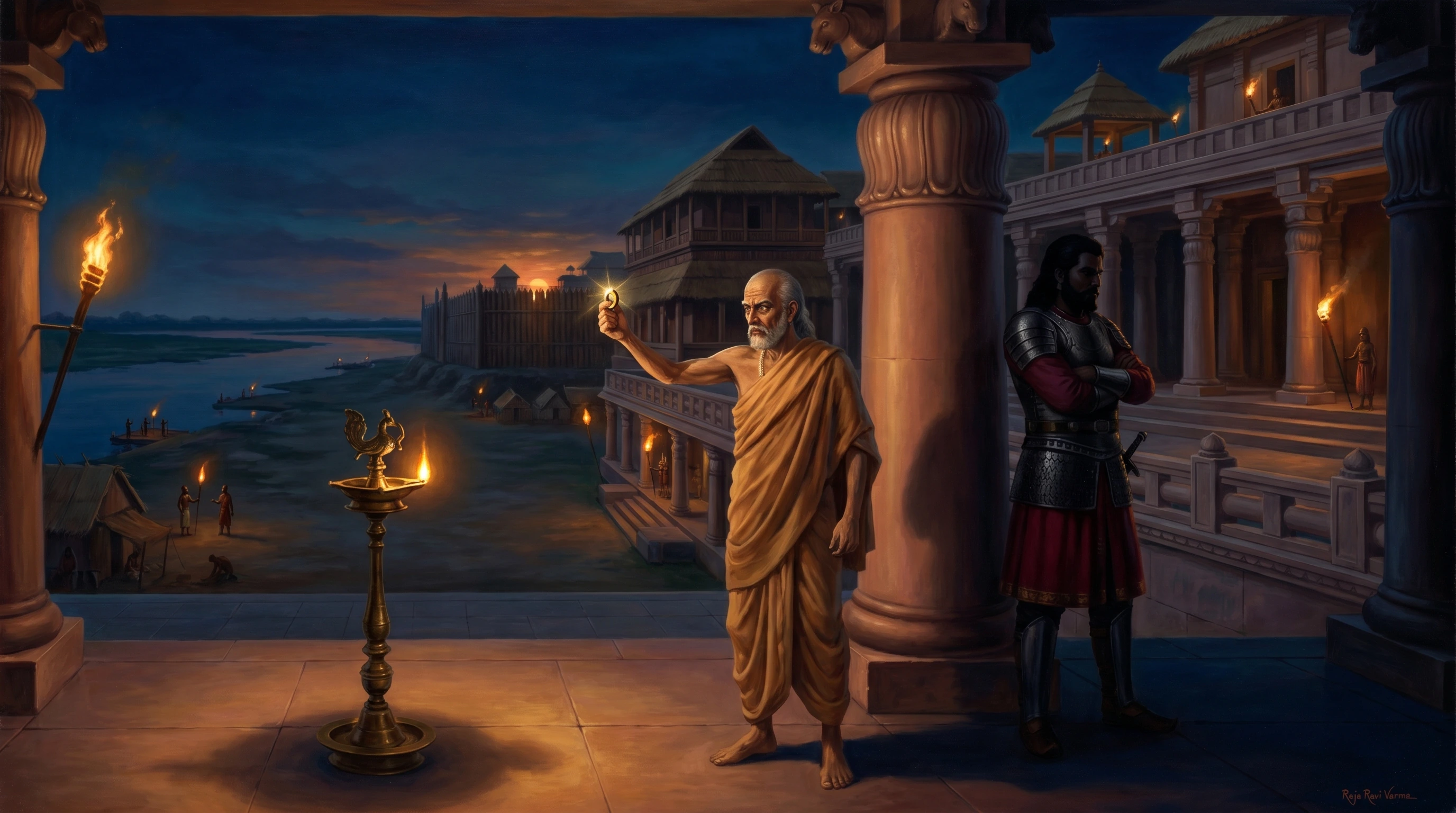
Now — a different scene. A fisher of the city sits with his catch on the riverbank. He has cut open a great rohita fish. And from the belly of the fish, between the rows of pale bone, something hard. Gold. He pulls it free. He turns it in his palm. The royal seal cut into a single great stone.
He is arrested for theft. He is brought before the king. The ring is laid in Dushyanta's palm.
Memory returned in a single breath. The grove. Her cream bark-cloth at the shoulder. The braid woven with jasmine. The two friends laughing. The river. The vow. The ring. And — what he had done.
He freed the fisher. He rewarded him. He stood in his hall in silence for a long time. And from that day he did not laugh, did not sit in council, did not hunt — he searched. For months. For years.
The chance came when Indra summoned him to a divine battle in the celestial regions. The demons had risen. The chariot of Indra came down for him. Dushyanta rode up, fought, won. On the way back, the celestial driver Matali turned to him.
"Matali — what is that mountain ahead? Whose hermitage stands there?"
It was Marichi's. The sage of the upper air. The celestial chariot descended. Dushyanta walked alone through a hermitage of dawn-light and unfamiliar trees. And in a clearing, in the grass — he saw a small boy.
The boy was wrestling with a lion cub. Fearlessly. Pulling open its jaws to count the teeth, as though counting beads. The hermit-women nearby were laughing softly. The lioness, watchful but undisturbed, sat at a little distance.
Dushyanta knelt. "What is your name, little one?"
The boy was Sarvadamana — "subduer of all" — six years old, lion-tamer at play. And in a moment, in a hermit's hut behind the grove, a woman in plain cream cloth stepped out, hearing voices. Older than the girl in the grove had been. Thinner. The eyes the same.
He did not call her name. He could not. He looked at her, and she looked at him, and the years between them — the rejection, the search, the silence — were neither denied nor explained.
"He is yours," she said.
"I — I know. Forgive me."
"You were not yourself. I know that now. The sage in your hall was speaking through your mouth. The curse, not the husband."
She lifted the boy into his arms. Dushyanta held his son for the first time. And then she let him take her hand, and the three of them walked out of the grove together, into the descending chariot, and home.
The boy's other name, the name history would remember him by, was Bharata. From him the line of kings would descend. From his name — the land of India would later take its own. Bharata-varsha. The country of Bharata.
But all of that was still ahead. In the play itself — in Kalidasa's hand — the story ends here. With a boy and a lion cub in a celestial grove. With a king at last kneeling. With a woman who has been wronged and chooses, anyway, to forgive.
This is what recognition is, the play says. It is not the moment we see someone for the first time. It is the moment we see them again — after the world, and our own forgetting, has done its worst — and we choose, even now, to know them.
0
The King, the Forest Maiden, and the Lost Ring
Overview
The King, the Forest Maiden, and the Lost Ring
सङ्क्षिप्तकथा
The complete arc of Kalidasa's Shakuntala in one sitting: a king hunting deer, a forest hermitage, a Gandharva marriage, a sage's curse, a ring lost in a stream, a fish-belly recovery, and a recognition that takes years to land.