# The Whole Story in 15 Minutes
**Narrator:**
The Raghuvamsa is Kalidasa's epic of a single royal line. Nineteen cantos. Thirty kings. One dynasty rising out of meditation and ending in a wine cup. It is shorter than the Mahabharata, more disciplined than the Ramayana, and stranger than either, because its actual subject is not heroism. Its actual subject is what time does to a great family that stops paying attention.
Kalidasa begins, as he always does, by apologizing.
**Kalidasa (invocation):**
"I am the son of a small house. I dare to speak of the dynasty of Raghu — kings whose words came true, whose conquests reached the seas, whose ascetic acts shamed the gods. Forgive me. As a small lamp is held to a great inscription, I will read what I can."
## Canto I — Dilipa
**Narrator:**
The dynasty begins with King Dilipa. He is wealthy, virtuous, just — and childless. The cosmos has no use for a wealthy, virtuous, just king without an heir. He goes to the sage Vasishtha. The sage tells him there is a curse. Once, returning from the assembly of Indra, the king passed beneath the celestial cow Kamadhenu without paying his respects. The cow's daughter Nandini was there. She remembered.
**Vasishtha:**
"Go to the forest. Serve Nandini for a year. Walk where she walks. Lie down where she lies down. Stand watch when she sleeps. Do not eat what she does not eat. When she is satisfied, she will give you what you need."
## Canto II — Nandini
**Narrator:**
Dilipa does it. He follows the cow for a year, dressed in bark, sharing her grass, sleeping at her flank. On the very last morning of his service, a lion rises from a thicket and pins her under its paws.
**Lion:**
"I am the doorkeeper of Shiva. The cow is my food, today. Stand aside."
**Dilipa:**
"Take me instead."
**Narrator:**
The lion considers. The king offers his body as substitute. The cow watches. And then it turns out — as it had to — that there was no lion. There was only Nandini, testing him. She blesses him. Within a year the queen Sudakshina bears a son.
## Canto III — Raghu
**Narrator:**
They name the son Raghu, and the dynasty after him. He is born the kind of child who walks at six months and learns the Vedas at four. By twenty he is leading armies. His father retires to the ascetic groves to make space.
## Canto IV — The Conquest
**Narrator:**
Raghu performs the Digvijaya. He marches east to the sea, breaks the kings of Bengal. He marches south, crosses the river Kapisha, takes tribute from the Pandyas of the deep south. He marches west, defeats the Yavanas on the bank of the Sindhu. He marches north into the Pamirs, the Hindu Kush, the realms beyond the snow. He returns to Ayodhya with the entire subcontinent's loot, performs a Vishvajit sacrifice, and gives it all away in a single ceremony.
When a Brahmin student comes to him afterwards asking for fees to pay his guru, Raghu has nothing left. He goes to the treasury of Kubera, the god of wealth, and threatens to take it by force. The god, recognizing him, rains gold into his courtyard.
## Cantos V–VI — The Nymph and the Svayamvara
**Narrator:**
Raghu's son Aja grows up. The poet says of him only: "He surpassed his father by the measure that his father had surpassed every other man." Aja is sent to the svayamvara of the princess Indumati at Vidarbha. He goes as a guest. The princess, a young woman with a steady, intelligent face, walks among the assembled princes of India one by one. To each she politely raises and lowers her gaze. When she reaches Aja, her companion — a court woman skilled at introductions — describes him. Indumati lifts the wedding garland. She places it on his neck. The other suitors take it badly. They attack the wedding party on the road home. Aja routes them with a single magical arrow Raghu had given him at the marriage. He brings Indumati to Ayodhya.
## Canto VII — Father and Son
**Narrator:**
Raghu hands over the throne and retires to the forest. Aja rules well. He and Indumati love each other. Their son Dasharatha is born.
## Canto VIII — The Garland
**Narrator:**
Years pass. One spring morning, husband and wife are walking in the palace garden. The celestial sage Narada is passing overhead, carrying a garland of unfading flowers. The garland brushes a low cloud. A single petal falls.
It lands on Indumati's chest.
She dies instantly.
**Narrator:**
This is the moment in the poem that has been remembered for fifteen hundred years. A celestial flower — divine, fragrant, beautiful — kills the woman a king loves more than the kingdom. Aja's grief is unhinged. He refuses to cremate her, then cremates her, then collapses on the pyre, then is pulled back. He performs the rites. He goes back to ruling. He performs them well. But everyone in the palace knows. Eight years later he walks to the river Sarayu, the same river his great-grandson Rama will one day walk into, and lets the water close over his head. He is reunited with her in the heaven the texts reserve for kings who die untimely of love.
## Canto IX — The Curse
**Narrator:**
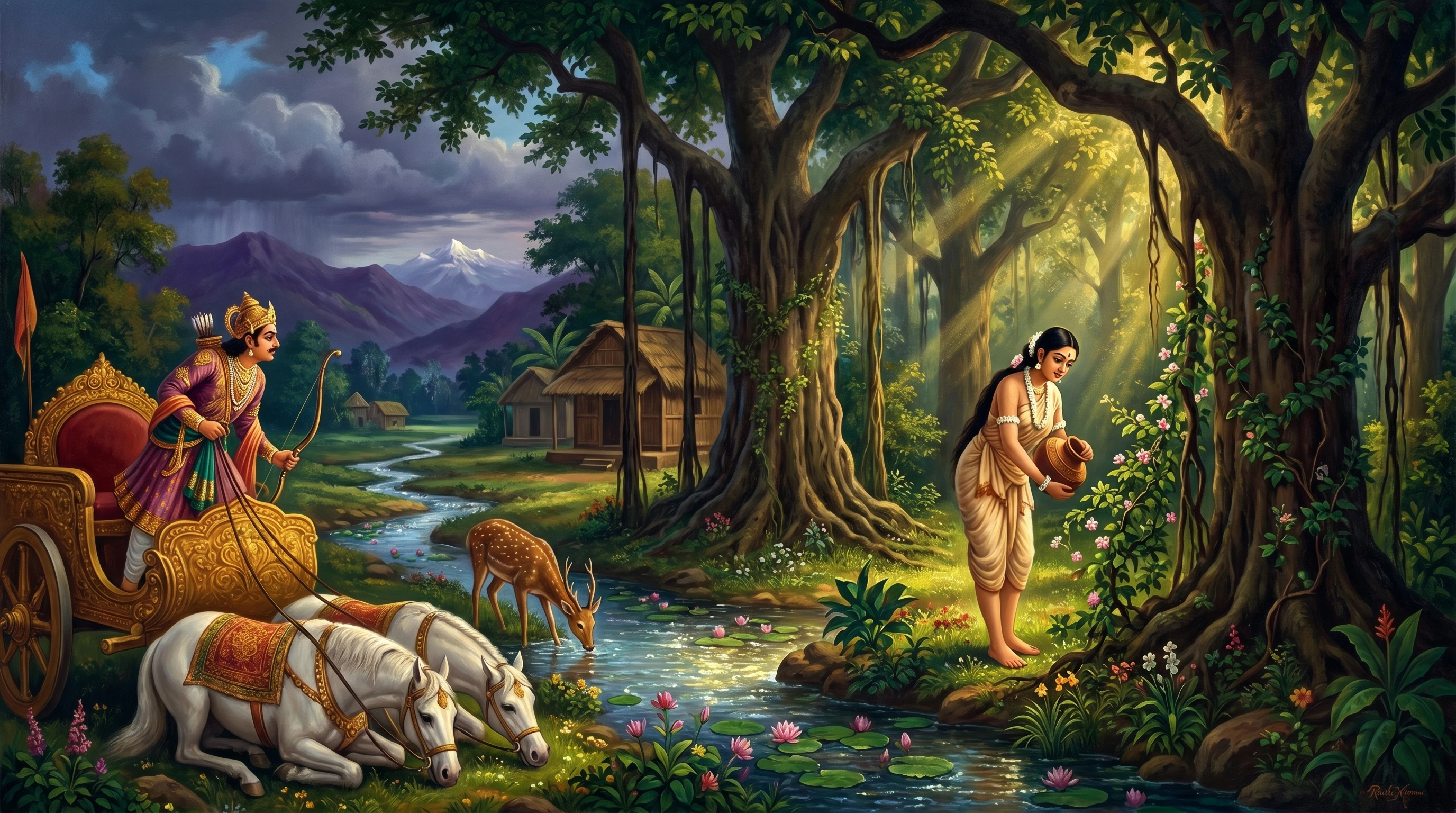
Dasharatha rules next. He is the great hunter, the great warrior, the great patron of priests. One night, hunting alone in a forest, he hears in the dark what he thinks is an elephant drinking. He fires an arrow at the sound. He has shot a boy — a young ascetic, son of an old blind hermit, who had been filling a pot for his father at the riverbank.
The boy dies in Dasharatha's arms. Dasharatha carries the corpse to the hermit. The hermit pronounces the curse that propels the entire Ramayana that follows: *You too shall die of grief for a son.*
## Cantos X–XIV — The Ramayana, Compressed
**Narrator:**
Here the Raghuvamsa briefly becomes the Ramayana, but told as Kalidasa tells it — from the side, from the inside, in private moments rather than military spectacle. Rama is born. The demon Ravana, terrified by a celestial prophecy that names him, goes mad in Lanka with foreknowledge. Rama goes into exile with Sita and Lakshmana. Sita is taken. Hanuman crosses the ocean. The army builds the bridge. The war happens. Kalidasa lingers, more than the original epic does, on the laments of Ravana — the demon-king watching his sons fall one by one, his army shrink, his court empty — and on the silent waiting of Sita in the Ashoka grove, where every leaf of every tree sounds in her ear like Rama's footstep returning. The battle ends. Rama, victorious, brings Sita home. They fly together in the captured chariot Pushpaka over the whole route of her abduction in reverse — every river, every forest, every hermitage she remembered passing. Then Ayodhya. Coronation. Rama Rajya. The kingdom that the poets call perfect.
## Canto XV — Sita Again
**Narrator:**
Then the rumor. Then the second exile. Then the hermitage of Valmiki. Then the twin sons. Kalidasa rushes through this, perhaps in shame. He gives only the closing image — Sita in the great hall, summoned back, refusing to defend herself a second time, asking the earth to take her — and the earth opens.
Rama performs the great Ashvamedha sacrifice. The twin princes Lava and Kusha capture the sacrificial horse, fight their way through Rama's army, and stand in the hall to recite the epic of their father in their father's hall. He recognizes them. He acknowledges them. He sends for Sita. She is gone. He continues to rule alone.
## Cantos XVI–XVIII — The Kings Who Follow
**Narrator:**
Kusha succeeds Rama and rules Ayodhya well. His son Atithi rules adequately. Atithi's son rules less well. Now the poem begins to do something very strange. It accelerates. Kings are named, summarized in a few stanzas, dispatched. Kalidasa's hand is steady, but his canvas keeps shrinking. Where the early cantos took a hundred verses to describe a single sacrifice, here whole reigns close in a couplet:
> *He ruled, he conquered, he was just. He died.*
We are watching, in real time, what time does to a great family. Each king has a little less of his ancestors in him. The poetry the poet uses for each new king is just slightly thinner than the poetry he used for the king before.
## Canto XIX — Agnivarna
**Narrator:**
And we arrive at Agnivarna. King Agnivarna inherits the throne of Ayodhya. He never sits on it. He stays in the harem. He passes administrative orders out through a curtain. He grows pale. He grows thin. He coughs blood. He dies young and childless of consumption. The queens beat their breasts. The ministers stand in the courtyard, paralyzed.
The dynasty is over.
**Narrator:**
The poem ends, exactly, on this image: the chief queen, pregnant by the dying king in his last weeks, standing among the ministers, her hand on her swollen abdomen, the line of Raghu surviving on a single unborn life.
## Coda
**Narrator:**
That is the Raghuvamsa. Begin with a king who serves a cow. End with a king who never gets out of bed. Begin with a dynasty rising from meditation. End with a dynasty dying from indulgence. Begin with the ceremonial gift of every coin in the treasury. End with a man who cannot remember the names of his own ministers. And note that the same poet — same craftsman, same hand, same metrical control — wrote both ends of this arc. The poem is not making an argument. The poem is making a comparison. Here is what a great family looks like at its first sunrise. Here is what one looks like at the moment the light goes out.
What rises rises by discipline. What falls falls by appetite. And Kalidasa — who at the start of the poem apologized for daring to write at all — at the end of it has earned the right to mean every line.
0
The Solar Dynasty, from Dilipa to Agnivarna
ॐ
Overview
The Solar Dynasty, from Dilipa to Agnivarna
सङ्क्षिप्तरघुवंशम्
Kalidasa's nineteen-canto dynastic epic compressed into one sitting — from King Dilipa serving the celestial cow Nandini, through Raghu's world-conquest, through the Ramayana retold in private moments, to the dynasty's final dissolution in the bedchamber of Agnivarna.

 10 min
 10 min
 12 min