Chapter 9 of 19
After his father, Dasaratha rules over Ayodhya as nobly as his predecessors. One morning he starts after a deer, alone and without followers. As the boy died, his sorrow-stricken father cursed the King as the author of his bereavement, with the words: “You, too, like me, shall die, in your old age, grieving for your son.”
Mist burns off the Sarayu river, leaving the scent of wet clay, crushed river-weed, and woodsmoke hanging in the dawn air. Ayodhya wakes with the brutal, rhythmic energy of absolute prosperity. Heavy iron-banded wheels of grain carts grind against the stone avenues, flattening fallen jasmine blossoms into a sweet, bruising paste that coats the paving stones. White oxen, their humps glistening with mustard oil, pull vast shipments of barley toward the royal granaries, their copper bells clanking a steady tempo. Merchants unroll bolts of raw silk, the crimson fabrics snapping sharply in the morning breeze. Everything functions flawlessly. The kingdom runs with the frictionless, terrifying momentum of a machine perfected by generations of unbroken law.
Inside the private chambers, Dasaratha feels the suffocating weight of this peace. He sits on the edge of his low sandalwood bed, pressing the heels of his hands into his tired eyes. In the darkness behind his eyelids, the deep silence of the palace roars. A monarch builds a flawless state so he might rest, but the absolute absence of crisis leaves him untethered. His ministers anticipate his commands; his wives notice the restless drumming of his fingers against the silk long before he realizes he is moving; his judges administer justice so cleanly that the great throne room stays empty. The velvet cushions and the heavy gold bracelets feel like the trappings of a cage. He craves friction. He craves the sudden, brutal reality of survival.
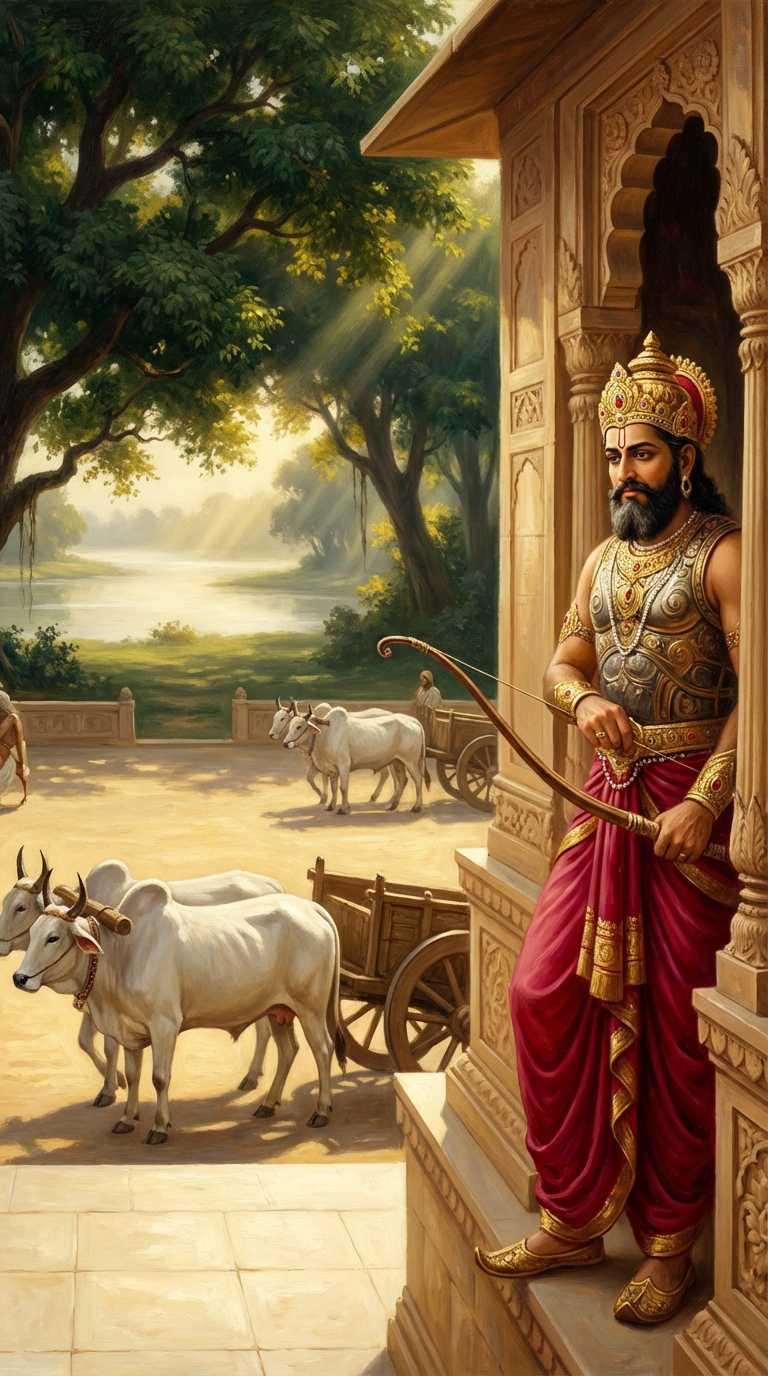
He strips away the fine silk robes of state, trading them for the rough, dark leather of a huntsman. He takes no attendants, no flag-bearers, no musicians to herald his approach. A king surrounded by his retinue experiences only an obedient world, a forest swept clean of danger long before he sets foot in it. Slipping quietly through the heavy timber postern gate, he mounts a dark mare and rides out before the sun crests the palace walls. The hooves strike the damp earth, a muffled drumbeat carrying him away from the stifling perfection of his own making, driving him toward the untamed tangle of the deep woods where a man must still fight for his breath.
Across his back rests the great horn bow, unstrung but humming with latent violence. It is a masterpiece of tension, carved from the deep ribs of a mountain goat, reinforced with cured bamboo, and bound tightly with dried sinew. He stops in a shaded clearing to string it, placing the lower curve against his leather boot and hauling the top end down with a violent exertion of his shoulders. The bow bends, fighting him bitterly, demanding the full measure of his physical strength to conquer it. When the loop of the bowstring finally slips into the notch, the weapon lets out a low, resonant thrum. Here lies the fundamental danger of immense capability without an immediate target: the drawn string aches endlessly to release its contained energy.
He draws an arrow from his leather quiver, rolling the perfectly straight cedar shaft between his calloused fingers. The fletching is made from the stiff feathers of a mountain eagle, engineered precisely for the sabda-vedhi—the closely guarded martial art of striking an unseen target by sound alone. It is an inherently arrogant skill, one that presumes human hearing can successfully parse the infinite, chaotic noise of the forest with absolute infallibility. To fire a weapon without looking requires an unshakeable belief in one's own judgment. It requires a man who has never made a mistake of profound consequence, a man who believes the physical world will always bend naturally to align with his will.
He walks deeper into the sal forest, leaving the mare securely tethered to the exposed roots of a banyan tree. The forest canopy thickens drastically, blotting out the harsh midday sun and replacing it with a dense, bruised twilight. Vines as thick as a man's thigh choke the massive trunks of the older trees. The air grows entirely still, heavy with the metallic tang of damp earth, crushed fern, and rotting timber. He steps forward silently, his soft leather soles sliding over the wet moss without generating a single whisper. He relies completely on his ears, tuning out the rustle of the wind and the screech of the macaques, listening only for the heavy, unmistakable intake of breath from a feeding animal.
Dusk bleeds through the overlapping leaves as he silently approaches the reedy banks of the Tamasa river. The water runs sluggish and dark, wholly concealed behind a towering, impenetrable wall of tall elephant grass. Dasaratha crouches low into the mud, his breathing deliberately slow and shallow. Then he hears it. A deep, wet gurgling cuts through the heavy twilight—the exact, rhythmic sound of a massive bull elephant drawing river water deep into its trunk. The sound is heavy, submerged, and entirely unmistakable to a seasoned hunter. He does not step forward to part the dense reeds. He does not wait for the grey bulk of the animal to break the tree line. His muscles lock into familiar memory. He raises the great bow, draws the taut string past his cheek, and releases.
The arrow hisses through the damp, cooling air, slicing through the thick stalks of grass with a sharp whisper. Instead of the furious trumpet of a wounded beast, a high, thin human cry tears the absolute silence apart. A splash follows instantly, sharp and chaotic, like a heavy stone dropped from a great height, and then the desperate thrashing of limbs in the shallow water. Dasaratha drops the heavy bow into the dirt. The breath leaves his lungs in a cold, horrifying rush. He plunges recklessly through the tall reeds, the serrated edges slicing thin red lines across his forearms and cheeks. He breaks through the grass and stands knee-deep in the cold river mud, the entire architecture of his world abruptly shattering around him.
A young boy lies clutching the cedar shaft buried deep in his chest. A clay water pitcher floats upside down beside him, bobbing gently in the slow river current, its hollow throat still bubbling with the exact sound of a drinking beast. The boy’s eyes are wide, fixed entirely on the darkening canopy, his chest heaving as blood pools dark and thick against the wet river clay. Not fifty paces away, under the twisted roots of a massive banyan, an old man and woman sit completely still. Their eyes are entirely clouded with thick white cataracts. They turn their faces toward the violent thrashing, their frail hands blindly gripping the empty air. The old man’s voice trembles, calling out in terror to the son who will never carry water to them again.
vajrapāta ivādrīṇāṃ hṛdaye patito dhvaniḥ Like a great thunderbolt splitting the unyielding core of a mountain, the blind ascetic’s voice strikes the center of the king’s chest. The agonizing grief of the old man does not manifest as helpless weeping, but hardens instantly into a terrible, unalterable law. He speaks the dreadful curse over the bleeding body of his son, his blind eyes locked unerringly onto the exact space where Dasaratha stands trembling in the freezing mud. He decrees that the mighty king, too, will eventually die in his old age, his heart utterly shattered by the agonizing absence of his own beloved son. The words carry the inescapable weight of physics; they are not merely spoken into the wind, but physically embedded into the deepest fabric of the king’s destiny.
The curse operates with the slow, insidious patience of a seed taking quiet root in deep masonry. Dasaratha stands paralyzed in the darkening water, staring blankly at his own bloodstained hands, realizing the absolute totality of his ruin. The sabda-vedhi arrow, fired from a place of supreme confidence and unchecked pride, has pierced the exact center of his own future. The irony wraps around his throat like a heavy iron chain. He deliberately sought out the forest because he desired the raw, unpredictable friction of life, a brief escape from the perfect control he wielded over Ayodhya. In his staggering arrogance, he believed his power extended safely to the very edges of the earth. He fired blindly into the dark, and struck his own unborn tragedy.
Power breeds a dangerous and quiet delusion. The ruler who entirely masters his environment, who systematically eliminates all threats and constructs a flawless machinery of governance, eventually comes to believe he has conquered consequence itself. He forgets that human action is a heavy stone thrown into a dark pool, its expanding ripples entirely beyond the thrower's control. Action undertaken without true sight—driven by the sheer, intoxicating capability to act—always strikes the most fragile thing hidden quietly in the reeds. We constantly wield our tremendous capacities blindly, easily mistaking the booming sound of our own desires for the absolute truth of the world, only to discover we have fatally wounded exactly what we swore to protect.
Yet the old man’s curse carries a devastating double edge, embedding a strange, terrible grace deep inside its malice. To die of unbearable grief for a child means that, one day, the childless king will first be granted the agonizing miracle of profound love. He will hold a son, he will watch him grow into a man, he will love him with a ferocity that entirely eclipses his great empire, and he will do so knowing the final bill for this joy will eventually come due. The highest price of immense love is the absolute certainty of its loss.