Chapter 8 of 19
Aja begins to reign, and Raghu continues to live near by, in secluded retirement, when after a few years he departs this life. Aja gives him a suitable funeral. In course of time Indumatî gives birth to a son who is named Dasaratha. The grief of the King at this unexpected stroke of misfortune knows no bounds.
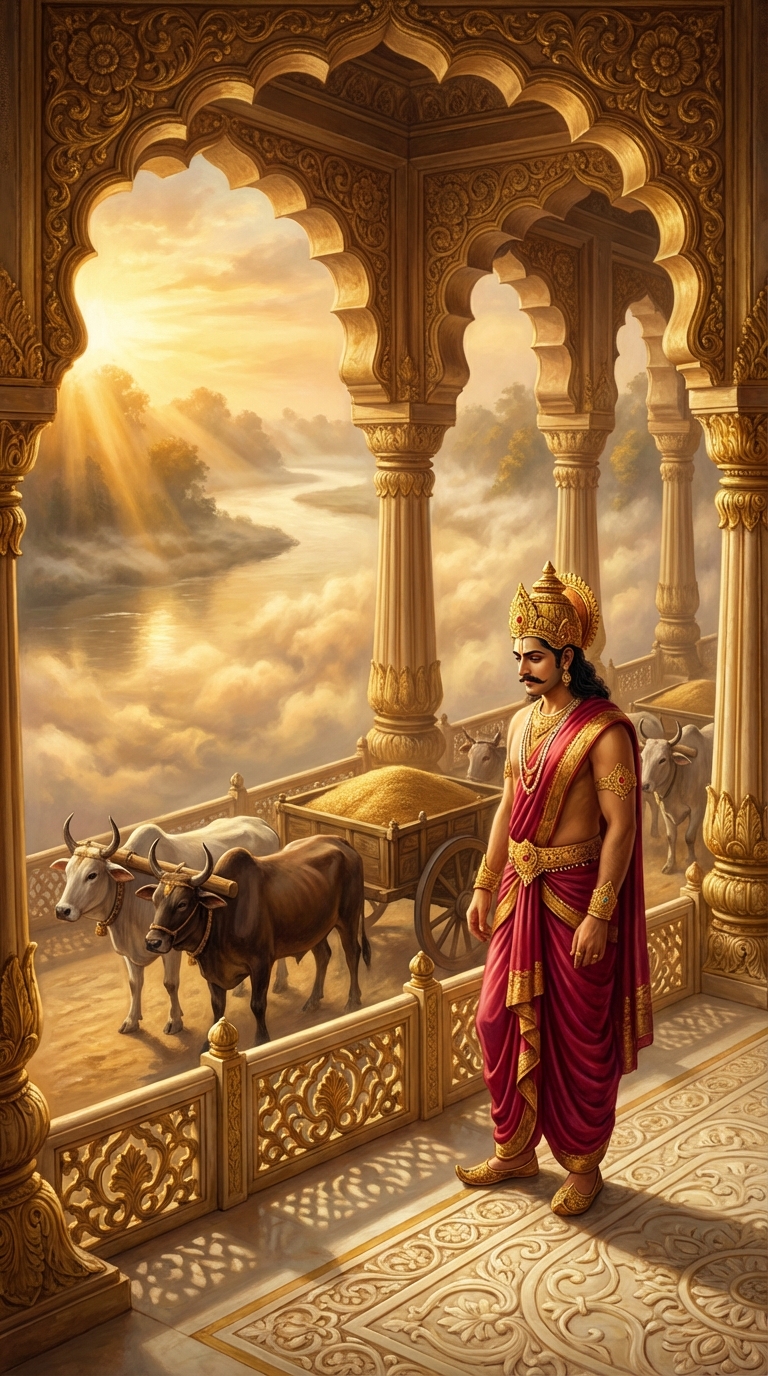
The white oxen drag carts of camphor and sandalwood through the wet clay of Ayodhya’s southern gates. Morning mist clings to the Sarayu river, smelling of crushed lotus stalks and the cold iron of ritual axes. King Aja watches the smoke rise from the cremation grounds, a thin grey finger pointing toward the fading stars. His father, Raghu, is dead. The old king had spent his final years in the ascetic groves, trading silk for rough bark, empire for measured breath. Now, the bark burns alongside the flesh. Aja stands on the palace terrace, feeling the unyielding edge of the basalt balustrade beneath his palms. The cold stone grounds him. He is alone at the summit of the known world, inheriting a throne built on ash.
The city beneath him orchestrates its grief with precision. Temple bells ring out in staggered tolls, rattling the copper weather-vanes shaped like mythical birds. Priests carry brass pitchers of river water up the ghat steps to wash the cooling ashes, their chanting a low drone that shudders through the soles of Aja's sandals. He does not weep. Kingship allows no room for the public indulgence of salt and water. Instead, he forces his mind toward the relentless mechanisms of empire: the granaries must be audited, the frontier garrisons paid in silver punch-marked coins. Yet his chest tightens, a sudden constriction, as if the royal white umbrella held over his head by silent attendants has become a crushing weight bearing down upon his spine.
A hand rests on his wrist. Indumatī. Her touch is light, smelling of crushed jasmine and sandalwood oil, yet it instantly anchors him to the earth. She wears white, the hue adapted for a daughter-in-law's mourning, but the gold bangles at her wrists catch the breaking dawn. In her shadow sleeps their infant son, Daśaratha, a warm, milk-scented weight wrapped in saffron silk. Aja looks at his queen, seeing the steady intelligence in her eyes, the quiet competence balancing his own volatility. The old era has turned to ash on the riverbank, but the new one breathes right here, fiercely alive against the cold stone. He turns his palm up to interlock his fingers with hers.
A single white lotus rests in a silver bowl on the mahogany council table. Aja stares at the bruised petals while his ministers argue over grain yields and unrest among the southern vassals. He turns his gold signet ring—Raghu's ring, still slightly loose on his index finger. The gold holds the heat of his skin, a constant abrasive reminder of the transference of absolute power. When he stamps the wax, he decides who eats and who starves across the subcontinent. The burden manifests as a physical pressure behind his eyes. Only Indumatī knows how to silence the noise. She smoothly shifts the silver bowl out of his line of sight, replacing it with a vellum map of the northern provinces.
She points to a narrow mountain pass, her fingernail tracing the pale blue ink of the river delta. Aja does not look at the map; he looks at the pulse beating at the base of her throat. This is the geometry of his reign. His ministers believe the throne rests securely on the standing army, the overflowing granaries, and delicate treaties negotiated with border kings. Aja knows the truth. The entire architecture of his sanity rests on the inhale and exhale of the woman sitting beside him. Without her sharp mind and grounding touch, the crown is merely a cage of gold. He watches her breathe, hyper-aware of the frail cage of ribs protecting that unceasing rhythm.
They leave the council chamber together, walking down long corridors lined with guards who snap to attention, their spears catching the high noon light. Aja feels an urge to hide her away, to lock her in the innermost chambers of the palace where the world cannot reach. It is the fear that haunts all men who possess too much: the absolute certainty that the universe demands a tax on perfect happiness. He watches the way the silk of her sari sweeps against the polished marble floors, a rhythmic sound like the sea. He reaches out and catches the fabric, halting her in the middle of the corridor, simply to verify that she is real, solid, and tethered to him in this moment.
They walk in the pleasure gardens under the fierce afternoon sun, seeking respite from the palace's blinding marble glare. Peacocks drag heavy, jeweled tails through the red dust, their calls metallic. The stagnant air is thick with the scent of overripe mangoes and blooming kadamba trees. Above them, a sudden wind tears through the upper canopy of the banyans. It is a localized gust, smelling sharply of ozone and high-altitude ice, completely out of place in the humid plains. A rapid shadow passes over the sun. From the invisible heights, a wreath of celestial flowers—vibrant, unnatural blue blossoms strung on a shimmering silver thread—plummets violently through the branches. It falls with the lethal velocity of a dropped stone.
The garland strikes Indumatī directly on the breast. The sound is dull, a soft, muffled thump against embroidered silk and flesh. She does not cry out or raise her hands to defend herself. Her dark eyes widen, fixing on Aja with a sudden clarity, as if she has just remembered an urgent appointment. Her lips part slightly, taking in one final, shallow draft of the heavy garden air. The garland slips down her body to the grass, the blue petals entirely unbruised by the impact. Indumatī’s knees unlock. She falls backward toward the earth with the uncontrolled grace of a felled cedar tree. Aja lunges forward and catches her, the momentum of her collapsing weight driving him hard into the dust.
"Breathe," he commands her, instinctively using the harsh voice that commands armies, the royal tone that orders battlefield executions and grants sovereign pardons. The garden is silent. Even the peacocks have stopped moving. He presses his ear tightly to her chest, right over the spot where the celestial flowers struck. He hears nothing but the rush of his own panicked blood. No flutter, no rhythm, no life. The silence rapidly roars in Aja's ears, deafening, swallowing the light. He pulls her violently against his chest, burying his face in her jasmine-scented hair, feeling the residual warmth fading from her skin. He screams, a raw guttural tearing of sound that thoroughly shatters the afternoon, frightening the birds into the empty sky.
sragiyaṃ yadi jīvitāpahā hṛdaye kiṃ nihatā na hanti mām
If this garland is a destroyer of life, Aja thinks, holding the blue blossoms against his own heaving breast, why does it not kill me when it strikes my heart? He presses the flowers brutally into his flesh, desperately willing the soft petals to act as poisoned daggers. This is the cruelty of the universe laid utterly bare. He recognizes the absurdity of a world where iron spears shatter harmlessly against a king's armor in the chaos of battle, yet a vibrant woman is instantly extinguished by a cascade of blossoms. The contrast is a physical violence. Aja crushes the celestial flowers in his fists, but they do not wilt, they do not bruise, and they absolutely refuse to grant him the mercy of death.
His subsequent grief entirely dismantles the boundaries of his disciplined mind. He speaks to the wind, to the banyan trees, to the unyielding blue sky, furiously demanding the immediate return of what was stolen. The verses pour from his mouth not as composed poetry, but as the fragmented logic of a man desperately attempting to reverse the flow of time. He actively reasons with her cooling corpse, passionately arguing that a true devoted wife does not stubbornly sleep while her husband loudly grieves. He points out the fundamental injustice of the cosmos, reducing the incomprehensible architecture of fate to a singular flaw. He is a sovereign who can summon thousands to willingly die for him, yet he remains powerless to make one woman draw a single breath.
We build our fortresses of stone and steel, accumulating power as if authority alone might serve as a barricade against the dictates of the cosmos. A king inherits an empire, audits the granaries, and commands the frontiers, believing that absolute control over the material world ensures the safety of the private heart. But the universe operates on an entirely different economy, one that does not recognize the heavy gold of a signet ring or the thick walls of a marble palace. Love inevitably transforms the most heavily fortified monarch into a defenseless creature, exposing the fragile pulse at the throat to the whims of a falling leaf or a sudden wind. Grief is the inescapable tax levied upon the audacity of loving deeply in a wildly unpredictable world.
The tragedy of Aja is not merely the loss of a queen, but the annihilation of the illusion of control. When the sky decides to hurl a weapon made of flowers, all the accumulated armor of human achievement is revealed as useless paper. We spend our lives marching armies to the borders, frantically guarding against the visible enemies across the river, while the sky waits quietly above us, holding the silent instruments of our undoing. We survive the battlefields only to be shattered by the blossoms in the garden.