Chapter 10 of 19
Some ten thousand years pass, but still Dasaratha remains without the expected son. At last, holy sages proceed to perform on his behalf a special kind of sacrifice intended to bring about the birth of a son. Vishnu promises that he would be born as a man, as a son of King Dasaratha of Ayodhyā, and that at his hands Ravana would meet death. Rama was the eldest of them, born of Kausalyā.
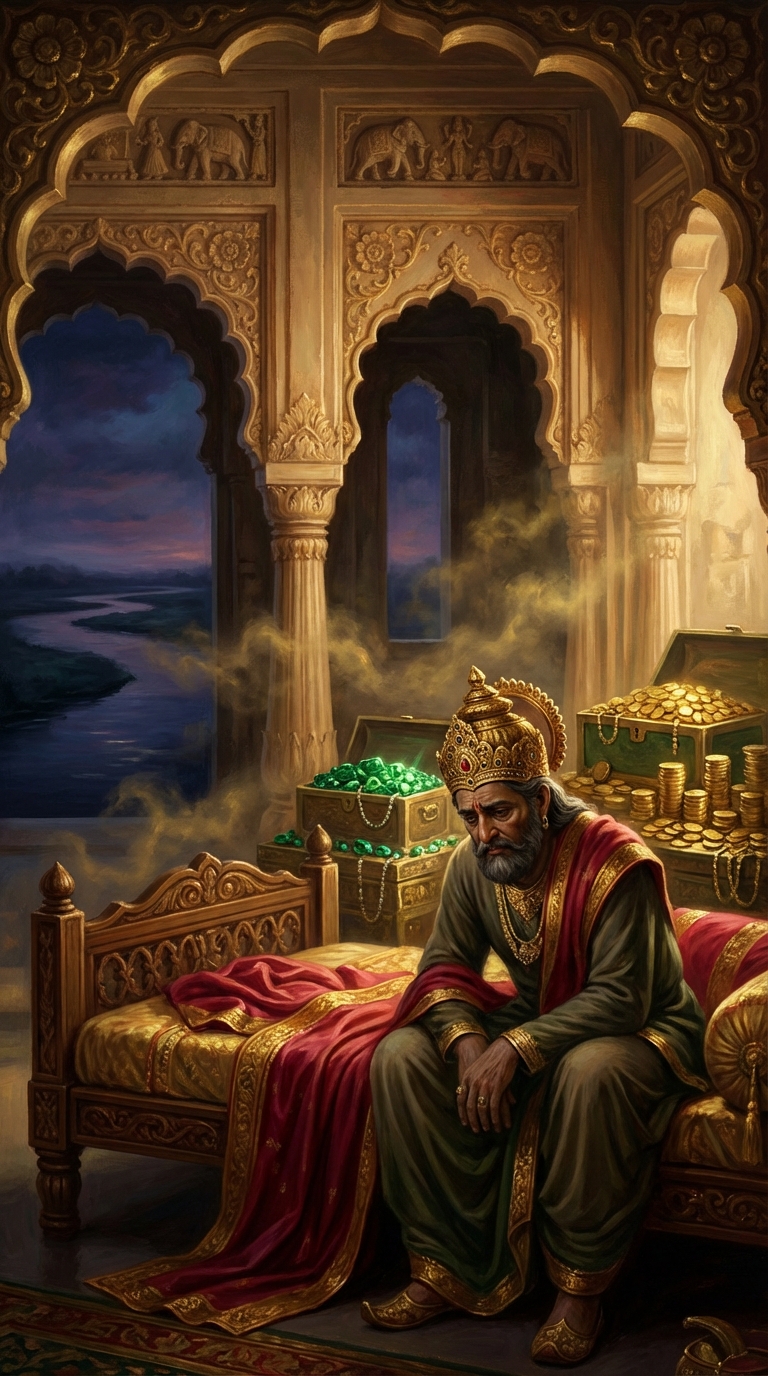
The Sarayu river exhales its morning breath—a thick mist smelling of wet alluvial clay and bruised lotus stalks. It crawls over the limestone parapets of Ayodhya, spilling into the inner courtyards where Dasaratha lies awake. The king stares at the cedar beams of his ceiling, counting the silence. Ten thousand years is the span the scribes will later record, an exaggeration meant to convey a grief defying arithmetic. But Dasaratha feels every season in the dull ache of his joints, in the papery thinness of his skin. He turns on his side. The silk mattress whispers beneath him, unnervingly loud in the pre-dawn quiet. He is an aging man presiding over an empire of dust, bleeding his youth into a terrifying void.
Beyond his balcony, the machinery of the capital begins to grind. Heavy teakwood yokes groan against the scarred white humps of oxen pulling grain-carts toward the central markets. Brass bells clank in a relentless, off-beat rhythm. Prosperity is heavy, loud, and relentless. The granaries bulge with red rice, the treasury vaults sink under the sheer tonnage of tribute gold, and the armories gleam with row upon row of oiled iron. Yet none of it can plug the rot expanding in the king’s chest. A kingdom without an heir is merely a beautifully decorated corpse waiting for the jackals to arrive. The gold feels exactly like ash. The chants of his courtiers ring out through the halls like mocking funeral dirges.
Three chambers down the corridor, Queen Kausalya stands barefoot on the cold, polished marble floor. She watches the oil lamps sputter in their copper sconces, the charred wicks drowning in shallow pools of black soot. She knows her husband’s terror intimately, because it is the precise, suffocating mirror of her own. She places a pale hand over her flat abdomen. The hollow space beneath her ribs aches sharply with phantom kicks. She smoothes the heavy gold weave of her sari, pressing her palms against the useless, empty terrain of her own body. The grand solar dynasty ends right here, in this lavishly appointed room, unless they can force the indifferent heavens to look down.
The sacrificial ground beside the churning river is a brutal geometry of power. Priests have measured the brick altars to the strict fraction of a fingernail, laying out a grid to trap the divine. The margin for error is nonexistent; a single mispronounced Vedic syllable, a misplaced wooden ladle, and the fire will consume the patron rather than the offering. The immense heat warps the dawn air into liquid, shimmering ripples. Dark khadira logs, slick with ladled pools of clarified butter, crackle furiously in the deep trench. The white smoke stings the eyes, carrying the cloying scent of roasted barley, melting fat, and crushed camphor. This is not a gentle act of devotion. It is a desperate siege laid against the sky.
Dasaratha stands at the perimeter of the heat, the towering flames casting deep, violent shadows across his exhausted face. He holds a single wooden spoon poised above the roaring fire. His knuckles are stark white, the veins rising blue and fragile beneath his translucent skin. This grip holds the absolute survival of his bloodline. He tilts his wrist just a fraction of an inch. The golden liquid drops into the inferno. A violent, crackling hiss erupts upward. A thick bead of sweat crawls down the ash-smeared temple of the chief priest, cutting a dark track through the white powder of his brow. Nobody moves. Nobody breathes. The silence hanging between the rhythmic chants is heavier than solid stone.
Hidden safely behind a screen of woven river-reeds, Kausalya watches the flames leap toward the canopy. The smoke suffocates her, coating her dry throat with a thick, greasy grit. She absolutely refuses to cough. She grips the bamboo frame of the screen until sharp splinters pierce the skin of her palms. This is their final barter with the cosmos. The king is hemorrhaging the wealth of generations, bankrupting the earthly realm to buy the attention of the infinite gods. If the fires burn down to gray ash and leave them empty-handed, the resulting quiet will shatter their minds. They are gambling the sanity of the empire, and the continuity of the world, on a fleeting spark in the dark.
The fire does not merely burn. It tears open. The flames peel back from the center like a curtain of torn orange silk, totally defying the morning wind. From the incandescent core of the brick altar, a colossal figure rises, unscorched by the absolute heat. His skin is the terrifying, luminous blue of a bruised thundercloud holding heavy rain. He is draped in yellow silk that flashes like caught lightning. This is Vishnu, stepping into the physical realm. He does not gently float down from the ether; his massive bare feet hit the sacrificial bricks with a concussive thud that vibrates through the soles of Dasaratha’s leather sandals, traveling straight up into the aching marrow of his aging legs.
The god holds a massive golden bowl in his dark hands. Thick, sweet-smelling steam rises from the pale, boiling nectar churning inside the vessel. When Vishnu finally speaks, the sound is deeply tectonic, reminiscent of the violent monsoon sea breaking against jagged coastal cliffs. He drives his unalterable promise directly into the smoke. He will willingly compress his boundless infinity into the strict, agonizing boundaries of human flesh. He will wear a mortal spine, breathe ordinary mortal air, solely to hunt down the terrifying demon king of Lanka. The cosmic debt is finally called in. He extends his muscular arms and thrusts the burning golden bowl directly into Dasaratha’s trembling, outstretched hands.
Dasaratha rushes the vessel back to Kausalya, the hot nectar sloshing violently against the rim, scorching the skin of his thumbs. He offers her the first and by far the largest share. She wraps her cold hands tightly over his shaking ones and drinks deeply. The liquid coats her throat—it tastes shockingly of wild honeycombs, sharp ozone, and wet iron. Instantly, a foreign gravity anchors her pelvis to the earth. The air inside the women’s enclosure snaps thin, humming with impossible pressure. She lowers the empty bowl, her rapid pulse hammering violently against her eardrums. She stumbles back a half-step, already feeling the leaden, suffocating weight of the absolute taking deep root in her mortal human blood.
dyauriva sphuradarcismat tejo garbhagatā dadhau
She held the blazing essence of the divine within her womb, just as the vast, impenetrable sky cradles the brilliant, burning sun. The metaphor does not soften the immense reality of the moment; rather, it sharply clarifies the inherent violence of the miracle. To carry a god is to be entirely hollowed out by light. The Sanskrit verse does not offer a woman softly glowing with mild, uncomplicated maternal joy. It offers a mortal creature actively stretching her physical limits to contain a collapsing star. Her soft flesh instantly becomes the volatile horizon line where the frail human condition and the absolute violently collide in silence.
Her body is no longer entirely hers to govern; it has been requisitioned. It is now the designated stage where the universe arranges its own brutal salvation. The golden nectar rewrites the very architecture of her veins. She feels the shift not as a gentle flutter of new life, but as a cosmic occupation. The child she is growing will never truly belong to her, just as the sun can never truly belong to the dawn that precedes it. She is serving as the necessary crucible. The heat of the incoming deity burns away her private grief, replacing it with a staggering, monumental duty that will inevitably demand the sacrifice of her own heart.
Every birth is an invitation to eventual ruin. To bring a child into the world is to tether your softest affections to a fragile, breathing thing that the earth will eventually try to crush. But to birth a promised savior is a uniquely terrible, devastating bargain. The frail flesh you knit in the dark, the small limbs you meticulously feed with your own iron and calcium, are violently conscripted by fate before they even draw their first breath. They belong completely to the prophecy. They belong to the desperate, waiting world. The exhausted mother is merely the doorway through which destiny walks, left behind on the threshold once the world-altering purpose is unleashed.
Love demands deep proximity, but immense power always requires vast distance. The divine boy who will rapidly grow in the royal chambers of Ayodhya is a devastating weapon wrapped in soft skin, forged specifically to break the spine of an invincible demon king across the southern ocean. He will bring the solar dynasty its highest, most untouchable glory, and in doing so, he will entirely fracture the minds of the very parents who begged the ritual fire for his existence. We pray for miracles to cure our aching emptiness, never calculating the permanent cost of the cure. The gods do not grant our desperate wishes; they merely use our grief to birth their own brutal necessity.