Chapter 7 of 19
The actual wedding-ceremony of Aja and Indumatî then takes place in the royal palace, after which all depart for their respective countries. A very fierce fight ensues. Aja entrusts his bride to the care of his minister, and personally takes an active part in the slaughter of his foes, whom he completely vanquishes by means of the miraculous 'Sammohana' astra, which the Gandharva had given him before.
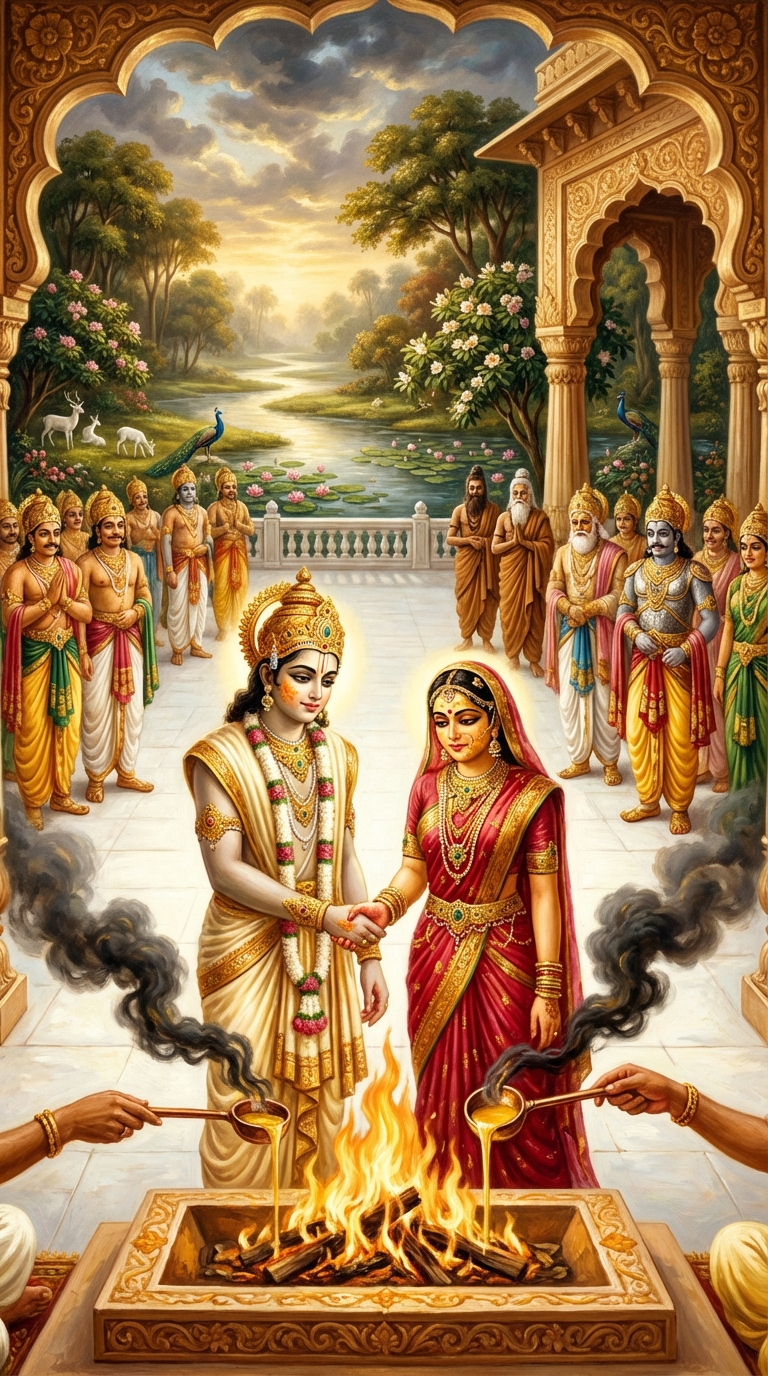
The smoke of the domestic fire bites Aja's eyes, carrying the heavy, roasted scent of clarified butter and toasted sesame. He kneels on the polished stone floor of the Vidarbha palace courtyard, his silk dhoti stiff with gold thread that digs into the skin of his waist. Around him, the chant of the priests rises and falls in absolute, measured intervals, vibrating against the high cedar beams of the canopy. The heat of the flames pulses against his cheek. Indumatī sits beside him, entirely still. Her breath barely disturbs the heavy garlands of crushed jasmine and damp lotus weighing down her narrow shoulders. Aja watches a single bead of sweat gather at her temple, sliding slowly past the red powder painted at her hairline. He wants to wipe it away, but the ritual demands his total paralysis.
The priests pour another ladle of ghee into the fire. The flames roar upward, painting the faces of the gathered kings in violent, flickering orange. Aja registers their presence just beyond the edge of the ritual circle. These are the men Indumatī passed over in the great hall yesterday, the suitor-kings who traveled hundreds of leagues for her garland, now forced to witness this final, irreversible binding. They stand shoulder to shoulder in the suffocating heat of the morning, their ceremonial armor clinking faintly as they shift their weight. Aja traces the rigid jawline of the king of Magadha, the white-knuckled grip the lord of Anga keeps on his broadsword. The air in the courtyard feels unnaturally compressed. The fire cracks like a breaking bone, and Aja feels the sudden, cold pressure of the crown waiting for him.
He turns his wrist to receive the raw rice grains from the chief priest. Indumatī's hand meets his beneath the stream of grain. Her skin is shockingly cool. For a fraction of a second, her fingers curl against his palm, a sharp and deliberate pressure that cuts through the thick haze of sandalwood smoke and the drone of the mantras. In that singular touch, Aja understands everything they are walking into. The rituals bind them, the fire acts as witness, but the real contract is forged in this unseen grip of hands. The rice spills from their cupped palms into the fire, hissing as it burns. The final syllables of the chant echo off the courtyard walls, swallowed immediately by the dense, expectant silence of the unchosen kings.
The royal procession moves out onto the rutted dirt of the southern highway, the heavy wooden wheels of the baggage carts groaning under the weight of the dowry. Aja rides in the vanguard chariot, the iron-rimmed wheels kicking up clouds of yellow dust that coat the wet flanks of the horses. Two leagues behind them, the rejected kings ride out of the city gates. Aja watches them in the polished bronze surface of his shield. They do not turn toward their own northern or eastern provinces. They ride together, a dense and silent mass of armor and spear-tips, keeping perfectly to the dust trail left by Aja's vanguard. Aja notes the absence of their processional banners. Men traveling in peace fly their silks to announce their names to the watchtowers; men traveling to kill ride under bare wood.
He looks down at Indumatī, who sleeps against the reinforced timber railing of the chariot, exhausted by the week of ceremonies. Her heavy bridal jewelry rocks with the violent motion of the carriage, the gold rubbing a red welt into her collarbone. Aja reaches out and places a folded woolen cloak between the harsh metal and her skin. If he fails today, her fate is mathematically precise: she will be dragged from this chariot by the hair, her gold stripped by the soldiers of Magadha or Anga, forced to marry whichever man murders him in the dirt. The laws of war dictate that a widow taken on the road belongs to the victor. He touches the cold iron of his quiver, feeling the fletching of his arrows, calculating the exact distance between the vanguard and the following army.
The first arrow shatters the wooden spoke of the outrider's wheel. The chariot collapses with a violent crack, throwing the driver into the thorn bushes. Instantly, the horizon swarms with horses. Aja does not shout. He grips the shoulder of his chief minister, an old man whose face has drained to the color of ash. Aja points to the heavy iron-bound transport wagon at the center of the column. He lifts Indumatī, who is awake now, her eyes wide and black in the dust-choked light, and pushes her into the minister's arms. He locks the heavy wooden door of the transport himself, sliding the iron bolt into place. The hammering of hooves hits the earth like a physical blow. Aja turns, draws his sword, and vaults onto the back of an unharnessed chariot horse.
The melee is immediate and formless, a terrifying crush of bodies pressing in from the scrub forest. Blood sprays across the dry yellow grass, bright and startling. Aja hacks downward, severing the collarbone of a spearman rushing his flank. The enemy numbers are overwhelming, a tide of desperate, humiliated men fighting with the brutal frenzy of wounded pride. A spear point tears through the linen of Aja's shoulder, scraping the bone. The pain is a sudden, blinding white flash. He kicks his horse backward, breaking out of the crush. His own guard is falling, the banners of Ayodhyā disappearing beneath the surge of rival infantry. Aja realizes conventional slaughter will end only in his own butchery. He drops his sword and reaches over his shoulder, pulling a single, unusual reed from the bottom of his quiver.
The Gandharva arrow feels unnaturally light, humming against his fingertips with a faint, resonant vibration. Aja fits the nock to his bowstring. He does not aim at the heart of the Magadhan king, nor at the vanguard charging toward him. He aims at the empty, dust-filled sky directly above the battlefield. He pulls the string back to his ear, the bow wood groaning, and releases. The arrow shrieks upward, trailing a pale, unnatural smoke. At the apex of its arc, it detonates without sound. A shockwave of pure, heavy air rolls outward, washing over the bloody scrubland. It hits the screaming infantry first. Weapons slip from suddenly slack fingers. Horses fold at the knees, settling gently into the dust. The kings drop their reins, their chins falling to their armored chests, instantly paralyzed by an irresistible, suffocating sleep.
rātryāgamo padmavanān ivāśu nidrā samastān aripān jagrāha
Just as the sudden arrival of evening forces the sprawling lotus forests to close their petals against the dark, an unnatural slumber seizes the warring kings. The genius of the image lies in its absolute stillness. The verse does not offer a bloody subjugation or a frantic retreat; it transforms a deafening, chaotic battlefield into a tranquil pond at twilight. The men who only moments ago were screaming for Aja's head now bow in profound, helpless silence. Their armor gleams dull in the settling dust. Their hands, still curled in the exact shapes of the sword grips they held, twitch with the ghost-spasms of a battle they are no longer fighting. The terror of the moment is replaced by a terrifying, absolute aesthetic beauty.
Aja rides slowly through the statuesque ranks of his enemies. He passes the king of Anga, whose mouth hangs open mid-war-cry, his spear perfectly balanced in a limp hand. He passes the Magadhan prince, whose warhorse snores softly beneath him, its powerful neck draped over a shattered chariot wheel. Aja touches nothing. He does not take their discarded banners or claim their dropped weapons. To kill them now, in this artificially induced twilight, would be the work of a butcher, not a sovereign. He merely rides the length of the field, his own bleeding shoulder a sharp reminder of the violence suspended just beneath this enchanted calm. He wipes the blood from his arm, letting it drip onto the dirt before the sleeping army, a quiet signature on his victory.
Power, in its most terrifying form, is not the capacity to destroy a man, but the ability to render him entirely irrelevant. The great victors of history do not merely kill their rivals; they step past them while they sleep, leaving them to wake to a world that has already moved on. Aja returns to the iron-bound cart and slides back the bolt. Indumatī steps out into the settling dust, her silks unmarked, looking out over the field of paralyzed men who believed they could claim her by force. She takes Aja's bloody hand, their fingers locking together exactly as they did over the sacrificial fire. The unchosen kings will eventually wake, their bodies stiff and their pride shattered, but they will find the road completely empty.
The chariot wheels of the victor leave deep, unerasable tracks in the earth, entirely indifferent to the men sleeping beside them.