Chapter 6 of 19
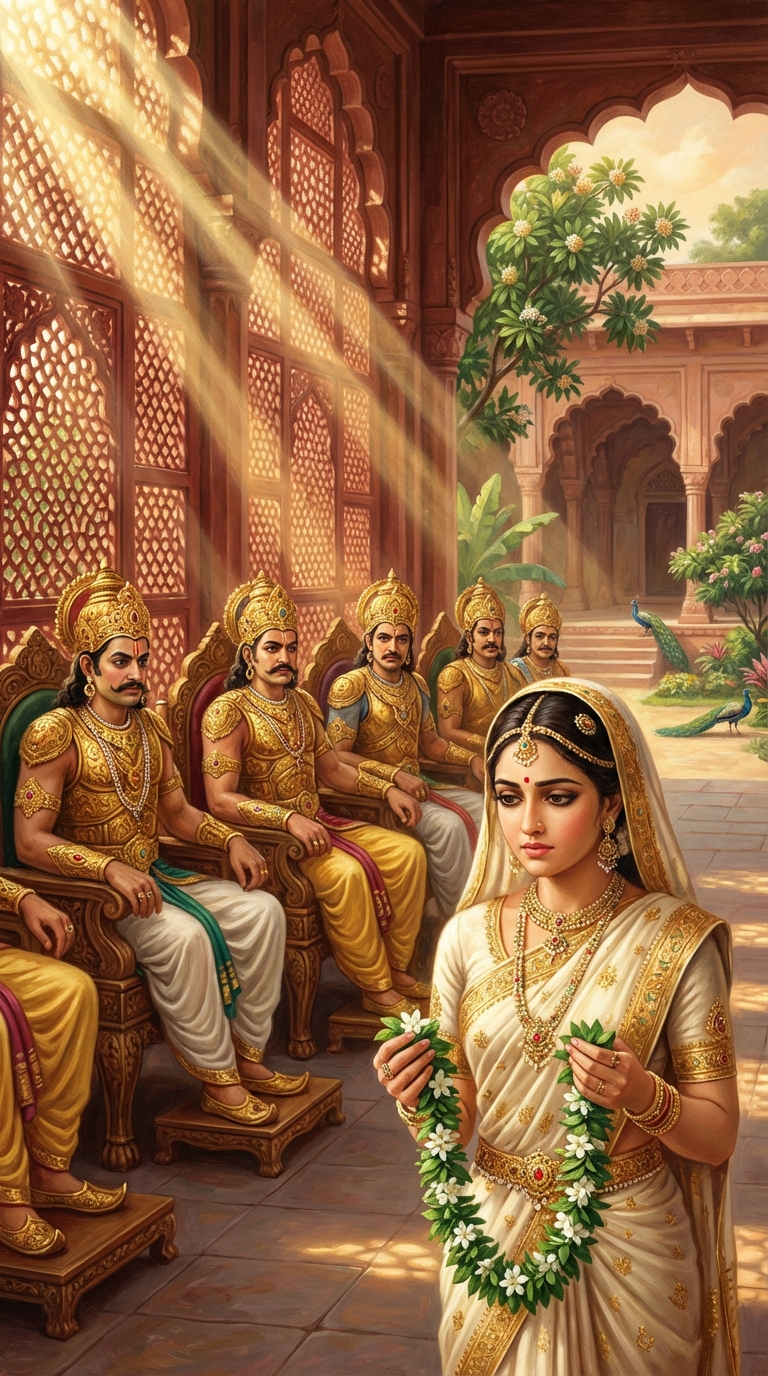
There he takes his seat in the assembly of numerous other kings who had come from far and near for the Svayamvara ceremony. The Princess Indumati enters, accompanied by her clever maid Sunanda, who takes her in turn to each one of the royal suitors and describes him and his qualifications in a few well-chosen words. Finally she comes to Aja, whom she chooses as her husband, to the deep chagrin of the other kings who feel envious and humiliated.
Crushed vetiver and damp earth mask the smell of nervous sweat inside the pavilion. Aja sits motionless on the raised dais, his spine perfectly aligned against the carved teakwood backrest. He focuses on a single brass oil lamp suspended from the heavy rafters, watching the orange flame bend under the collective, shallow breath of three hundred rival kings. They are pressed together shoulder to shoulder in the suffocating heat of the Vidarbha afternoon, their heavy silk robes clinging stubbornly to their skin. The air vibrates with the clinking of jewelled armbands and the restless shifting of ivory scabbards against polished stone. Nobody speaks. Aja keeps his hands loose on his lap, consciously uncurling his fingers, refusing to betray the cold tightening in his own chest.
Outside the arched windows, the city of Bhojakata boils with festival crowds. Street vendors hawk fried sweets in hot oil, and war elephants trumpet in the dust-choked holding pens. But inside this cavernous hall, time has seized completely. Motes of dust drift lazily through the diagonal shafts of harsh sunlight cutting through the gloom, suspending the entire assembly in a state of agonizing amber. Aja lets his gaze slide over the faces of the men beside him. He reads the twitching jaw of the Kalinga warlord, the white-knuckled grip the Magadhan emperor keeps on his ceremonial dagger. These are men born to absolute authority. They do not ask for what they desire; they take it with force.
They have brought their vast entourages and their tribute, dragging the wealth of an entire continent to this polished floor. Aja thinks of the smell of the Sarayu river at dawn back in Ayodhya—the clean, sharp scent of cold water and wet clay—and wishes he were walking its quiet banks. The oxen pulling grain-carts through his home city move with a slow, predictable rhythm, their heavy wooden yokes creaking softly in the morning mist. Here, the accumulated wealth is aggressive, jagged, and heavily armed. Every gold chain worn by a king in this room, every sapphire glinting in the dim light, represents a thinly veiled threat, a potential declaration of war hovering in the still air.
The heavy double doors groan open on their bronze hinges, and the sharp scent of crushed blue lotus floods the stifling air. The kings lean forward as one single, predatory organism. Indumati steps over the threshold. She carries a woven garland of fresh madhuka flowers, a braided ring of white petals so thick it forces her slender wrists apart. Water drips steadily from the bruised green stems, dotting the pristine marble tiles with dark, momentary stains. That wet circle of flora holds the fate of kingdoms. Whoever bends his neck to receive it takes command of the deepest armies and the richest trading ports on the peninsula. It is a noose of extraordinary power masquerading as a bridal offering.
She does not look at the faces of the men who would own her. Beside her walks Sunanda, a maid carrying a gold-tipped cane of black bamboo. Sunanda’s cane strikes the stone floor with the terrifying finality of an executioner’s axe. Each sharp crack echoes against the vaulted ceiling, signalling the imminent dismantling of a monarch’s immense pride. Aja watches that cane rise and point, tracking its devastating progress. He knows the political reality of this brutal ritual: the men sitting in this room are completely unaccustomed to being judged, let alone by a woman. They conquer territories; they lay siege to fortresses. They do not sit on cushions waiting patiently to be chosen.
The humiliation of a public rejection cannot be undone. It is an injury written permanently into the dynastic record, an insult that will fester in the proud bloodlines for generations. Aja sees the sweat beading rapidly on the forehead of the Anga king, the nervous swallow of the ruler from Avanti. A single decision from this young woman will violently redraw the map of alliances, turning lifelong allies into bitter, vengeful enemies before the sun sets. The dripping garland in Indumati’s hands is not a symbol of romance; it is a heavy yoke of political destiny. Her choice will invariably unleash a sudden storm of violent envy that threatens to tear the assembly apart.
Sunanda halts deliberately before the King of Magadha. Her voice slices through the heavy silence, sharp and perfectly pitched for the vast acoustics of the hall. She details the emperor’s unbroken bloodline, his thousands of armored war elephants, the way defeated kings drink the dust from his jewelled footstool. The Magadhan sits taller, puffing his chest beneath a heavy emerald breastplate, a smug, expectant smile curling his thick lips. Indumati briefly raises her dark eyes. She sees the cruelty tightening his mouth, the grotesque vanity rigid in his posture. Without uttering a single word of apology, she bows her head slightly, turns her shoulder away from his throne, and steps deliberately into the next shaft of sunlight.
The bamboo cane strikes the marble again. Down the long line they go, Sunanda’s brilliant oratory constructing immense monuments to each king’s martial glory, only for Indumati’s silent passing to ruthlessly tear them down. Aja watches the immediate, visceral aftermath of her rejection. The moment her silk hem sweeps past a suitor, the man’s face drains completely of blood. Broad shoulders slump in defeat; eyes darken with a sudden, venomous fury. Men who command thousands of bronze chariots bite the insides of their cheeks until they taste copper, desperately fighting to keep from crying out in sheer humiliation. The room turns increasingly dangerous as the dark reservoir of collective shame rapidly rises to a boiling point.
Sunanda’s cane clicks directly in front of Aja. He stops breathing. He does not adjust his silken robes or puff his chest; he remains utterly still, his hands open, meeting the princess’s gaze with a quiet, unwavering intensity. Sunanda speaks of his father, the great Raghu, of golden arrows that darken the midday sun, of a chest broad as a temple door. Indumati studies the calm anchor in his dark eyes, recognizing the total absence of arrogance. Her hands tremble slightly, sending a shower of water droplets to the floor. She lifts the heavy loop of blue lotuses and madhuka blossoms over his head. The wet petals brush coolly against Aja’s skin as the garland settles around his neck.
sañcāriṇī dīpaśikheva rātrau yaṃ yaṃ vyatīyāya patiṃvarā sā narendramārgāṭṭa iva prapede vivarṇabhāvaṃ sa sa bhūmipālaḥ
Like a walking flame of a lamp in the deep night. The words capture the brutal, luminous truth of her progression down the shadowed aisle. As a torchbearer moves along a grand avenue at midnight, the golden light washes over the magnificent facades of the mansions lining the street. The flame illuminates their intricately carved balconies and grand stone pillars for one brilliant, fleeting second of absolute clarity. Every detail of their wealth is exposed to the admiring dark. But then the flame moves relentlessly on. The palace, stripped of the light that gave it form, is plunged instantly back into a total, devastating blackness. It is an architecture of brief salvation followed immediately by instant ruin.
The rejected kings fall helplessly into this absolute shadow. The glowing anticipation of possibility abandons their faces, leaving behind a profound loss of color and spirit. They are nothing more than grand mansions on the king's highway, briefly visited by the terrifying light of Indumati's attention, only to be swallowed whole by the dark when she turns her back. The pure genius of the observation lies in its stark cruelty. A woman’s appraising gaze becomes the sole source of illumination in a cavernous room full of impossibly powerful men. When she looks at them, they exist in absolute glory; when she looks away, they simply cease to matter, erased entirely from the narrative of power.
The svayamvara acts as a mechanism of terrifying economy. It forces the sprawling complexity of human ambition into a single, binary act of selection. The ritual permits no negotiation, no diplomatic compromise, no treaty sealed with traded horses or border towns. Only the ruthless clarity of the garland remains. To be chosen is to ascend into the brilliant, consuming fire of history. To be bypassed is to suffer a sudden death of relevance, a social erasure so complete it burns hotter than a battlefield wound. The rejected men sitting in the dark carry that silence with them forever, an open sore of denied destiny that eventually twists itself into the ugly shape of war.
Victory born of desire demands a heavy collateral price. The garland heavy with wet petals marks the beginning of a magnificent union, but it also weaves the very snare that will eventually unravel their lives. Love claimed in the face of public humiliation is love surrounded by a ring of drawn swords. The victor wins the light, but the light only serves to make him a clearer target for the men left nursing their bruised pride in the shadows. The flame illuminates the chosen one for a fleeting, glorious hour, before the dark inevitably closes in to reclaim the hall.