Chapter 5 of 19
While Raghu had thus practically beggared himself in the Visvajit sacrifice, an ascetic called Kautsa came to him. Raghu planned an expedition against Kubera, the God of wealth, to obtain the money from him. Divining his intention Kubera filled Raghu's treasury with a shower of gold during the night, and Raghu gave all that to Kautsa.
Morning light hits the sandstone pillars of the Ayodhya palace, illuminating empty niches where sapphire and beaten gold caught the dawn only a week ago. The Visvajit sacrifice has consumed everything. King Raghu steps onto the stone terrace, the chill of the morning biting through his simple white cotton wrap. From the Sarayu river below, the wind carries the scent of crushed river-reeds, cold black silt, and the woodsmoke of a hundred awakening hearths. Down in the streets, iron-rimmed wheels of grain-carts clatter against the paving stones, pulled by massive white oxen with painted horns. The kingdom thrives, heavy with harvest and commerce. Yet inside the palace walls, the king possesses nothing but the breath in his lungs.
He walks through the long corridors, his bare feet registering the cold grit on the flagstones. The silence of the royal apartments rings in his ears, absent the chime of golden anklets and the heavy tread of armored guards. Servants avert their eyes, unsure how to behave in a house where the sovereign has given away his own dining vessels, his silken carpets, the rings from his fingers. Raghu lifts a rough, unbaked clay cup to his mouth. The terracotta scratches his lower lip. The water tastes of dust and deep earth. He drinks, feeling the strange, terrifying weightlessness of a man who has surrendered the entire world.
The vow requires total dispossession, and Raghu holds nothing back, peeling away the accumulated wealth of generations until the treasury floors are swept bare. The emptiness brings a new, sharper anxiety. A king is defined by his capacity to give, by the shade he provides to those who seek refuge. Without his wealth, he is only a man standing in a hollow stone room. He listens to the river wind rattling the teak shutters, wondering how he will answer the next soul who crosses his threshold asking for the protection of the crown.
Kautsa stops at the threshold of the audience hall. Dust coats his bare shoulders, and he carries the sharp, astringent smell of forest ash and bruised mango leaves. He has walked for weeks from the hermitage of his guru, carrying a debt that crushes the breath from him: fourteen crore gold coins, the impossible fee demanded for his education. He raises his head to speak, but the words dry in his throat. He looks at the bare stone walls, the stripped pillars, the king sitting on a woven grass mat instead of a jeweled throne. Kautsa realizes immediately that he has arrived too late. The great ocean of Raghu's wealth has already dried to sand.
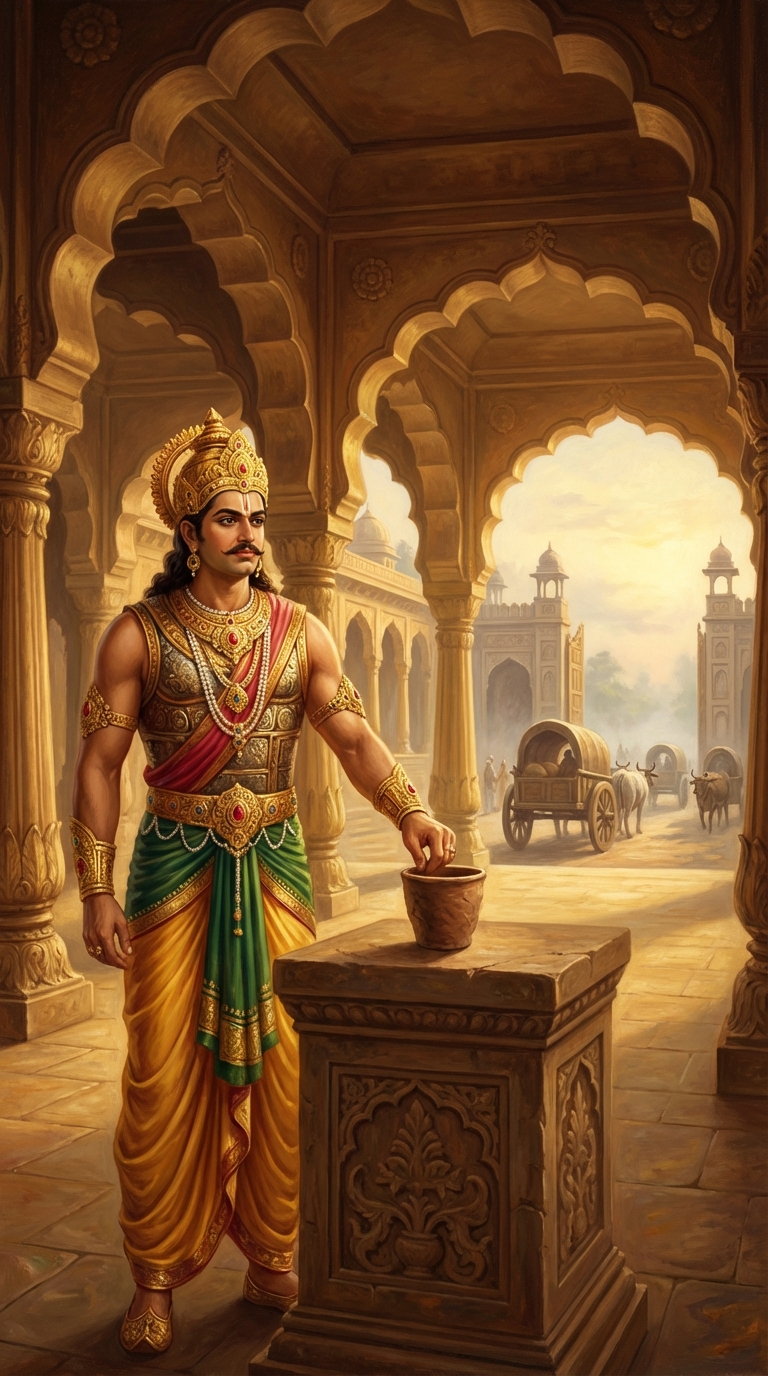
Raghu rises, feeling the sharp spike of adrenaline, the immediate recognition of a scholar's need. He steps forward with an earthen pot to offer the customary foot-washing water. The water spills from the crude lip of the clay vessel, splashing over Kautsa's callused toes. The moisture pools on the flagstones, carrying the dark soil of the ascetic's journey. This terracotta pot holds the entire crisis. To turn away a scholar who asks for his rightful fee is to break the fundamental law of the universe. A king who cannot pay a guru's ransom is a failure of the cosmic order, a broken axle on the chariot of state.
Ashamed to ask a destitute man for an empire's ransom, Kautsa bows his head and turns back toward the sunlit doorway. He will seek another patron. Raghu watches the ascetic's retreating back, and panic seizes him, a cold, metallic dread that tastes like blood in the back of his throat. He cannot let this happen. The dishonor outlasts the stars. His mind works furiously, scanning the exhausted earth, the empty allied kingdoms. Only one vault remains untouched, one treasury deep enough to yield fourteen crore coins before nightfall. Raghu's gaze drifts north, past the river, toward the snow-capped peaks of Mount Kailasa, where the Lord of Wealth hoards the earth's veins.
Raghu's voice cuts through the morning air, arresting Kautsa in his tracks. He orders the scholar to wait in the fire-sanctuary for two days. Raghu strides to the armory, lifting his great bow. The weapon is massive, the dark wood polished to a dull shine by the sweat of his ancestors, the grip molded to the exact contours of his palm. He strings it with a snap that echoes like summer thunder through the empty stone halls. He orders his chariot readied. He does not plan to send emissaries or politely petition the heavens. He will march directly on Kubera. He will pry open the mountain of the god with iron and arrow, extracting the wealth by force.
By nightfall, the war-chariot stands in the courtyard. Raghu sleeps inside it, fully armed, his leather breastplate rigid against his chest, the stiff rawhide reins resting lightly across his thigh. The courtyard remains completely still, the air heavy with the sheer audacity of a mortal preparing to lay siege to a god. The horses shift nervously, their hooves scraping the paving stones. The sentries stand like statues, their breath pluming in the cooling night air. High above, the wind shifts direction, blowing down from the Himalayas, carrying the sharp, ozonic scent of an approaching storm, though the sky remains utterly clear.
The dawn breaks not with light, but with a deafening, metallic roar from the center of the palace. It sounds like a mountain collapsing inward. The guards throw open the heavy teak doors of the royal vault. Inside, a cataract of solid gold cascades down the stone steps, a blinding, glittering flood of stamped coins, heavy ingots, and raw, uncut ore smelling of deep subterranean rock. Kubera has surrendered in the dark, yielding his treasury before a single bowstring was drawn. Raghu stands at the edge of the vault, the yellow light reflecting in his dark eyes. He does not touch the gold. He turns to his commander and orders Kautsa to be brought from the sanctuary.
mṛnmaye vītahiraṇmayatvāt pātre nidhāyārghyamanarghaśīlaḥ
Because the gold was gone, he placed the offering water in a vessel of mud, he whose character was priceless. The poetry locates the exact pivot of the catastrophe in the texture of the clay. The prefix vīta strips away the gold, leaving only the bare earth of mṛnmaye, the mud-born pot. The verse hinges on the final, devastating compound word: anarghaśīlaḥ. Pricelessness. The gold has vanished, but the true wealth, the unyielding, uncompromising grain of the king's integrity, remains untouched. The mud vessel becomes a mirror, reflecting a spiritual opulence that no heavenly treasury can match.
This is the genius of the vision up close. The language does not soar into airy abstractions about virtue; it forces us to look at the dirt, the fired earth scraping against the skin, the physical reality of a king reduced to the status of a peasant. By withholding the grand adjectives and focusing strictly on the material substitution of mud for gold, the verse achieves a crushing emotional gravity. The ascetic and the king are bound together in this single exchange of water, two men stripped of all worldly camouflage, confronting the terrifying, absolute demands of their respective duties over a cheap earthen bowl.
True power is never about accumulation; it is about the courage to act as a conduit. Wealth is like rain falling on a forest. It must be absorbed, gathered, and immediately released to nourish the roots, or else it stagnates and rots the soil. The gold that fills the vault belongs to neither the king who conquered it nor the ascetic who demanded it. It is merely a current of energy required to restore the balance of a fractured world. When Raghu tells Kautsa to take the gold, the scholar refuses to take a single coin more than his exact debt, and the king refuses to keep the remainder.
They argue not over who gets to keep the treasure, but over who must bear the burden of taking it away. The conqueror pleads with the beggar to take the spoils, and the beggar insists the conqueror keep the excess. It is a breathtaking subversion of human greed, a moment where the ferocious machinery of empire and the severe discipline of the forest crash into one another, resulting only in a profound, mutual relinquishment. The greatest empires are built not by hands that clench tightly around their gold, but by hands that remain fiercely, deliberately empty.