Chapter 4 of 19
King Raghu now begins to rule, and all are made to feel his equal justice and cautious vigilance. When autumn comes, Raghu decides to start upon an expedition of conquest. Then by land he proceeds northwards, where he conquers the Pârasikas. Thence he traverses as far as the Sindhu river, where he defeats the Hunas and the Kambojas.
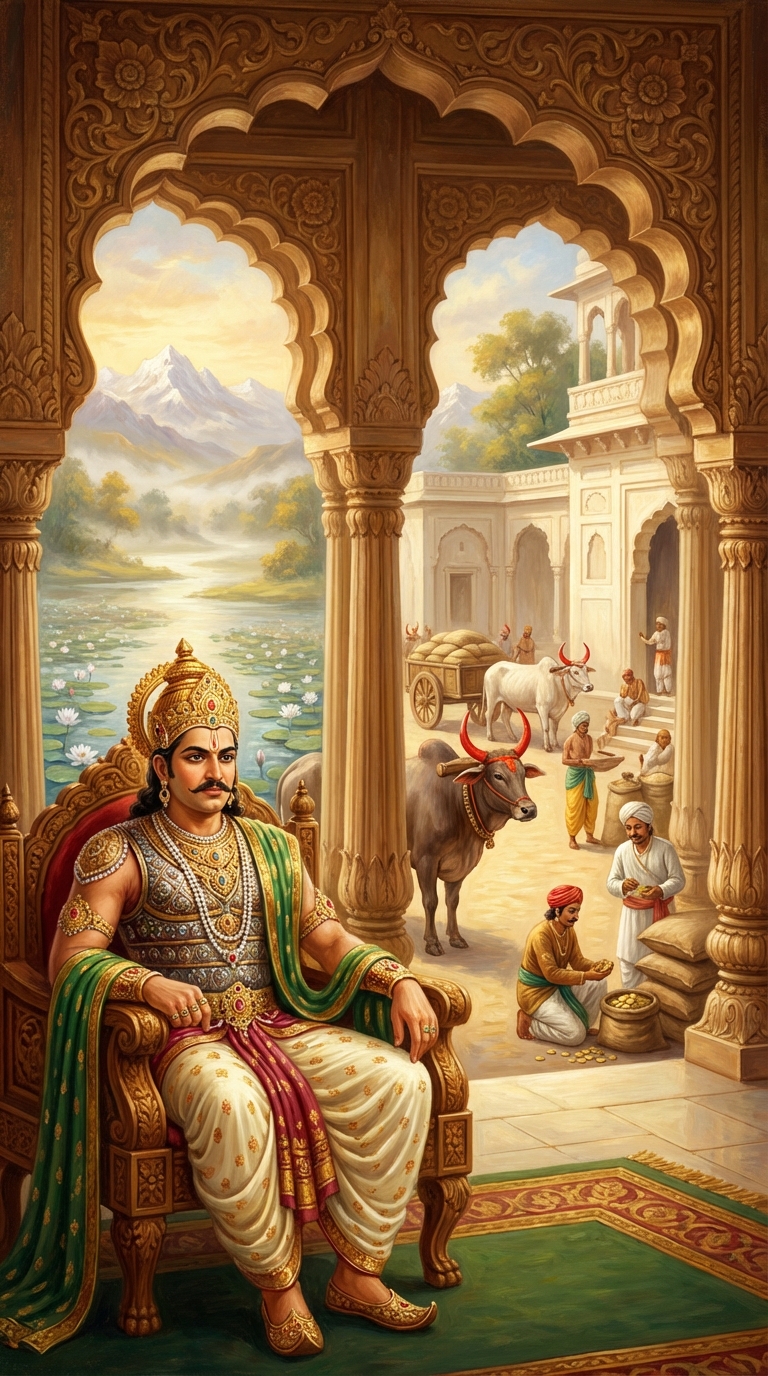
Heavy wooden wheels of the grain carts trench deep into the drying mud along the Sarayu river. The monsoon is over. The wet decay of August yields to the crisp, flinty edge of an Ayodhya autumn. Oxen with painted horns chew through bundles of fresh sugarcane, their massive flanks steaming in the cold dawn air. The smell is specific and inescapable: bruised river reeds, baking clay, and the sharp smoke of dung fires burning in the merchants' quarter. King Raghu sits in his open stone pavilion, the silk cushions damp with morning dew. He watches the silver surface of the water mirror the pale, cloudless sky, listening to the city wake. The rhythm of the capital beats in exact time with his own pulse.
A kingdom functions as a massive, intricate machine of grievances, and Raghu listens intently to the grinding of its gears. Two farmers kneel before him on the polished marble floor, disputing the redirection of a drainage trench. Raghu hears the tremor of desperation in the younger man's voice, and registers the calloused exhaustion in the elder's folded hands. He does not rule by abstract decree from behind a wooden screen. He leans forward, smelling the sour sweat of their labor, and divides the water rights with the precision of a jeweler splitting a flawed gemstone. This is the texture of his equal justice: the terrifying, meticulous attention of a monarch who refuses to look away from the mundane miseries of his people.
The court heralds strike the brass gongs, announcing the midday shift. The low vibrations hum through the soles of Raghu's bare feet. He dismisses the petitioners and stands, his joints stiff from hours of absolute physical stillness. He walks to the edge of the pavilion and looks north toward the distant mountains. The sky is stripped of its heavy rain clouds. The thick lotus stalks in the royal pools have snapped under the weight of the cooling northern winds. The earth has finally hardened. The trade routes are no longer impassable rivers of thick sludge. The season of administration ends with the dropping temperature, and the season of war inevitably begins.
In the depths of the armory, the grindstone screams against the iron edge of a broadsword. Raghu runs his thumb over the flat of a newly forged spearhead, feeling the residual heat of the charcoal furnace still trapped in the dark metal. The scent of hot steel, leather dust, and rancid animal fat fills the low-vaulted room. A map of the northern territories, painted in crushed lapis and soot on a cured antelope hide, lies unrolled on a wooden trestle. Raghu stares at the jagged lines marking the treacherous mountain passes. The kingdom's perimeter is a fragile illusion, a boundary held together by nothing but the momentum of power. To sit idle in Ayodhya is to invite the borders to collapse inward.
Queen Sudakṣiṇā stands in the shadowy doorway, the heavy gold bangles on her wrists silencing against her hips as she stills her breath. She notices what his hardened generals miss: the subtle tightening of the muscle along his jaw, the way his knuckles turn bone-white as he grips the spear shaft. She knows the profound, echoing isolation of his power. He does not fear defeat on the battlefield; he fears the slow, corrosive rot of complacency. The northern winds carry rumors of the Pārasīkas massing their cavalry, of the Hūṇas crossing the frozen rivers. He must meet them, not out of unbridled malice, but to secure the fragile silence of his own royal chambers.
Raghu drops the spearhead onto the oak table. The iron clatters against the wood, a definitive, unretractable sound that echoes against the stone walls. He turns and issues the marching orders to the high commanders waiting in the shadows. The infantry will mobilize at first light. The war elephants must be fitted with their heavy spiked armor before dawn. He watches the commanders bow in unison and retreat into the sunlit courtyard, their hurried footfalls fading into the distance. The monumental decision hangs in the heavy armory air. Blood will soak the high mountain passes before the next moon reaches its zenith. The machinery of conquest engages, and the king steps out into the cold, blinding light of his own decree.
Choking dust eclipses the sun above the high northern steppe. Raghu rides at the vanguard in his war chariot, the heavy bronze axletrees screaming as they violently carve deep ruts through the fractured shale. Ahead, the Pārasīka cavalry surges forward, a vast, terrifying sea of bearded men clad in oiled ringmail. The arid air reeks of horse sweat, crushed desert scrub, and the metallic tang of unsheathed iron. Raghu pulls his heavy yew bow back until the string touches his ear. The bowstring sings a lethal note. A Pārasīka warlord falls backward off his galloping mare, an ash-wood arrow driven clean through his leather gorget. The Ayodhya vanguard crashes into the enemy lines, splitting their formation like an iron wedge driven into dry timber.
The army pushes ruthlessly northwestward, the landscape turning brutally steep and barren. The Sindhu river cuts a freezing, glacial trench through the rocky valley floor. On the far bank, the Hūṇas wait behind an impenetrable wall of interlocking wooden shields. Raghu does not order his men to make camp. He spurs his massive warhorse directly into the churning, ice-choked current. The cavalry immediately follows, the horses screaming as the freezing water violently bites their flanks. Raghu breaches the far bank, icy water streaming from his chainmail. He brings his heavy broadsword down in a devastating, unbroken arc, cleaving through the bronze rim of a Hūṇa shield and burying the steel deep into the collarbone of the screaming defender.
The northern resistance shatters under the unyielding, mechanical pressure of the Ayodhya march. The Kāmbojas surrender in the deep shadow of the highest peaks. The tribal chiefs kneel in the freezing mud before Raghu's canvas tent, offering their desperate tribute: towering stacks of rare, dark walnut timber and lines of shivering, thick-coated mountain ponies. Raghu sits rigidly on a folding stool, his armor battered, the crimson stains on his gauntlets drying into a rusty brown in the brutal wind. The thin altitude air burns his exhausted lungs. He accepts the tribute with a silent, barely perceptible nod, his gaze fixed on the snow-capped horizon. The borders of Ayodhya now stretch to the edge of the known world, bought entirely with shattered bones and frozen blood.
yathā prahlādanāccandraḥ pratāpāttapanō yathā Just as the moon claims its name by offering cooling delight, and the sun earns its title through blazing heat, a true king becomes his name only by capturing the hearts of the earth. The Sanskrit balances the celestial and the terrestrial with perfect mathematical symmetry. Raghu does not merely rule over the citizens of Ayodhya; he becomes the inescapable atmospheric condition under which his subjects breathe and labor. The poetry strips away the artificial, constructed rhetoric of a god-given mandate, replacing it with the brutal, undeniable reality of the natural world. Sovereignty is not bestowed by the heavens; it is proved in the dirt.
The profound genius of the linguistic construction lies in its immediate sensory demand. Political legitimacy is never rendered here as an abstract, philosophical legal concept. It is intimately equated with physical sensation—the vital, desperate relief of the moon rising over parched summer fields, the necessary, terrifying power of the midday sun burning off the morning rot. Raghu's equal justice functions as a climate. It is the steady, nurturing warmth that ripens the winter wheat, and the lethal, searing heat that consumes those who dare to cross the sovereign perimeter. He rules because the earth itself physically and violently responds to his presence.
The machinery of empire requires perpetual, grinding motion to sustain its own fragile illusion of permanence. Men build towering stone walls and violently define borders only to push them outward again, confusing the frantic accumulation of territory with the absolute guarantee of peace. To hold a crown is to accept that the exhausting work of securing it never truly concludes, that every conquered river only reveals another fertile valley beyond it, thick with suspicious strangers and the heavy promise of a future war. The king who governs with pure, equal justice at the very center of his realm must inevitably become a relentless engine of terror to those who live out at the frayed margins of his map.
Peace is an exquisite, fleeting luxury, paid for entirely by unspeakable violence at the periphery. The great conquest secures the sprawling kingdom, but it irrevocably alters the inner soul of the conqueror, filling the quiet throne room with the invisible ghosts of slaughtered foreign soldiers and the silence of widows screaming in distant, unnamed valleys. Empire is a restless, unappeasable hunger that masquerades beautifully as permanent order, devouring the physical horizon until there is absolutely nowhere left to march, leaving the king utterly alone in the center of a silent, subjugated world.