Chapter 3 of 19
A son is then born to Dilipa. He is named Raghu, as one destined to be the most illustrious of the kings of the solar race, the family being named after him. Indra, Lord of the gods, in jealousy secretly steals the sacrificial horse to prevent the completion of the rite. Raghu then sees Indra carrying away the horse, and fights with him most gallantly.
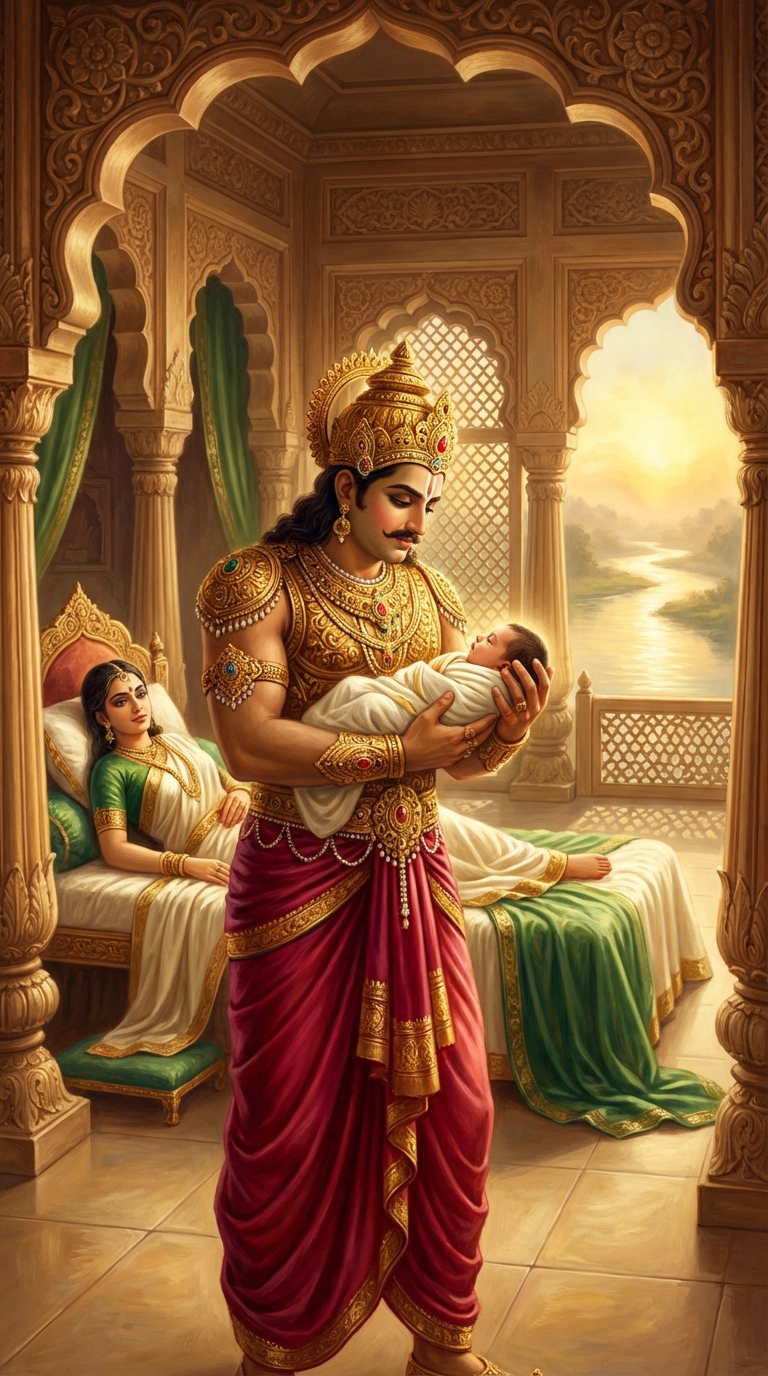
Dilipa stands by the lattice window, holding a weight so slight it feels like breath itself. Down below, morning mist lifts off the river Sarayu, carrying the thick, metallic scent of wet red clay mixed with crushed jasmine scattered on the bathing steps. Heavy-shouldered oxen shift in wooden yokes, their iron-rimmed wheels grinding against the courtyard’s wet cobblestones as they haul the winter grain. The king looks down at the child wrapped in unbleached silk. His son’s chest rises and falls in rapid, fragile rhythms. A pulse beats blue against the translucent skin of the newborn’s temple. The kingdom demands a solar king, a pillar to uphold the earth, yet Dilipa holds only a mortal infant.
The silence of the royal chambers offers no refuge from the king's dread. Every shadow cast by the bronze oil lamps looks like a thief come to snatch the boy away. Queen Sudakshina sleeps behind the gauze curtains, her pale face damp against her neck. She shifts, her fingers curling inward, grasping the empty space where the child lay an hour ago. Dilipa traces the curve of the boy’s ear with a calloused thumb. He has waged wars, commanded thousands, watched chariots shatter into kindling, but nothing terrifies him like this soft, milk-scented warmth. He presses his mouth to the dark down on the infant’s crown.
They name him Raghu. The syllables ring against the high stone ceilings of the audience hall, spoken by priests whose heavy robes smell of clarified butter and burning sandalwood. Raghu: the one who leaps, the one who moves swiftly across the world. The king watches the wet nurse carry the boy into the inner courtyard, where the morning sun strikes the polished basalt pillars. The child opens his eyes, staring unblinkingly at the brilliant canopy of light. He does not cry. He tracks the flight of a hawk spiraling above the battlements, his small fists clenching the silk tight. Dilipa feels a sharp ache in his ribs, recognizing the ruthless gravity already taking root in his son.
Years slip away like water over a weir, and the infant hardens into a warrior standing guard over the great horse sacrifice. The imperial beast breathes heavily in the damp dawn air, steam rising from its white flanks. A thick golden plate, hammered flat by the royal smiths and inscribed with the dynasty's seal, is riveted to its brow. Raghu holds the braided silk tether, the coarse fibers biting into his palm. The horse tosses its massive head, hooves striking sparks from the flinty soil. This beast defines the physical boundary of the empire. Wherever it wanders unquestioned for a year, Dilipa’s sovereignty becomes absolute. Every muscle in the animal’s neck represents a kingdom subjugated or a war yet unfought.
Dilipa watches his son from the high wooden balcony, his jaw tight. If the horse completes its wandering, the king achieves unprecedented glory. If it falls to an enemy, or if a beast takes it, the spiritual ruin will be total. Generations of ancestors will starve in the afterlife, deprived of their sacrificial offerings. The air around the tethered beast feels heavy, pregnant with the silent, suffocating hostility of the unseen world. Gods despise human perfection. Courtiers murmur in the shadows, their silk robes rustling, eyes darting between the restless horse and the unmoving boy. Raghu adjusts the brass bracer on his left forearm, oblivious to the metaphysical weight pressing down on the courtyard.
A sudden chill drops the temperature. The leaves of the banyan tree go entirely still. An unnatural shadow sweeps across the flagstones, cold and sharply defined, making the veteran guards shiver and grip their spears. The scent of ozone, sharp as cracked flint, floods the clearing. Raghu feels the silk cord go completely slack in his hand. He stumbles backward, the sudden absence of tension throwing him off balance. The white horse is gone. Not bolted, not slaughtered, but violently excised from the physical space it occupied a fraction of a second ago. The golden tether drops to the dirt, the severed end cleanly sheared, curling like a dead snake in the dust.
Raghu drops to his knees, pressing his palm to the cold earth. Deep, crescent-shaped hoofprints gouge the mud, ending abruptly as if the beast took flight. He throws his head back, his eyes scanning the bruised sky. High above the canopy, a massive golden chariot dissolves into the edge of a thunderhead, the stolen white horse tethered firmly to its iron axle. Raghu springs up, slipping his longbow from his shoulder. He draws an arrow from the quiver, the ash-wood shaft smooth against his cheek, the iron broadhead catching the gray light. He hooks the bowstring, pulls the tension back to his ear, and releases. The string sings a high, lethal note cutting through the wind.
The arrow streaks upward, embedding itself deep in the chariot’s wooden rail with a violent crack that rings across the entire valley. Raghu cups his hands to his mouth, his voice raw with fury. Lord of the hundred sacrifices, you demand worship from men, yet you steal from us like a starved bandit in the night. The sky instantly turns the color of bruised iron. The clouds shear apart, and Indra reveals himself. The storm-lord stands massive and terrifying, cloaked in the violent turbulence of a monsoon squall, holding a bow that crackles with raw lightning. The sheer physical pressure of the encounter makes the courtyard's stone walls fracture, but Raghu does not drop his gaze. He reaches for another arrow.
Lightning forks toward the earth. Raghu plants his leather-shod feet in the loam, drawing the heavy bow until the wood groans. He releases, and a shaft of mortal iron meets the blazing bolt in midair. A concussive wave of heat blasts Raghu backward, singeing his hair and blistering his cheeks. An invisible arrow strikes his chest, shattering the hardened leather of his breastplate and driving him to his knees. Blood pools hot and thick in his mouth. He spits it onto the ruined grass, forces himself up, and draws again. His next arrow severs the silk banner flying from Indra’s mast. The storm-lord halts, lowering his lightning. A deep, resonant laughter rolls down from the clouds, genuinely delighted by the bloody, unbroken boy.
śuṣkendhanaṃ prāpya yathā sphuliṅgaḥ kṣaṇena dāvāgni-samo babhūva
Just as a spark, finding dry wood, becomes in a single instant a raging forest fire. The image arrests the eye precisely because it refuses to marvel at the heavens, focusing entirely on the flesh and blood below. The boy does not need celestial lightning; he possesses his own terrifying combustion. The verse anchors heroism not in unearthly pedigree, but in the brutal, sudden physics of a spark. Raghu bleeds real blood into the dirt. His breath comes in ragged, wet gasps. Yet the friction of his will against towering arrogance provides the very kindling for his transformation. He burns through his own limitations in real time, consuming his boyish frailty to produce an inferno of pure, terrifying competence.
The metaphor does more than describe a battle; it maps the architecture of dynastic power. A son is a spark requiring the dry timber of his father's realm to ignite. Dilipa has spent a lifetime accumulating the fuel, gathering the wealth, the armies, the sacrificial horses, only to realize that fulfilling his purpose means letting his son burn it all down. The genius of the verse lies in making the smoke tangible. The sudden, intense heat radiates against the skin, the violent rush of oxygen pulling from the clearing as the boy entirely eclipses the father. Indra leaves the horse to the blazing prince, recognizing that a fire this fierce cannot be extinguished by rain.
To raise a child for greatness is to engineer your own obsolescence. The parent meticulously builds the scaffolding of a kingdom, only to watch the child dismantle it to forge a weapon. A profound, necessary cruelty governs the succession of generations. Love demands protection, but legacy requires offering the beloved up to the storm. A parent holds the fragile, pulsing weight of the future in their arms, terrified of the unforgiving world that will inevitably try to break it, knowing all the while that the child’s only salvation lies in learning how to strike back. A father’s deepest victory is the moment he looks at his son and realizes he is no longer needed.