Chapter 2 of 19
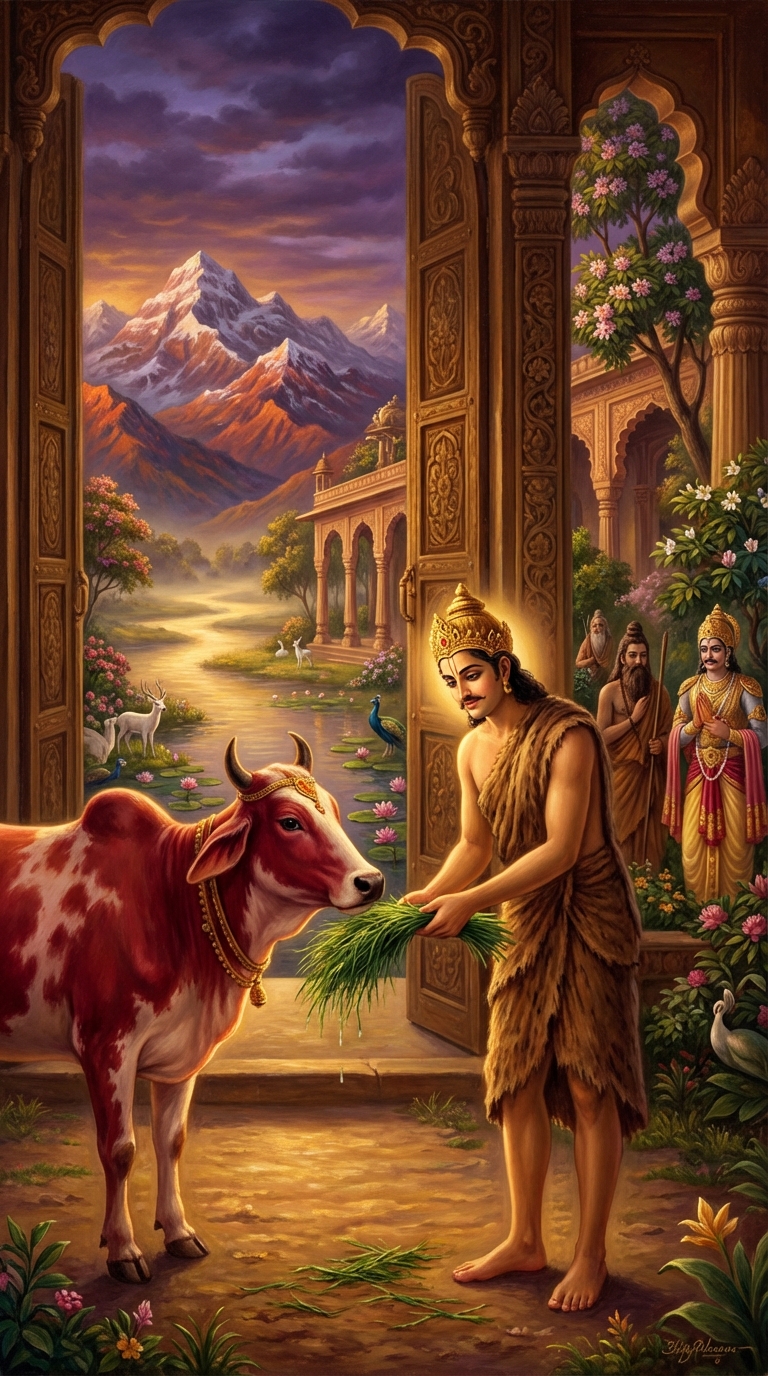
The next morning Dilipa begins the daily routine of disciplined service of the cow, Nandini. He regularly accompanies her every morning, after she was worshipped, to the forest and back again to the hermitage in the evening when she returned from the pasturage. On the 22nd day, the cow, wishing to test the devotion of her follower, enters a cave of the Himalayas, overgrown with grass, for grazing.
The smell of wet pine and dung fires hangs low over the Vasistha hermitage, trapping the dawn chill against the earth. Emperor Dilipa stands knee-deep in the silvered grass, holding a wooden bucket of warm water. He does not summon a servant. He dips a bristled brush into the water and brings it to the flank of the red cow, Nandini. Her coat steams in the mountain air. Sudakshina, the queen of the solar dynasty, kneels in the mud beside him. She presses a paste of crushed sandalwood and unbroken rice grains between the cow’s wide, dark eyes. The paste smells sharp, cutting through the heavy scent of milk and wet earth.
The animals in the royal stables at Ayodhya wear gold-tasseled halters and eat fermented grain from silver troughs, but this creature answers to no human architecture. Nandini chews a mouthful of fresh panic-grass, her jaw moving with slow, mechanical indifference. Dilipa watches the rhythmic pulsing of her throat. He has commanded armies across the sea, yet here his breathing synchronizes with the inhalation of a beast. The forest of the Himalayas rises around them like a wall of green iron, thick with cedar and dripping ferns. A single crow calls from the canopy, shattering the morning quiet.
Sudakshina steps back, wiping her hands on the coarse hem of her bark-cloth ascetic robe. She touches the dust near Nandini’s left forehoof and brings her fingers to her forehead, leaving a smudge of dirt across her pale skin. Dilipa nods to his wife, picking up a bamboo staff. He turns his back on the thatched huts of the hermitage, tracking the swish of the cow’s tail as she ambles toward the treeline. The emperor of the earth becomes a herdsman, his bare feet sinking into the damp, decaying leaves of the forest floor.
A royal parasol of white silk, heavy with seed-pearls, leans forgotten against their temporary hut. It is the physical weight of an empty throne room rendered in wood and fabric. Dilipa’s mind snags on the silence of his palace courtyards, the way his ministers lower their eyes when the subject of succession arises. He traces a deep scar on his forearm, a souvenir from a forgotten campaign, and realizes the wound was pointless. Territory means nothing without an heir to hold it. His bloodline, stretching back to the sun itself, narrows to this singular, humiliating chokepoint. If this cow denies him her milk, the solar dynasty dies in the dark.
Every thorn that tears at Dilipa’s calves is a reminder of this precarity. He refuses the leather sandals his guards offer, matching his stride to the slow, meandering path of the animal. Nandini stops to pull leaves from a low-hanging bhurja tree, and Dilipa stops with her. He swats a biting horsefly from her flank with a handful of kusha grass. He anticipates her movements, studying the twitch of her ears, the dampness of her muzzle. He is terrified of his own impatience. A single moment of royal arrogance, a sudden yank on a rope, could unravel weeks of penance.
For twenty-one days, the routine devours him. The sun burns the mist from the Himalayan valleys, baking the resinous cedars until the air hums with heat, and still he follows. He watches Nandini drink from glacial streams, the water so cold it fractures the light. He waits until she finishes before he cups his own hands to drink. His muscles ache with a profound, unaccustomed exhaustion, the deep fatigue of submitting to another creature's will. The forest watches them, the silent deer and the monkeys swinging through the high canopy, witnessing an emperor dissolve into the rhythm of a grazing animal.
The morning of the twenty-second day breaks with a strange, metallic clarity. The sky is stripped of clouds, exposing the jagged peaks of the Himalayas like shattered bone against the blue. Nandini moves with an unfamiliar urgency, bypassing the sweet clumps of durva grass she usually favors. Dilipa follows, his hand tight around the bamboo staff. The air grows noticeably colder, carrying the unmistakable scent of raw granite and old ice. The tree line begins to thin, giving way to a sheer cliff face covered in creeping moss and pale alpine flowers.
At the base of the rock wall, a cavern opens its dark mouth. Thick tufts of mountain grass grow violently around the entrance, green and inviting. Nandini does not pause. She steps into the shadow of the cave, her red coat swallowed by the sudden gloom. Dilipa hesitates. The royal guards are miles behind; the ascetics are at their fires. The silence of the mountain presses violently against his eardrums. He peers into the dark, his eyes struggling to adjust after the glare of the high-altitude sun. A primal instinct, sharp and cold, flares in his chest.
He crosses the threshold. The temperature plunges, raising the hair on his arms. The scent of the cow is instantly masked by the heavy, iron-rich smell of a predator’s den. Dilipa hears the scrape of a hoof against loose gravel, followed by a sudden, unnatural stillness. He grips his bow, his thumb instinctively finding the fletching of a steel-tipped arrow. The test has shifted from endurance to survival. Nandini stands motionless in the subterranean twilight, her head lowered, waiting to see if the protector of the earth will protect her, or if he is merely a king in a forest.
sthitaḥ sthitām uccalitaḥ prayātāṃ niṣeduṣīm āsanabandhadhīraḥ jalābhilāṣī jalam ādadānāṃ chāyeva tāṃ bhūpatir anvagacchat
When she stands, he stands; when she moves, he moves. He sits only when she settles into the grass, and drinks only when she takes water. The king follows her exactly as a shadow would. This is the architecture of absolute surrender. The verse strips away the armor of monarchy, reducing the sovereign to a silhouette. A shadow possesses no independent will, no desires to assert against the object that casts it. It is bound completely to the source, an echo painted on the dirt.
By becoming a shadow, Dilipa achieves a startling physical intimacy with the world he usually governs from a palanquin. The genius of the metaphor lies in its rigorous literalism. The text insists on the material reality of the body at labor, chronicling the standing, walking, sitting, and drinking. The emperor’s ego is not conquered through abstract meditation, but through the granular, physical mimicry of a bovine life. The man who holds the earth in his palm allows himself to be dragged by a tether of devotion, his humanity bound to the slow, heavy grace of an animal.
The machinery of power conditions its operators to believe that control is the only mechanism of survival. Rulers bend the landscape, alter the flow of rivers, and break the wills of men to ensure the ground remains solid beneath their thrones. But true stewardship demands a terrifying inversion of this order. To govern the world is, ultimately, to be completely at its mercy. Authority is not a weapon to be wielded against the dark, but a willingness to step into the cave stripped of privilege, abandoning the self to save the fragile, breathing thing that guarantees the future.
Legacy is never secured through force alone. It requires the systematic humiliation of the ego, the shedding of accumulated titles, and the silent, unglamorous labor of trailing behind the living world in the dust. The myth of sovereignty is that a king stands above nature, immune to its violent unpredictability. Yet the throne of Ayodhya survives only because its greatest monarch kneels in the mud, breathing in time with a beast. The man who will father a dynasty must first learn, with absolute and devastating humility, how to be nothing but a shadow.