Chapter 18 of 19
This canto provides a genealogy of the twenty-one kings who succeeded Atithi in the Raghu dynasty. The poet enumerates their names in succession without providing significant narrative details for each ruler. The lineage begins with Niṣadha, Nala, and Nabhas, and concludes with Sudarśana.
The gold-leaf dome of the consecration pavilion traps the stifling heat of the ceremonial fire. Clarified butter sizzles violently against burning logs of green mango wood, sending up a thick, sweet smoke that stings the eyes of the boy king. Sudarśana is six years old. He sits perfectly still on the stiff bristles of a Bengal tiger-skin rug, his bare legs too short to reach the edge of the carved mahogany dais. He listens to the high priest chant the opening invocations, watching the old man’s throat vibrate with the Vedic syllables. The priest’s breath carries the sharp, astringent scent of crushed camphor and fermented betel leaf. Even in the blistering heat, the boy feels a cold knot tightening in his stomach.
Beyond the heavy silk curtains of the pavilion, the city of Ayodhya thrums with the anxious, brittle energy of a sudden regime change. Bullocks with painted horns strain against their yokes, dragging wooden carts of winter grain through the wet mud of the market square. Their split hooves slip and clatter against cobblestones slick with morning dew, the drivers shouting hoarsely in the damp air. To the north, the Sarayu river runs sluggish and dark, its muddy current carrying the pale ash of Sudarśana’s father out toward the floodplains. His father, Dhruvasandhi, was torn apart by a lion in the eastern hunting grounds barely a fortnight ago, leaving a vacuum that the state is desperately rushing to fill.
The high priest lifts a copper ladle, pouring another thick stream of ghee onto the embers. The flame leaps upward, throwing sharp, nervous shadows across the faces of the ministers gathered in the marble colonnade. They are exhausted, hollow-eyed men, their skin textured like cured leather, their jaws clenched against the glare of the fire. They have stood in this exact semicircular formation for the coronations of four different monarchs. They do not look directly at the boy’s terrified face. Instead, their gaze is fixed firmly on the empty space just above his brow, waiting for the diamond-crested diadem of the Raghu emperors to descend and solve the crisis of the empty throne.
The chief minister raises the sapphire-studded royal parasol over the dais. The lacquered bamboo shaft groans under its own immense weight. It is an impossible, archaic object, heavy with gold fringe and centuries of trapped dust, passed blindly from Niṣadha to Nala, and from Nala to Nabhas. Sudarśana watches the shadow of the canopy creep slowly across the polished marble floor until it eclipses his own small silhouette. It feels like the shadow of an approaching mountain. To bear the parasol is to forfeit the right to be a person, becoming merely the next anonymous, sacrificial link in an iron chain that is rapidly corroding. The boy grips the pleated silk of his royal garments, steadying his trembling hands.
The royal archivist steps forward from the shadows, unfurling the long birch-bark scroll of the dynastic succession. The paper is dangerously brittle, the dried ink flaking off in tiny black specks onto his white robes. He clears his throat and begins to read the names of the twenty kings who ruled between the legendary Atithi and this fragile, smoke-filled morning. Puṇḍarīka. Kṣemadhanvan. Devānīka. The polysyllabic names fall into the quiet room like heavy stones dropped down a dry well. Sudarśana feels the sheer terror of their brevity. The great patriarchs of his bloodline ruled for sweeping, majestic generations; these recent men flared up and burned out in the span of a single breath.
A single, stifled cough interrupts the rhythmic recitation. It comes from the queen mother, sitting rigid behind the latticed cedar screen at the rear of the pavilion. She watches her son's narrow shoulders bracing under the crushing weight of the brocade coronation coat. She tracks the archivist's trembling finger tracing the list of the dead, noticing how terribly crowded the names have become at the bottom of the long scroll. The blank margin is entirely gone. The dark ink of her husband’s name is still fresh on the bark, yet the archivist already holds a sharpened quill in his left hand, ready to permanently write her child's name directly below the man who just died.
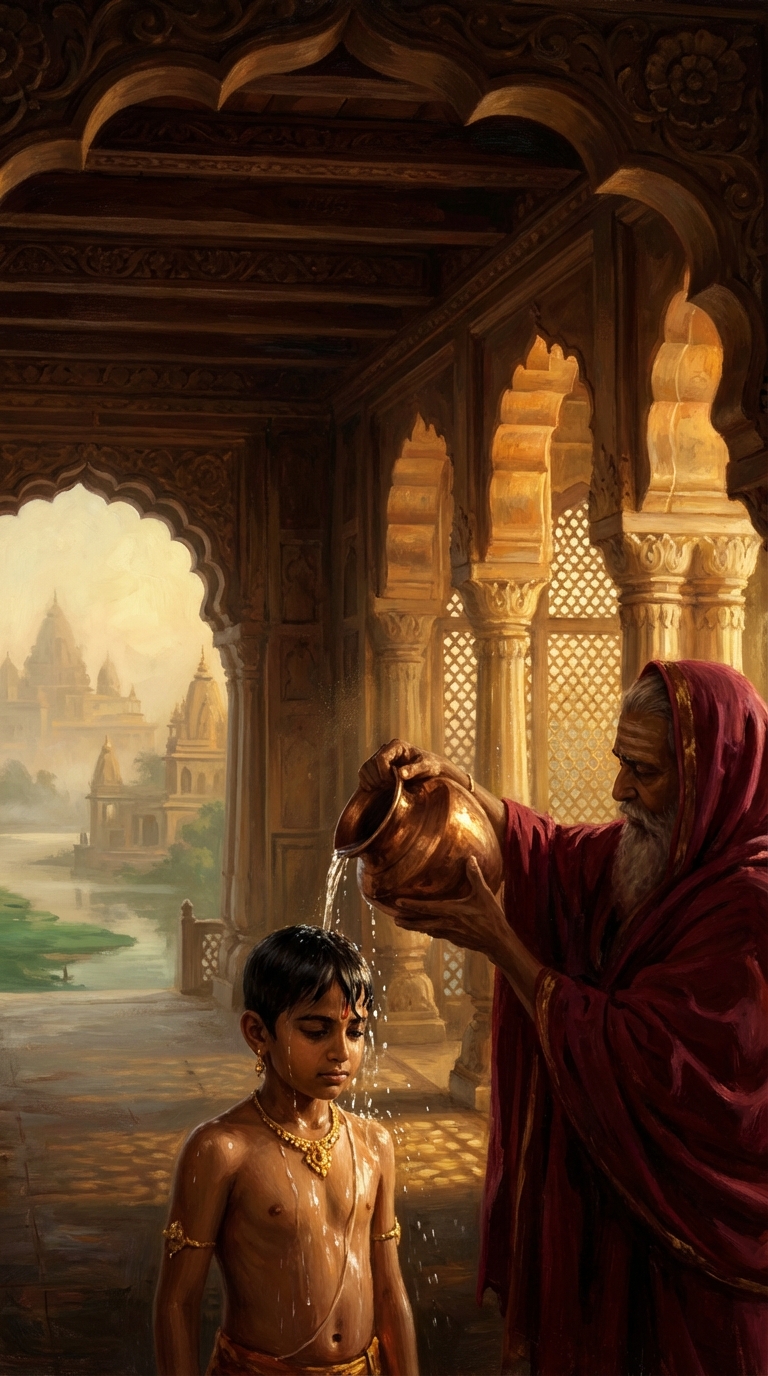
"Ahīnagu," the archivist intones, his reedy voice vibrating against the teak pillars. "Pāriyātra. Śila." Sudarśana squeezes his eyes shut, trying desperately to summon the faces of these grandfathers, but they blur into a single, exhausted mask of sovereign duty. The high priest steps onto the edge of the tiger skin, carrying the heavy crown of the empire in a wide brass basin filled with purified river water and stalks of durva grass. Cold water drips continuously from the intricate gold rim, splashing aggressively onto Sudarśana’s bare forearm. The shock of the cold water breaks his concentration, bringing him sharply back to the terrifying reality of the altar and the ring of silent, staring men. The scent of wet brass and wet grass fills his lungs, overwhelming the sweet smoke of the mango wood.
"Hold your head entirely steady," the high priest whispers, briefly breaking the melodic rhythm of the ritual chant. The raw, unvarnished intimacy of the command shocks the boy into total paralysis. Sudarśana stiffens his neck until the tendons ache. The aged ministers step out of the shadowy colonnade, bringing their hands together in the formal gesture of absolute submission. The archivist relentlessly continues reading the scroll. "Vajraṇābha. Śaṅkhaṇa. Vyuṣitāśva." They are trying to bury the boy under the sheer, accumulated gravity of his bloodline, chanting the final syllables faster now, visibly eager to finish the dreadful list before the auspicious astrological hour passes and leaves the empire vulnerable to the ruinous ambitions of rival kingdoms waiting at the borders.
The boy feels the collective desperation of the room pressing tightly against his skin, demanding that he stop being a child and instantly become an institution.
The golden crown finally descends. It is agonizingly heavy, a thick band of solid metal pressing sharply into the tender, unformed bone of Sudarśana's skull. He gasps, a sharp, involuntary intake of breath that echoes loudly in the silent, vaulted pavilion. Behind the carved screen, his mother half-rises from her cushion, her glass bangles clinking sharply against the wood as maternal panic briefly overrides court protocol. She forces herself to sit back down, digging her nails into her palms. A king cannot be rescued from his own crown. "Sudarśana," the archivist shouts, his voice rising to a sharp, triumphant crescendo, officially bolting the frightened boy to the terrifying, inescapable machinery of the royal lineage.
The ministers immediately drop to their knees, their foreheads touching the cold marble, bowing not to the six-year-old orphan trembling on the dais, but to the unbroken continuity of the state.
The chanting finally ceases. The archivist rolls the long birch-bark scroll and steps backward into the shadows of the colonnade, leaving the boy king alone in the center of the dais. Stepping to the edge of the blazing sacrificial fire, the court laureate raises his hands toward the gold-leaf dome to offer his concluding benediction. He projects his voice over the crackle of the burning mango wood, delivering a perfectly metered verse to seal the dreadful transition of power.
bālo 'pi siṃhāsanam āruroha navo ravir dhvāntam ivāpahartum
The words land heavily in the stifling air, likening the small boy ascending the lion-throne to the newly risen sun ascending the eastern sky to obliterate the morning darkness. The enduring brilliance of the image lies entirely in its devastating double edge. The morning sun reliably brings necessary light, but it also brings the terrible, scorching heat that inevitably withers the green crops and bleaches the bones of the unburied dead. The boy king is radiant, wrapped in his heavy gold and stiff silk, but he is fundamentally trapped in the unforgiving machinery of the cosmos. He is no longer a human child who is permitted to weep for a mauled father; he is a celestial body, bound to a fixed, fatal, and intensely lonely orbit across the sky of Ayodhya.
A royal genealogy is a political graveyard deliberately stripped of its grief. We read these sprawling lists of kings, emperors, and conquerors, reciting the rhythmic syllables of their names as if human history were a steady, unbroken march of administrative triumphs, conveniently forgetting that every peaceful transition of power fundamentally requires a funeral. The crown does not peacefully rest upon a sovereign's head; it slowly devours the head, turning living, breathing, flawed men into abstract, mathematical increments of historical time. The architecture of power explicitly demands this violent erasure, seamlessly trading the fragile, chaotic warmth of an individual human life for the cold, unyielding permanence of a dynastic legacy.
The terrified boy sitting rigidly upon the throne intuitively understands what the old men kneeling in the colonnade refuse to admit to themselves. To be born into an unbroken line of glorious kings is merely to stand at the very end of a long, dark corridor, watching the torches go out one by one. The true greatness of a lasting empire is measured not by the vast territory it successfully conquers, but by the sheer quantity of human ash it takes to keep the royal parasol standing upright in the wind.