Chapter 17 of 19
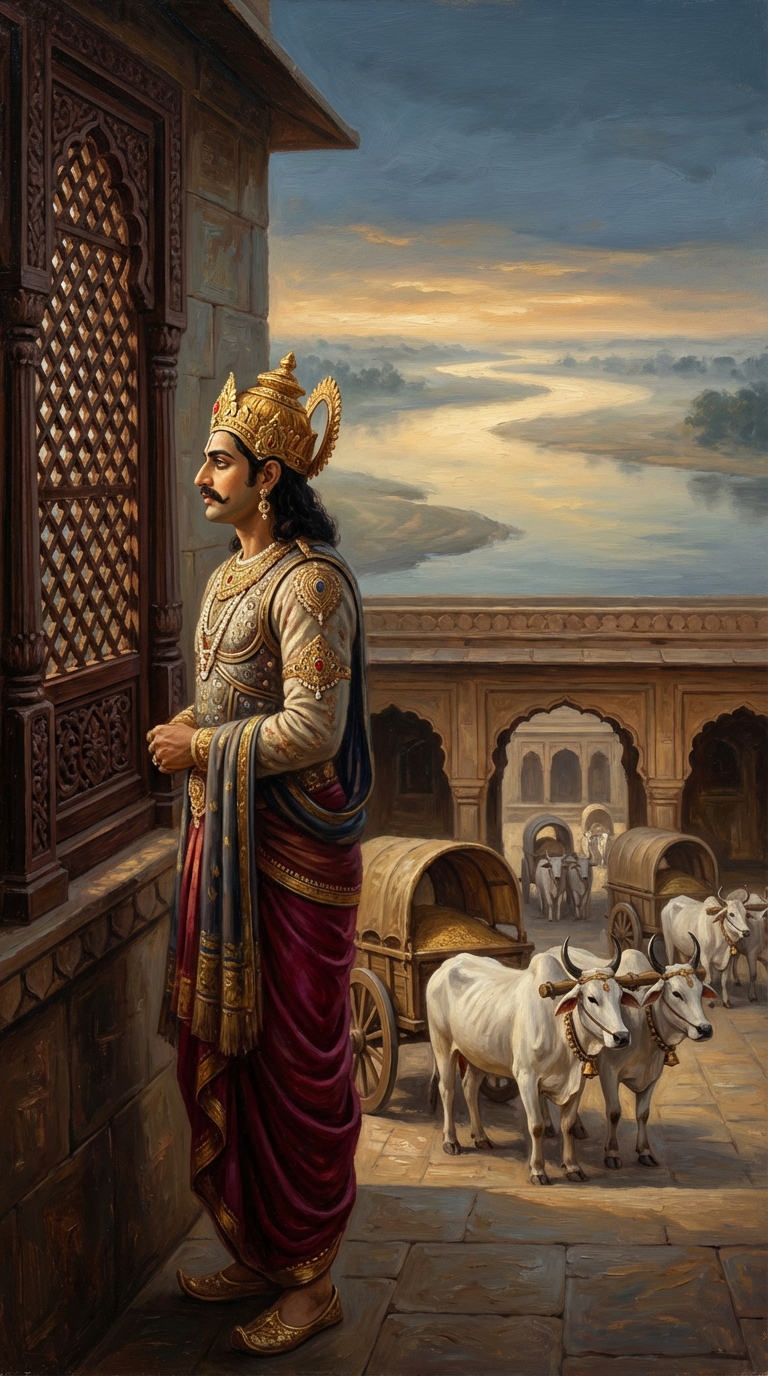
Kuśa and Kumudvatī have a son named Atithi. After Kuśa's death in battle, Atithi ascends the throne. He is described as a model king who possesses great political wisdom. The canto is devoted to a detailed exposition of the principles of statecraft (Rāja-Nīti), which King Atithi diligently applies in his governance.
The chill of wet river-clay and crushed marigolds rises from the banks of the Sarayu before the sun crests the eastern ridge. Atithi stands barefoot on the sandstone balcony of his private quarters, letting the damp wind bite through his unbleached linen tunic. Below him, the vast grid of Ayodhya wakes. Kingdom prosperity is not an abstract ideal; it is a deafening, physical pressure bearing down on his shoulders. He hears the rhythmic thud of heavy wooden mallets pounding grain in limestone mortar bowls, the sharp sizzle of mustard oil in shallow brass pans, the lowing of heavy-flanked cows driven toward the inner city pastures. The morning air smells intensely of roasting barley, damp cook-fire ash, and the heavy musk of elephants shifting in the royal stables. Every single sound demands his protection.
He is too young for the deep lines already etching themselves into the corners of his mouth. The sudden, violent death of his father, King Kusa, left an echoing void in the grand throne room, a terrible silence Atithi must now fill with the absolute certainty of an anointed sovereign. He presses his palms against the balustrade, feeling the stone slick with morning dew. He watches a long line of oxen hauling teakwood carts up the main artery of the lower market. Their massive, muscle-knotted humps sway under oiled wooden yokes; their curved horns are painted with bright red ochre. They move with an inevitable, plodding momentum, dragging the vast, suffocating wealth of the Kosala empire behind them.
The young king closes his eyes, trying to locate the texture of his own grief, but there is simply no room for it. A monarch cannot afford the quiet luxury of private weeping. His father’s blood still stains the dry grass of a distant, unnamed battlefield, yet right here, guild weavers are already unrolling endless yards of saffron silk in the commercial bazaar, trusting their new ruler to keep the borders sealed and the trade routes safe. Atithi turns his back on the rising dawn. The cool darkness of his chambers swallows him as he walks toward the low sandalwood table where the day’s burdens wait, sharp and unyielding.
The entire geography of his reign is contained in six tightly rolled cylinders of birch bark resting in a hammered copper bowl. These are the intelligence dispatches, smuggled over mountain passes by riders who change exhausted horses at midnight. The scrolls smell of hardened pine resin, old sweat, and the damp red earth of the southern provinces. Statecraft is not found in soaring, righteous philosophy; it lives exclusively inside this brittle bark. If he misreads a single character, if he fails to discern the treacherous lie hiding between the lines of hurried ink, thousands of men will die, and armies will march across the jagged peaks of the Vindhya mountains.
Atithi picks up the thinnest scroll from the pile. The crimson wax seal, stamped with the imperial lotus, crumbles under his thumbnail, flaking onto the woven floor-mat like chips of dried blood. The cramped script inside is smeared by monsoon humidity. The viceroy of the southern marches writes of withered millet crops and diseased cattle, begging a formal reprieve from the annual tribute of raw gold and war-horses. It is a highly calculated test. The provincial lord is deliberately probing the soft underbelly of a grieving king, disguising a nascent military rebellion as an unavoidable agricultural tragedy. The withheld tribute is a drawn blade presented handle-first.
The king’s pulse accelerates, drumming violently against his ribs. His immediate instinct urges him to dispatch the heavy cavalry, to burn the arrogant viceroy’s palace to the ground and mount his head on an iron pike to terrify the rest of the restless vassals. But Atithi simply holds the curling bark over a lit butter-lamp. He watches the yellow flame eat the treacherous words, turning a declaration of rebellion into fragile black ash that drifts harmlessly onto the table. Anger is an unforgivable indulgence. To rule is to know precisely when to deploy absolute terror, and when to smile pleasantly while tightening an invisible noose. He brushes the ash away and summons his chamberlain.
The morning assembly hall hums with the suppressed, nervous energy of fifty ambitious men. Shafts of pale sunlight pierce the high latticed windows, illuminating the thick dust motes dancing above the polished marble floor. Atithi enters, the heavy folds of his ceremonial cotton robes rustling sharply against the stone. He bypasses the towering gold-leafed lion-throne entirely, choosing instead to sit on a plain, low wooden dais. This forces his standing ministers to look down at him—a subtle, deeply unnerving inversion of spatial power. Sumantra, the ancient prime minister, steps forward, his knee joints popping loudly in the quiet room. "The southern storehouses are completely empty, Lord," he rasps, reading from a bundle of incised palm-leaves.
Atithi lets the silence stretch until it becomes physically uncomfortable. He slowly scans the faces arrayed before him, finally locking eyes with the southern envoy standing near a rear teakwood pillar. "A profound tragedy," Atithi says, his voice pitched so low the royal scribes must lean far over their inkpots to catch the words. "However, the monsoon rains were unusually heavy in the southern hills last month. The mud clinging to the soles of your leather boots, envoy, is rich, black river-soil. It is most certainly not the cracked, pale dust of a severe drought." All the air leaves the room at once. The envoy swallows hard, his throat working frantically against the heavy silver collar of his diplomatic office.
"Since the provincial granaries are so unfortunately vulnerable," Atithi continues, his tone laced with velvet sympathy, "we will dispatch our own supply carts immediately." He casually adjusts the heavy ruby resting at his collarbone. "They will be escorted by three fully armed battalions of the royal guard. To protect the empty storehouses from roving bandits, naturally. The troops will remain garrisoned in your cities until the earth heals." He has perfectly trapped the province in its own deceit. The envoy bows low, a thick bead of sweat tracing the curve of his jawline. No blood is drawn, no swords are unsheathed, yet an entire regional rebellion is systematically dismantled before noon. This is the brutal, bloodless geometry of his reign.
phalānumeyāḥ prārambhāḥ saṃskārāḥ prāktanā iva
The endeavors of a master sovereign can only be deduced from their final harvest, much like the deeply hidden deeds of a previous birth are revealed exclusively by the fortunes of a present life. The brilliance of this thought lies in its devastating patience. To map the mind of a true ruler is to realize that absolute authority must remain entirely invisible while it works. We never witness the seed splitting in the suffocating dark of the topsoil; we only notice the thick stalk of golden wheat when it is finally ready to snap against the curve of the iron sickle.
Atithi moves his pieces in the deepest shadows of the palace, his intentions buried so thoroughly that even his closest confidants cannot trace the roots of his quiet commands. He does not announce his suspicions in the assembly, nor does he trumpet his military strategies to his generals. He merely acts, setting unseen wheels into motion. When the southern province is subdued without a single casualty, the ministers only register the sudden, inevitable fruit of his intellect. The policies of true kingship operate strictly with the mechanics of karma itself: silent, entirely unhurried, devastatingly precise, and absolutely impossible to escape.
We like to believe that power is loud. We imagine the history of empires as a dramatic sequence of shattered city gates, roaring generals, and heavy bronze swords flashing in the merciless sun. But the endurance of a dynasty relies entirely on the tedious, unglamorous mechanics of daily administration. True statecraft is a ledger balanced in the dead of night. It is the careful rationing of fear and generosity, weighed out in individual grains and measured by exhausted men who understand that a sudden urban famine is far more dangerous to a throne than an invading army.
Love for a nation is not a passionate, sweeping embrace; it is a profound and sleepless vigilance. The sovereign who sustains a golden age must surrender his own humanity to secure the peace of the crowded streets he rules. He becomes the unseen mechanism ticking flawlessly inside the clockwork, wearing his own gears down to nothing so the outer hands may continue to turn for others. The crown is never a reward, but a magnificent, terrifying trap.