Chapter 19 of 19
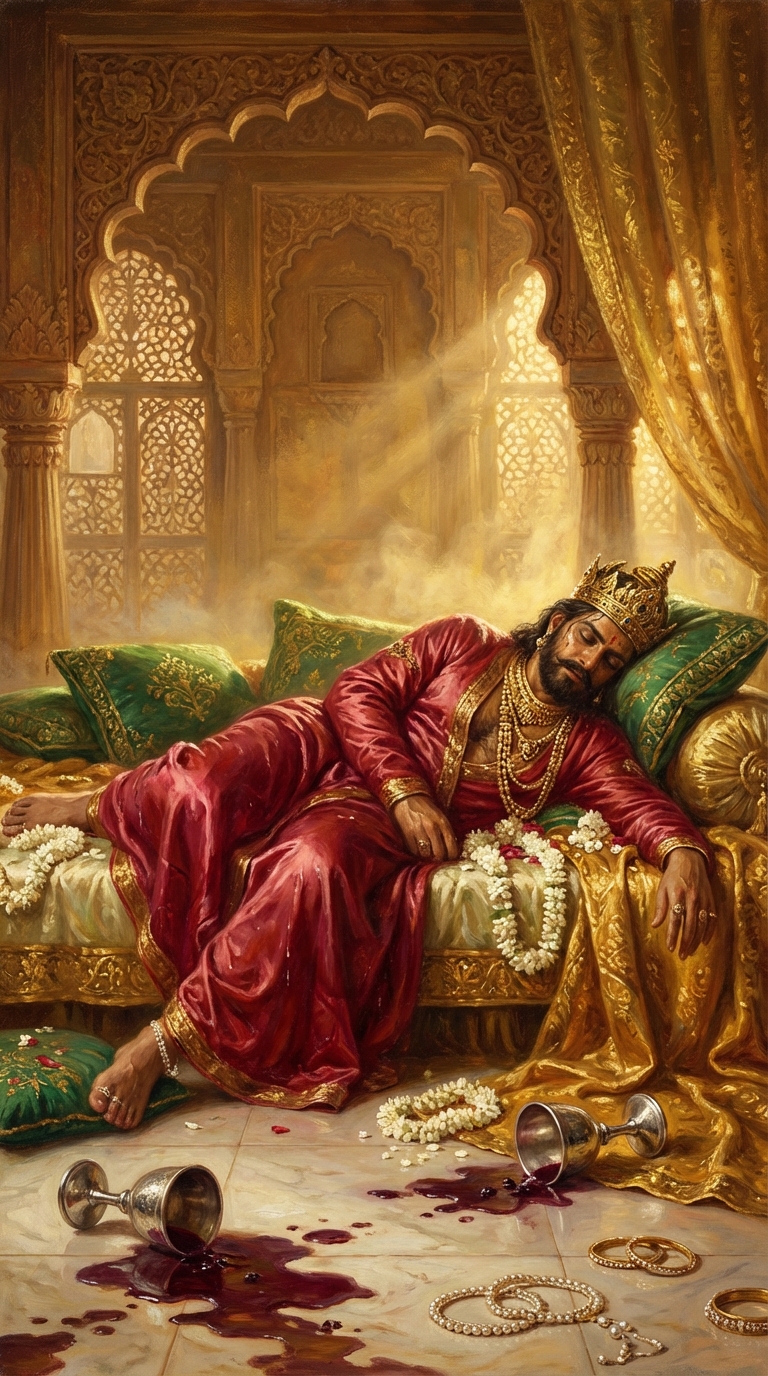
The dynasty culminates with Agnivarṇa, the son of Sudarśana. Unlike his ancestors, he is a voluptuous and pleasure-seeking ruler who neglects his kingly duties for a life of indulgence. His debauchery leads to consumption and an early death. The story ends abruptly with his pregnant wife ascending the throne as Queen-regent, leaving the future of the dynasty uncertain.
The Sarayu river exhales a thick, mud-sweet mist that crawls up the limestone steps of the palace, settling into the open fretwork of the women’s quarters. Inside, the air hangs heavy with the exhaustion of forced pleasure. Spilled mango liquor sours on the marble floors, crushed lotus petals turn brown underfoot, and the sharp, metallic tang of sweat clings to the silk drapery. Agnivarṇa wakes with a dry cough that rattles the silver cups on his bedside table. He does not open his eyes. The bedsheets cling to his wasted thighs. His breath catches in his chest, shallow and wet. He tastes blood and sandalwood at the back of his throat. The morning sun climbs the pillars, but the king draws the heavy saffron canopy shut, burying himself back in the dark.
Beyond the palace walls, the great capital of Ayodhya hums with a hollowed-out rhythm. Brahmins stand waist-deep in the cold river, reciting morning oblations to a monarch who has not shown his face at the eastern window in seven months. In the grain market, sway-backed oxen drag massive wooden carts over cobblestones, their hooves slipping in the crushed husks of millet. The merchants trade in hushed, urgent tones, watching the royal guards who lounge against the armory gates with unpolished spears. A stray dog laps at a puddle of sweet milk spilled from a brass urn. The empire of the Raghus, which once measured its borders by the sea, now ends at the threshold of a locked bedchamber.
The chief queen sits perfectly still on a low cedar stool. A lattice screen woven of pale reeds separates her from the council of ministers. In her lap, she turns the royal signet ring over and over. It is solid gold, carved with the solar boar, heavy enough to bruise the bone. It used to dig deep into Agnivarṇa’s thumb. Now she wears it on her index finger, and still it slips. She feels the cold metal bite against her knuckle. Through the reeds, the white-robed ministers are nothing but blurred, trembling shadows. Their voices drop to whispers when they speak of the treasury, of the border lords who no longer send horses for the autumn tribute.
She knows what they are calculating. They listen to the muffled, hacking cough echoing down the marble corridors, measuring the days left in the king’s dissolving lungs. The physicians come at midnight through the servants entrance, carrying wrapped bundles of black pepper, long pepper, and dried ginger. They burn pippali root in clay braziers until the smoke stings the eyes, but the remedy does nothing to stop the blood from staining his silk handkerchiefs. The queen presses her palm against her own belly, feeling the taut, unyielding swell beneath her sari. The child kicks, a sharp flutter against her rib. This tiny, blind violence is the only thing standing between the dynasty of the sun and total annihilation.
The prime minister clears his throat, the sound dry as dead leaves. He asks for the royal decree on the copper-mine disputes in the south, extending a parchment toward the reed screen. The queen takes the parchment. She does not read it. She holds the heavy gold ring over the candle flame until the metal warms, then presses the solar boar firmly into the hot red wax. She passes the sealed scroll back through the narrow slit in the lattice. The minister hesitates before taking it. He knows the seal is cold forgery, sanctioned by silence, holding a fractured world together through the sheer bluff of a woman who cannot yet show her face.
Agnivarṇa forces himself upward as the evening lamps are lit, demanding to be carried to the crystal pavilion. Two mute attendants lift him by the armpits. His collarbones protrude like the handles of a silver urn, and his skin carries the yellowish translucence of old paper. He collapses onto the velvet cushions, gasping, the sweat beading instantly on his forehead. Below him, the courtyard is ablaze with torches. The barrel drums strike a slow, throbbing beat. He waves a trembling hand, rings sliding down his emaciated fingers, signaling for the musicians to play faster. He wants noise. He wants the roaring, deafening distraction of the flesh to drown out the wet rattling deep inside his own chest.
A dancer from Vidarbha spins into the center of the mosaic floor, her ankle-bells shivering in time with the flute. She bends backward, her dark braid sweeping the polished stones, her eyes locked on the king. Agnivarṇa leans forward, a desperate hunger tightening his jaw. He reaches for a necklace of heavy pearls resting on the silver tray beside him. He means to toss it over the balustrade, a grand, careless gesture of royal favor. His hand closes around the pearls. He pulls, but his wrist betrays him. The heavy string slips through his grip, catching on the edge of the tray. The silk thread snaps. Pearls scatter across the marble like hail, rolling off the edge into the dark.
He lunges after them, and the sudden movement tears something open inside him. The cough hits him not as air, but as a violent, physical rupture. He doubles over the carved railing, his body jerking with brutal spasms. Dark, arterial blood splatters across the white marble of the balustrade. The flautist stops mid-note. The drums cut out. The dancer freezes, her arms suspended in the cold air. Agnivarṇa falls backward onto the cushions, his eyes rolling up to the painted ceiling, his mouth slack and shining red. The queens shriek, a sharp, tearing sound that shatters the courtyard. Attendants rush the stairs, but the prime minister is already there, throwing a heavy woolen cloak over the king’s ruined face.
snehakṣayān nāśam upaiti dīpaḥ śuklakṣayāc cāpi śaśīva rājā
The poetry of the era understands the mechanics of collapse through the physics of light. Just as a lamp meets its destruction from the depletion of oil, and the moon wastes away from the fading of the bright fortnight, so too did the king. A wick flares brightest just before the fuel burns down to the dry clay. The moon is eaten alive by the dark half of the month, sliver by sliver, until nothing remains but the memory of its shape in the black sky. Agnivarṇa vanishes into his own disease, consumed by the very heat he generated. The Sanskrit plays on the word sneha, meaning both the thick, fragrant oil that feeds a flame and the sensual affection that binds human beings to the flesh. The king has burned through his reserves of both.
He has loved the physical world too fiercely, and the friction has reduced him to ash.
To watch a monarch die of his own appetites is to witness a profound inversion of the cosmic order. The solar dynasty, born from the pure, untouchable fire of the sun, drowns in the damp, rotting fluids of a single human body. Those who document this fall do not moralize. They watch the terrible, quiet beauty of decay with an unflinching eye. They see how the lotus wilts when the frost hits the pond, not because the flower is wicked, but because the season has turned. The tragedy lies in the absolute inevitability of the depletion. Every golden cup drained, every silk girdle undone, every night spent thrashing in the perfumed dark was a step walked willingly toward the pyre.
Empires do not require invading armies to shatter them. They hollow themselves out from the inside, quietly, behind locked doors and drawn velvet curtains, until a single cough brings the roof crashing down. The machinery of state continues to grind forward purely out of habit, sustained by the frantic improvisations of those left standing in the wreckage. When the funeral fires burn out on the banks of the Sarayu, it is not a triumphant heir who claims the lion-throne, but a pregnant widow sitting alone in the cold halls of Ayodhya. She holds the entire weight of a three-hundred-year-old mythos in her swelling abdomen, waiting in the dark for a child who might be a savior, or might be a ghost.
This is the brutal, unspoken truth at the heart of all dynastic glory. The bloodlines that claim descent from the stars are still tethered to the fragile, failing anatomy of the human animal. We build monuments of eternal stone, we draft laws meant to outlast the mountains, and we hand the keys to men who cannot even conquer their own private hungers. The crown is passed from the god to the hero, from the hero to the administrator, and finally to the addict, until the grand narrative of history runs out of words. Power always dies in the dark, choking on its own indulgences, leaving a woman to sweep up the ashes and pretend the sun will rise again.