Chapter 16 of 19
After Rāma's ascension to heaven, his son Kuśa rules from Kuśāvatī. The guardian deity of the deserted city of Ayodhyā appears to him in a dream, urging him to return and restore the capital. Kuśa agrees and brings the city back to its former splendor. While bathing in the Sarayū river, he meets and marries the Nāga princess Kumudvatī.
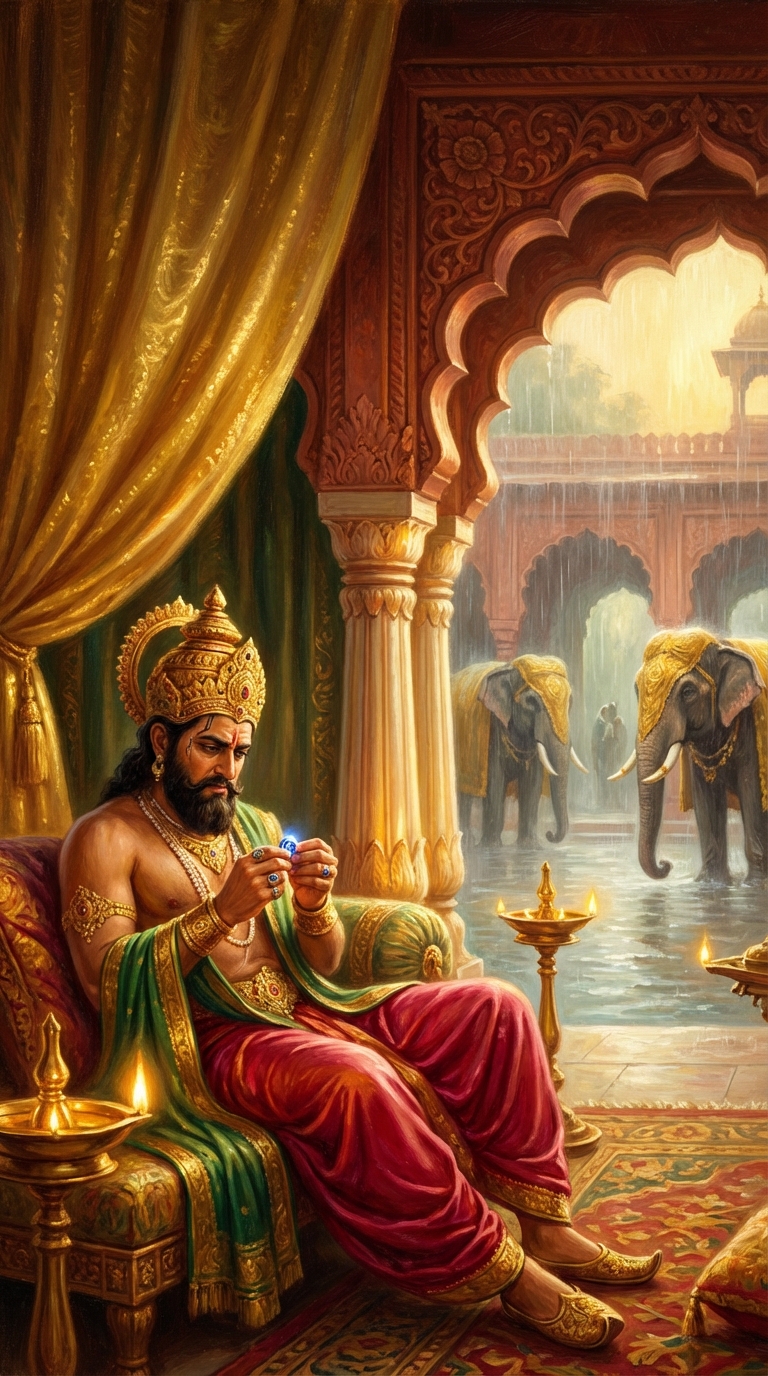
Kuśa shifts on a mattress of raw silk, the coarse weave pressing into his shoulder blades in the heavy Vindhyan heat. Kuśāvatī sleeps outside his open windows, a newly minted fortress of cut sandstone and iron-bound gates, its broad streets smelling of freshly split sal timber and wet, green grain. Draft oxen rest in the paddocks below, their massive humps slick with the night mist, jaws working rhythmically through heaps of fodder. He listens to the sharp strike of the sentries’ iron-shod staves against the granite cobblestones. This is his kingdom, wealthy and militarily secure, breathing with the scent of wet earth and crushed jasmine. Yet a cold, physical pressure settles at the base of his throat. He presses his palms against his eyes, desperate to shut out the relentless, mechanical perfection of his own creation.
He inherited an empire from a living god, but gods leave an unbearable, suffocating silence in their wake. Rāma is gone, drawn up into the river of heaven, leaving his son to manage the brutal, earthly mechanics of taxation, grain stores, and border skirmishes. The king rises from the bed, his bare feet registering the shocking chill of the polished marble floorboards. He walks to the high archway overlooking the northern plains. The wind carries the metallic tang of distant rain and the faint, bitter smoke of drying dung fires. He watches the long shadows lengthen across the valley floor. The sentries call out the change of the guard, their voices swallowed instantly by the vast, indifferent darkness of the forest.
Kuśāvatī functions flawlessly, yet it is merely an exile's triumph, a citadel built from nothing to prove that Rāma’s heir can command the physical earth. But the earth remembers older masters, older debts. Kuśa stares into the dark, feeling the undeniable pull of the north, the invisible tether connecting his blood to the alluvial plains he abandoned. A sudden, unnatural drop in temperature makes the brass oil lamps sputter, their flames turning a sickly, translucent blue. The rich scent of sandalwood incense burning in the corner suddenly turns sour, carrying the unmistakable stench of rotting lotuses and damp mildew. The silence in the room thickens into a physical barrier.
Out of the dancing shadows near the heavy camphor-wood chest, a woman forms. She wears no crown, but the crushing weight of an empire hangs in the severe, shadowed lines of her jaw. Her silk sari is the color of dried, flaking blood, frayed at the golden hem, and her coarse hair falls unbound, trailing across the immaculate floorboards like black water. She smells of stagnant river pools and shattered limestone. Kuśa steps back, his hand dropping instinctively to the empty leather sheath at his waist. He recognizes her not by the features of her face, but by the overwhelming, ancient grief that radiates from her pale skin. She does not breathe, yet she occupies the center of the room with absolute authority.
She speaks, and her voice is the dry, rasping sound of dead leaves scraping over hollow masonry. She is Ayodhyā. The great capital of the Ikṣvāku dynasty lies utterly abandoned, choking on its own magnificent ruins. She forces Kuśa to look directly upon her face, mapping the devastation in her hollow cheeks. She describes the royal pleasure gardens where wild boars now root blindly among the dying, disease-ridden mango trees. She speaks of the brutal monsoon winds ripping the gilded weather vanes from the sagging palace roofs, of pristine marble courtyards splitting wide open under the relentless, slow-motion violence of banyan roots. Every word drops into Kuśa’s mind like a stone down a dry well, offering no escape.
She holds out a hand stained to the wrist with white dust. The gesture demands nothing less than his entire life. If a king abandons his ancestral hearth, he severs the root of his lineage, leaving his ancestors to starve in the dark. Ayodhyā is desperate for the deep resonance of Vedic chants, for the sharp scent of clarified butter poured onto sacrificial fires, for the heavy, earth-shaking tread of royal war elephants. Kuśa looks at her trembling, dust-covered fingers. He understands the brutal, uncompromising arithmetic of dynastic survival. To ignore her plea is to let the jungle swallow his family’s name forever. To follow her is to surrender his hard-won peace and return to a graveyard.
The northern road vanishes beneath a river of foot soldiers, heavy cavalry, and rumbling supply wagons. Kuśa does not merely return to Ayodhyā; he excavates it from the earth's grip. Masons and carpenters swarm the ruined capital, their iron chisels ringing against basalt and sandstone from dawn until dusk. Kuśa stands directly in the debris, his royal robes dusted with white plaster, directing the brutal labor of lifting a fallen, vine-choked column. Men strain against thick hemp ropes, their muscles corded and shining with sweat in the afternoon sun, while bullocks dig their hooves into the soft mud, hauling carts loaded with fresh timber. The thick stench of rot is slowly driven out, replaced by the sharp, clean scent of damp mortar and sawdust.
By the height of summer, the resurrected city gleams once more, but the heat is a physical weight, pressing the breath from the citizens. Kuśa rides his horse down to the banks of the Sarayū river. The water runs high and black, bordered by blinding white sandbars and thick reeds. He strips off his heavy linen robes and plunges directly into the current. The shock of the glacial water is absolute, freezing the sweat on his skin. He swims outward, feeling the dangerous drag of the deep channel against his legs. As he strokes against the powerful tide, the jeweled clasp on his wrist catches on a submerged branch. The heavy gold bracelet—an irreplaceable heirloom of his father—slips free, sinking immediately into the impenetrable green depths.
He dives, the water pressure building violently in his skull, his hands sweeping blindly through the soft, blinding silt of the riverbed. He finds nothing but smooth, water-worn stones. When he finally breaks the surface, gasping for air and wiping the water from his eyes, he realizes he is not alone. A woman treads water in the shallows. Kumudvatī, daughter of the submerged Nāga kingdom, holds the dripping gold ornament in her pale hands. Her thick black hair clings to her neck, smelling intensely of deep-water minerals and crushed lotus stems. She lifts her eyes to him. In that single, unblinking stare across the surface of the river, the restitution of Ayodhyā is finally sealed. Kuśa wades toward her, the lost bracelet gleaming in the sharp sunlight.
niśāsu bhāsvatkalanūpurāṇāṃ yaḥ sañcaro'bhūd abhisārikāṇām
In the night, the pathways once bright with the ringing anklets of women hurrying to their lovers are now overtaken in the darkness by the howling of jackals whose mouths breathe fire. The poetry captures the precise, merciless physics of ruin. The tragedy of the fallen city does not reside in the abstract loss of political power or the collapse of economic trade, but in the brutal, physical inversion of sound. The delicate, rhythmic silver chimes of human anticipation are violently replaced by the throat-rattling snarls of wild dogs fighting over scraps in the dark. The city is no longer a container for human life; it has become a hunting ground.
The devastation is measured entirely through the sensory memory of joy. The paved stones themselves remember the hurried, breathless steps of the abhisārikās, the brave women braving the terrifying dark solely for love. Now, those exact same stones echo with the sounds of scavengers. The fiery breath of the jackals illuminates the hidden alcoves and shadowed corners where lovers once pressed against each other. By placing the intimate, fragile human pursuit of desire directly against the cold indifference of the encroaching wild, the loss becomes unbearable, lodging directly in the chest. Ayodhyā’s decay is not just architectural failure; it is a profound betrayal of the living body.
Cities are not permanent arrangements of stone and mortar; they are fragile, temporary agreements we make with the earth. We push back the forest, lay the heavy paving stones, and declare a specific geography immune to time, but the roots are always waiting patiently beneath the floorboards, ready to reclaim their territory. To inherit power is to inherit the urgent, terrifying responsibility of keeping the wilderness at bay. Kuśa learns what every builder and every monarch eventually discovers: nothing stays standing without a human hand to actively brace it against the wind. The jungle never sleeps, and it never forgives weakness.
We are all haunted by the ruined capitals of our predecessors. The ghosts of abandoned ambitions and forsaken homes come to us in the dead hours of the night, demanding that we return, demanding that we rebuild exactly what we did not break. We dive into the dark, rushing water, searching desperately for what was lost, and emerge holding an entirely different future in our hands. History is the quiet, relentless labor of lifting the fallen column out of the mud.