Chapter 15 of 19
Sītā's sons, Kuśa and Lava, are raised by Vālmīki, who teaches them to sing the Rāmāyaṇa. When Rāma performs a horse-sacrifice, Vālmīki brings the twins, who recite the epic in the royal court. Rāma recognizes them as his sons and wishes to take Sītā back if she proves her purity. Sītā calls upon the Earth to receive her, and the goddess emerges and takes Sītā away.
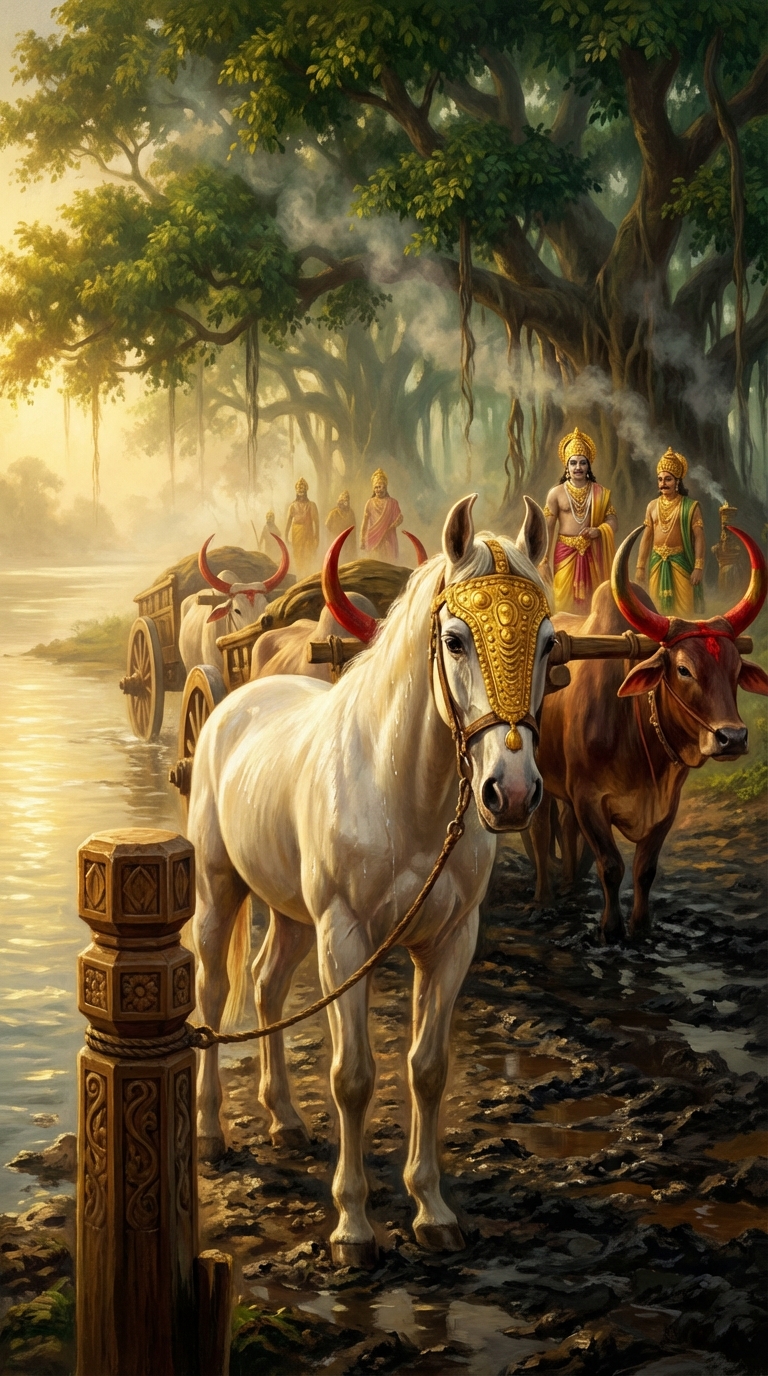
The white horse stamps the packed mud of the sacrificial grounds, tossing its garlanded mane against the wind. Clarified butter drips from the long wooden ladles of the priests, hissing into the open brick fire pits and sending thick, sweet plumes of smoke into the morning air. The Sarayu river, choked with silt from the retreating monsoon, smells heavily of wet loam, crushed marigolds, and the smoke of distant pyres. Servants carry immense wicker baskets of unbroken barley, their bare feet slapping against the worn paving stones, their dark shoulders dusted with yellow pollen. Rāma sits rigid beneath the silken canopy. His ceremonial robes weigh heavy with embroidered gold thread, stiff against his skin. The heat of the fire presses against his jaw, drawing a thin line of sweat, but he does not blink.
The empire demands a sovereign without fracture, a man wiped clean of personal grief. Beside him on the high stone dais sits a life-sized statue of his exiled wife, cast in solid gold. The metal catches the harsh morning light, throwing a hard, yellow reflection across the king's collarbone. The courtiers keep their eyes averted. They do not look at the empty space where breath should lift a woman's ribs, nor at the lifeless eyes of the effigy staring toward the river. The statue holds a rigid lotus bloom fashioned from polished rubies. It is perfectly silent, perfectly pure, and perfectly dead. Rāma rests his hand near the cold metal folds of her dress. The gold holds the chill of the previous night, drawing the warmth directly from his palm.
A low murmur ripples through the outermost ring of spearmen. Two boys step through the abruptly parted crowd, carrying heavy lutes carved from dark jackwood. They wear the rough bark cloth of ascetics, yet they walk with the long, predatory stride of the Ikṣvāku kings. Their hair, matted with ash and river clay, catches the breeze, framing faces that stop the breath of the ministers. Behind them walks the blind old poet, his back bent like a strung bow, leaning heavily on a bamboo staff. The twins take their position before the fire. They strike the copper strings of their instruments in perfect unison. The resulting vibration cuts through the crackle of the sacrificial fires, sharp and bright, demanding total, absolute silence from the vast assembly of the royal court.
The boys begin to sing. The syllables of the epic roll from their tongues in flawless meter, carrying the dark, resonant cadence of the deep forest into the heart of the city. They sing of a stolen wife, a burning island kingdom, an empire reclaimed through blood. Rāma grips the heavy cedar armrests of his throne. The wood grooves deeply under his fingernails. He recognizes the aggressive tilt of the older boy's chin, the exact angle of defiance he sees in his own mirror. He hears the unmistakable inflection of Sītā's voice hiding in the younger boy's high, clear notes. The state requires undeniable lineage, bloodlines carved out in public view, but memory operates through muscle and bone. These are his sons. They carry his face and her grief.
He cannot simply step down and claim them. A king does not operate within the fluid realm of personal desire; he is a captive of public law. The whispering courtiers, the vigilant priests pouring oblations, the citizens who questioned Sītā's purity in the streets a decade ago circle the throne like hungry dogs. The golden effigy beside him is the only wife the kingdom will accept: voiceless, unmoving, purged of the messy realities of human flesh. To acknowledge the boys openly is to acknowledge the woman who bore them in the wilderness. To bring her back into the palace requires another public breaking, another display of agonizing compliance to the mob. He must ask her to prove she has not been ruined by the world.
The royal messenger departs, and by noon, Sītā stands at the edge of the sacrificial enclosure. She wears the plain russet robes of the hermitage, her head bowed, her dark hair streaked with lines of silver. The sharp scent of pine needles and damp earth clings to her skin, brutally foreign against the heavy musk of the court. Rāma steps down from the dais. The space between them hums with an unbearable, suffocating pressure. He demands the final oath. He speaks the harsh words required by the state, his voice echoing flatly against the carved stone pillars, asking her to prove her virtue one last time before the masses. He needs her to perform the ritual of public submission, to scrub away the stain of suspicion so he might finally take her hand.
Sītā does not look at the king. She does not look at the glittering golden parody of herself sitting frozen on the throne, nor at the two adolescent sons weeping quietly beside the old poet. She looks steadily at the ground. She presses her bare toes into the trampled mud of Ayodhya, feeling the vibration of the subterranean rock. She raises her head, and the silence in the vast courtyard turns absolute, thick enough to stop the breath in a thousand throats. She does not defend herself against the accusations. She issues no desperate apologies for surviving. Her voice, when it comes, is low and terrifyingly resonant, bypassing the weeping king entirely and speaking directly to the ancient, unyielding bedrock buried deep beneath the paving stones.
The paving stones groan. A massive fissure rips through the dead center of the courtyard, snapping the stone altar in two and scattering the sacred fires into the dust. Lightning flashes upward from the abyss, illuminating the sheer, jagged walls of the underworld. A throne rises from the depths, borne on the hooded heads of stone serpents, carrying the dark goddess of the Earth. The goddess reaches out her hands, pulling Sītā firmly by the wrists. They descend together. The chasm seals shut with the concussive, deafening crack of a summer thunderclap. Thick dust billows into the stifling air, coating the fine silks of the shrieking courtiers and the king's paralyzed face. Where a breathing woman stood moments before, only an unbroken stretch of packed dirt remains.
vāṅmanaḥkarmabhiḥ patyau vyabhicāro yathā na me / tathā viśvambhare devi mām antardhātum arhasi Sītā binds the cosmos to her unyielding truth. She declares that if she has never strayed from her husband in word, mind, or deed, the Goddess Earth must hide her away from the light. It is an oath of devastating, surgical precision. She does not fall to her knees and beg for a belated vindication. The poetry arms her with the very instrument of her lifelong oppression, her absolute, terrifying purity, and transforms it into a weapon of permanent departure. She uses the exact flawlessness the empire relentlessly demands to orchestrate her final, irreversible escape from its grasp.
The syntax of the verse functions as an iron trap snapping shut. The perfect alignment of thought, speech, and action leaves no semantic space for the king's lingering doubt, no tiny gap where the venom of public rumor might take root. It is an airtight, cosmic legal contract presented not to a flawed husband, but to the deep geology of the world itself. The earth recognizes its own elemental material. The mother opens wide to receive the battered daughter who has finally exhausted the usefulness of men. The verse falls over the scene with the heavy finality of a granite stone dropping into a lightless well, erasing the agitated surface and refusing any possibility of an answer.
Power builds a cage of shining gold and desperately calls it order. Kingship requires the systemic excision of the human heart, replacing the chaotic, breathing reality of intimate love with unbending statues, rigid protocols, and bloodless ideals. The sovereign who fully submits to the insatiable demands of the crowd inevitably ends up ruling an empty empire of phantoms. He gains unquestioned, absolute authority over the state, yet loses the very soul that gives his reign its meaning. History is endlessly littered with powerful men who preserve the institutions of state at the cost of everything they love, sitting alone on high thrones beside cold metallic effigies, choking slowly on the bitter ashes of their own public righteousness.
True justice rarely arrives in the form of a gracious courtroom pardon. It arrives as a sudden, violent rupture, an absolute refusal to continue playing a rigged game. When the structures of power demand an impossible, endless performance of submission, the only absolute victory lies in walking off the board entirely, taking the pieces with you into the dark. The earth silently remembers what anxious empires try so violently to forget. The ground always opens, sooner or later, to swallow the things men break but can never truly own.