Chapter 14 of 19
Rāma is crowned king. Soon after, public gossip arises questioning Sītā's purity after her captivity. To uphold his 'dharma' as a king, Rāma painfully resolves to abandon the pregnant Sītā, though he knows her to be innocent. Lakṣmaṇa leaves her near the hermitage of the sage Vālmīki, who takes her into his care. Sītā later gives birth to twin sons, Kuśa and Lava.
The Sarayu river smells of silt, bruised marigolds, and the smoke of damp cedar wood burning on the morning ghats. In the city of Ayodhya, prosperity has a distinct acoustic signature. It is the rhythmic, grinding weight of iron-rimmed wheels crushing gravel as oxen drag impossibly heavy grain-carts toward the royal storehouses. It is the syncopated striking of coppersmith hammers echoing against limestone walls, the continuous, low-throated murmur of commerce in the bazaar. Wealth means a kingdom in perpetual motion, loud and fat and secure. Dawn light strikes the gilded eaves of the palace, casting long, sharp-edged shadows across the sandstone courtyards. Everything rests in perfect order.
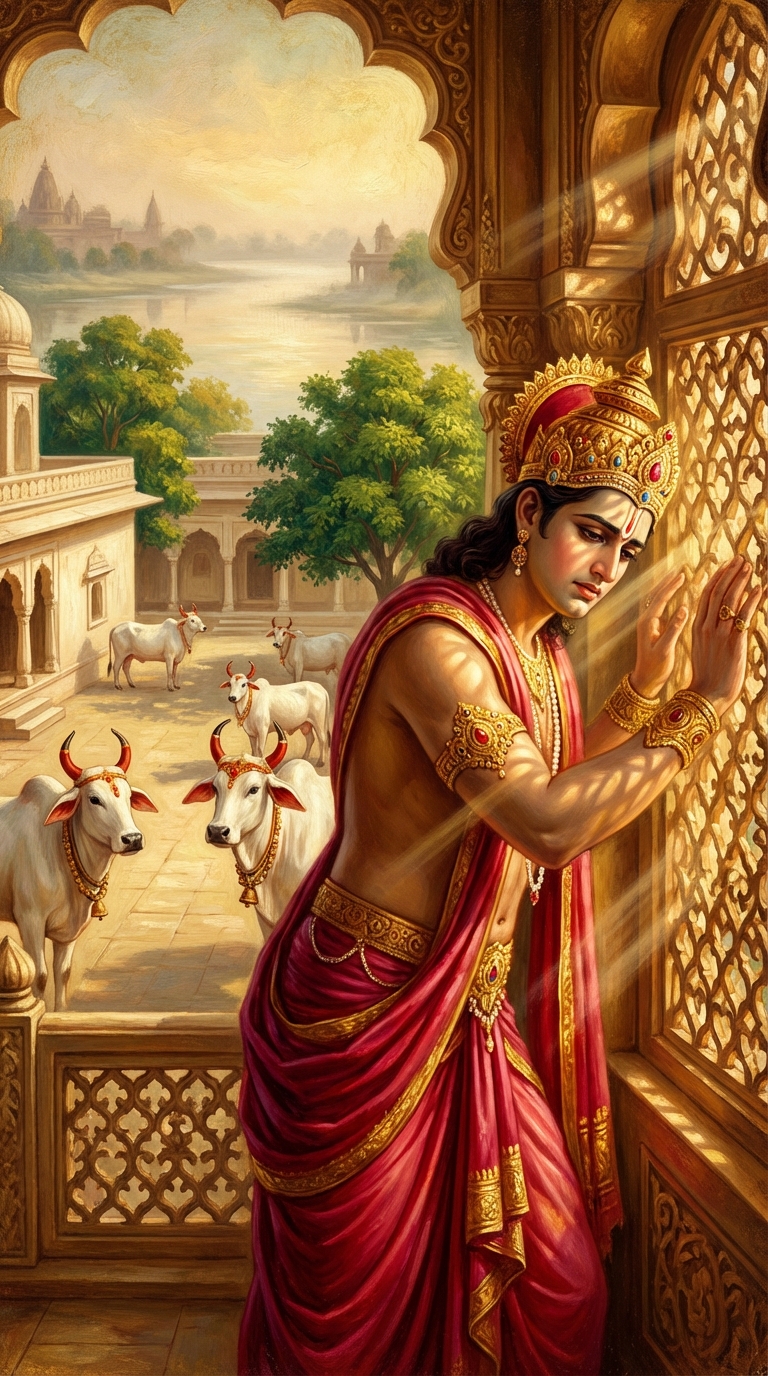
Rama stands by the high, carved window of his private chambers, watching dust rise from the merchant caravans. The crown of the Kosala kings sits on a teak stand behind him, cold and immense. He feels its phantom pressure against his temples even when his head remains bare. For fourteen years, his body adapted to the deep silence of the Dandaka forest, to the rustle of leaves signaling a panther moving through the underbrush. Now, the threats remain entirely invisible. They travel on the breath of his subjects, mutating in narrow alleys and crowded public baths.
A spy named Bhadra waits near the threshold, shifting his weight from his left heel to his right. The coarse linen of Bhadra’s tunic holds dark stains of sweat, smelling faintly of the open city streets. He keeps his gaze fixed firmly on the polished marble floor. Rama requires no look at the man’s face to know the atmosphere in the room has grown brittle. The king closes his eyes, bracing himself. He nods once, offering a curt and microscopic movement of his chin, signaling the informant to speak the words poised to dismantle the world.
The hesitation in Bhadra’s throat fills the chamber, acting as the physical manifestation of terror. Reporting treason ranks as a sworn duty, but repeating the exact, vulgar syllables of a washerman in the market amounts to handing poison directly to a god. The spy’s voice cracks as he forces the syllables into the air. He speaks of a citizen who drove his wife into the street, shouting that he holds no foolishness, that he refuses to blindly accept a woman who spent ten months in the palace of a ten-headed raksasa. The words drop into the silence like stones plunging into an empty well. Lanka. Fire. Purity.
Rama stands perfectly still, but a devastating coldness floods the hollow of his chest. He encounters the iron cage of royal duty. A man might forgive, a man might know with absolute, marrow-deep certainty that his wife walked through the flames and emerged as unblemished as morning dew, but a king operates outside manhood. A king functions as a mirror reflecting the kingdom's own virtue. If the mirror clouds, the state fractures. The scandal operates as a disease, and the throne demands brutal amputation before the rot leaches into the soil of Kosala itself.
Through the cedar doors, Rama hears the faint, silver chiming of anklets. Sita walks through the inner gardens, entirely unaware of the executioner's block waiting for her. She carries the heavy burden of his child, currently craving the smell of rain on parched clay, asking only to visit the quiet hermitages along the Ganges to feel the cool wind against her face. She holds the absolute future of his bloodline. The sheer physical reality of her—the scent of jasmine in her hair, the warmth of her palms—presses against his mind. To sever her means cutting out his own heart with his eyes wide open.
Laksmana’s hands shake as he tightens the leather reins. The chariot’s wooden wheels jolt violently over the uneven forest tracks, carrying them far beyond the manicured borders of Ayodhya. Beside him, Sita watches the canopy of sal and banyan trees close over their heads, her face bright with the anticipation of the distant riverside hermitages. She points to a kingfisher diving into the rushes, completely oblivious to the rigid set of her brother-in-law’s jaw. Laksmana cannot breathe. The air in his lungs turns to ash. He clutches the reins until his knuckles bleach white, keeping his face turned deliberately toward the horses so she misses the tears tracking through the dust on his cheeks.
They reach the sandy bank of the Bhagirathi river, where the water churns fast and green against the knotted roots of the great trees. The chariot lurches to a halt. The dense silence of the deep woods presses in on them, broken only by the sharp, repetitive cry of a hawk circling above. Laksmana steps down, the metal rings of his armor clinking dully in the quiet. He tries to offer her his hand, but his knees give out. He collapses into the damp sand at her feet, his broad shoulders heaving, choking on the vile edict the king forced into his mouth.
He tells her. The syllables spill out in a ragged, desperate rush—the whispers in the city alleys, the king's terror of a tainted dynasty, the royal command of permanent exile. Sita emits no scream. She steps back, her golden bracelets sliding down her wrists with a sharp clatter. Her eyes dart wildly from the dark river water to Laksmana’s prostrate form, searching for the punchline of a cruel joke. When she understands the silence holds no trick, that the man who moved heaven and earth to pull her from Lanka has discarded her to silence a rumor, all the blood leaves her face. She sinks into the riverbank, her fingers curling convulsively into the wet earth.
The violence of the abandonment does not register in blood or bruised flesh, but in a sudden, catastrophic failure of the body. The mind refuses to process the cruelty of the king’s decree, and so the physical form simply gives way. The sheer velocity of the shock severs the invisible tether that binds her to the waking world, dropping her instantly into a quiet void of pure gravity. She offers no physical resistance, finding only the immediate cessation of her upward reach.
bhūmau nipatitā kṣīṇā vātarugṇeva mañjarī
Falling exhausted to the earth, like a blossom broken by the wind. The language strips her of her royal consequence and her mythic origins, leaving only the fragile biology of a living thing snapped at the stem. A wind-broken blossom does not fight the storm; it simply surrenders to the dirt. She carries new life, holding the twin heirs of the empire in her womb, yet the careless breath of a city's gossip renders her entirely weightless. The damp riverbank catches her fall, the dark mud smudging her fine silk, as the state's cold machinery crushes the woman it was built to protect.
To wear the crown is to willingly submit to a form of living death. Power demands the systemic amputation of the private heart, replacing love and loyalty with the cold, unyielding calculus of public perception. The monarch becomes a prisoner of the masses he rules, trapped inside a gilded cage built from the expectations of the crowd. He sacrifices the most true and beautiful thing in his life to appease an endless, anonymous hunger for moral perfection. Justice, when divorced entirely from human compassion, mutates into a profound and irreversible cruelty.
History records the glory of the golden age, the unbroken laws, and the wealthy merchant squares, but it conveniently ignores the bones ground into the palace mortar. Institutional duty operates as a magnificent, terrible altar requiring the most honorable men to hold the sacrificial knife. Yet love survives the blade, learning to breathe out in the wilderness, entirely free of the throne's jurisdiction. A kingdom bought with the destruction of a blameless woman is only a beautifully decorated tomb.