Chapter 13 of 19
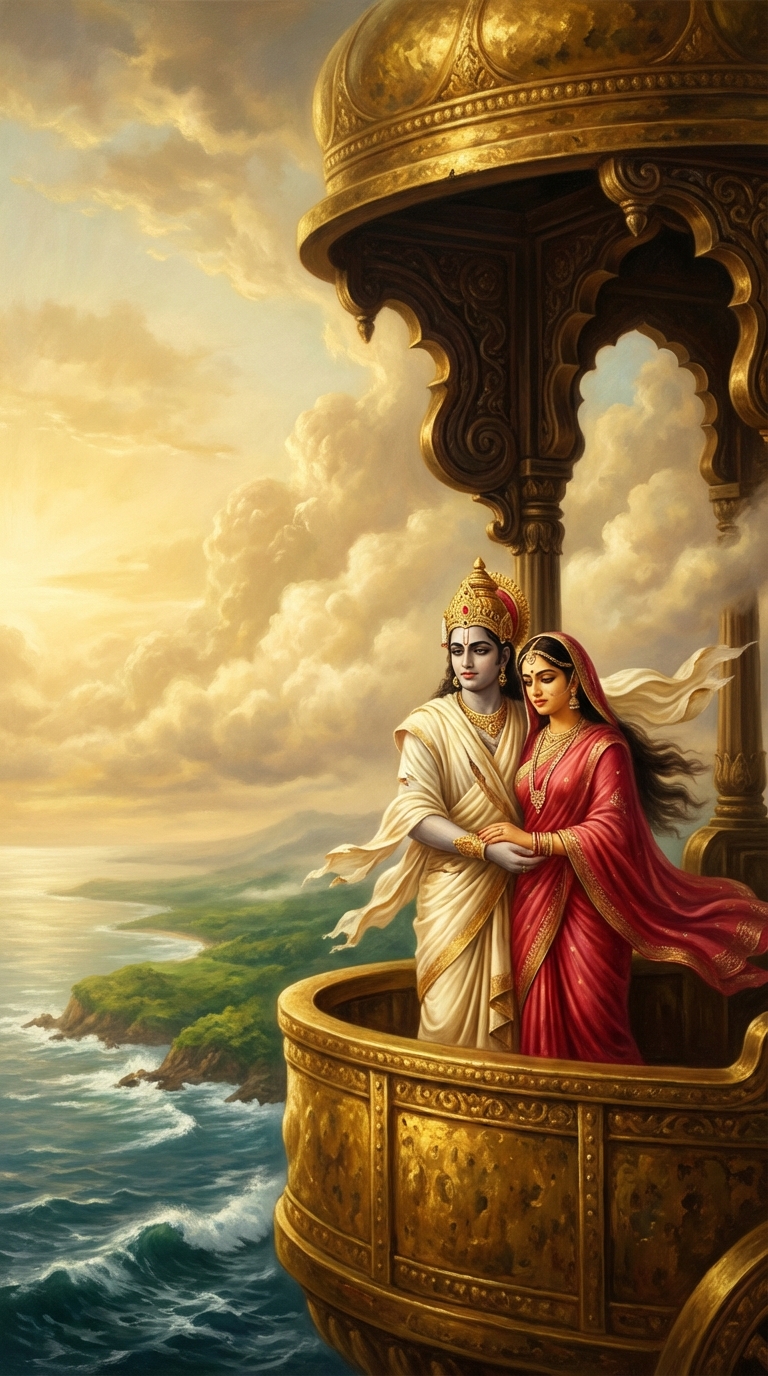
Rāma, Sītā, and Lakṣmaṇa, along with their allies, return to Ayodhyā from Laṅkā in the celestial flying chariot, Puṣpaka. During the journey, Rāma points out to Sītā the significant places they had traversed during their exile. Upon reaching the outskirts of the capital, they are met by Bharata, and the brothers are joyfully reunited.
The shadow of the flying chariot sweeps over the salt flats, a bruised purple stain speeding across the blinding white shore. Inside the Puṣpaka, the air grows thin, carrying the bitter chill of the upper atmosphere. Sītā grips the gilded railing. Fourteen years of dirt, terror, and captivity are behind her, yet she watches the ocean recede with a sudden, involuntary tightening in her throat. The chariot shudders. It is a machine of pure thought and spun gold, vibrating in direct response to the gravitational pull of Rāma’s will. Below them, the surf breaks violently against the southern tip of the continent, a jagged white spine of foam marking the definitive boundary between the island of demons and the land of men. The harsh sea wind rips at the heavy gold embroidery bordering the edge of her crimson silk sari.
She refuses to look at her husband. Instead, she traces the deep grooves carved into the chariot’s sandalwood strut, her fingertips finding the damp, gray grit of Laṅkā still lodged deep in the grain. They are suspended in the dizzying architecture of the sky, riding a plundered celestial vehicle toward a kingdom they left as soft, untested children. The mainland unfurls beneath them in hypnotic ribbons of emerald forest canopy and baked copper-red earth. Rivers flash below them like dropped blades catching the brutal midday sun. The sheer scale of the continent threatens to swallow them whole.
Beside her, Lakṣmaṇa sits with his great bow resting horizontally across his knees, staring fixedly toward the northern horizon. His knuckles are completely white. He does not blink, holding his body with the rigid tension of a soldier waiting for an ambush that will never come. The sky around them hums with an almost unbearable velocity, a continuous, low-frequency thrum that vibrates in the marrow of their bones. The machine is pulling them backward into the lives they abandoned, dragging them toward a home that no longer exists as they remember it. The silence between the three of them is dense, heavy with the blood of thousands.
Rāma reaches across the low, cushioned bench and covers Sītā’s hand with his own. His fingers are hard, violently calloused from years of pulling the heavy bowstring, scarred pale by the iron teeth of rakshasa arrows. She looks down at this hand, measuring the terrible cost of their survival in its ruined, brutalized topography. This is a king's hand, a weapon capable of drowning an entire island in fire and blood to retrieve a single woman, yet it trembles slightly as it rests against her knuckles. He points downward, past the carved railing, tracing the meandering path of their long grief. They are reading the raw geography of their suffering from the merciless height of gods.
"There," he says. His voice is barely audible over the roaring rush of the wind, but it carries the heavy, dark timber of absolute command. He points to a vast, sprawling stain of dense trees bordering a silver vein of river. The Daṇḍaka forest. Sītā leans over the edge. She remembers the suffocating smell of rotting jasmine, the wild panic of the deer, the shadows that detached themselves from the thick canopy and became nightmares with jaws. The true risk of this flight is not in the impossible mechanics of the chariot, but in the viewing. Looking down means acknowledging the unalterable past.
They are rolling up the vast map of their tragedy, but seeing it laid bare makes it agonizingly permanent. Every stolen month, every cry swallowed by the dark, every drop of blood spilled on the root-choked ground is permanently etched into the dirt below. It cannot be unlived, only flown over. The forest holds the ghosts of the people they used to be—the hopeful exiles who believed their virtue would act as an impenetrable shield against the world’s malice. Now, they know better. The chariot glides over the canopy, leaving those naive ghosts behind in the humid shade, bound to the soil forever.
The chariot banks sharply northward, following the broad, serpentine coil of the Godāvarī river. Rāma leans closer to Sītā, narrating the earth. He points to the jagged peak of Citrakūṭa, its upper slopes dark with heavy rainclouds, where they built their first, naive hut of mud and broad leaves. He points to the isolated ashrams where the forest sages burned, their charred bones leaving stark white chalk-marks in the black soil. He speaks incessantly to fill the terrifying silence, constructing a shared, official history out of shattered fragments. He is naming the world so they might somehow bear the crushing weight of it.
Sītā listens to the steady rhythm of his breath, realizing that he is not just pointing out geographical landmarks. He is offering her physical proof that the nightmare was real, and that it is finally over. The landscape slowly shifts beneath them. The wild forests thin into the manicured fields of Kośala. The strict geometry of agriculture replaces the chaotic wildness of the jungle. Oxen, pale as milk and slick with sweat, drag heavy wooden plows through the rich black loam. The smell of the Sarayū river rises to meet them—a distinctly domestic scent of wet clay, crushed yellow marigolds, and sweet woodsmoke.
Ayodhyā sits on the horizon, a sprawling cluster of blinding white stupas and gold-tipped roofs shimmering in the heat distortion. At the edge of the capital, a vast dust cloud balloons into the clear sky. It is an ocean of citizens waiting in the harvested fields. At the center of the dust, a lone figure kneels in the dirt, clutching a pair of worn wooden sandals to his chest. Bharata. The Puṣpaka descends, its massive golden struts hitting the soft earth with a dull, heavy thud. Before the dust settles, Rāma leaps over the railing. The two brothers crash into each other, a violent tangle of royal silk and rough ascetic bark.
The entire journey is an act of bearing witness. To arrive at this desperate reunion, they must first read the landscape of their own suffering. Looking back at the deep water of the southern coast, Rāma does not want Sītā to look away. He wants her to comprehend the sheer, impossible scale of the violence done for her sake. The dark water churns against the rocks, furious and untamed, yet it bears the undeniable mark of his iron will. He points out the causeway built by an army of beasts, a brutal line of crushed boulders piercing the white surf.
Vaidehi paśyāmalayād vibhaktam matsetunā phenilamamburāśim
See, Vaidehī, the foaming ocean divided by my bridge all the way to the Malaya mountain. He compares the churning dark water, split by the pale stone of his causeway, to the clear autumn sky cleft by the luminous white band of the Milky Way. The image holds the quiet arrogance of a conqueror and the terrifying tenderness of an obsessed lover. He has split the sea, he has broken the laws of the universe, merely to walk across the water and pull her from the ash. He forces her to witness the geometry of his devotion, a permanent, arrogant scar left across the throat of the ocean.
Exile does not end with the return. The physical geography of homecoming is a beautiful illusion, a comforting trick of political borders, drawn lines, and brightly decorated city walls. Those who leave are never the exact ones who come back. The boy who walked into the forest fourteen years ago was a sheltered prince, blinded by the pure, unyielding light of his own uncompromised virtue. The hardened man who descends from the sky today is a weapon forged in the furnace of profound loss, his soul permanently darkened by the brutal things he had to kill to restore order to the world.
Power demands the sacrifice of innocence, and the heavy gold throne waits patiently to consume whoever sits upon it. They embrace in the dust of Ayodhyā, surrounded by the weeping, jubilant multitudes, yet they remain entirely alone, locked forever inside the isolating, invisible architecture of their shared trauma. A kingdom can be reclaimed, but the self that was lost to the wilderness is gone forever. You can bridge the churning ocean, you can slaughter the demons, you can descend from the heavens in a chariot of spun fire, but you can never wash the forest from your bones.