Chapter 12 of 19
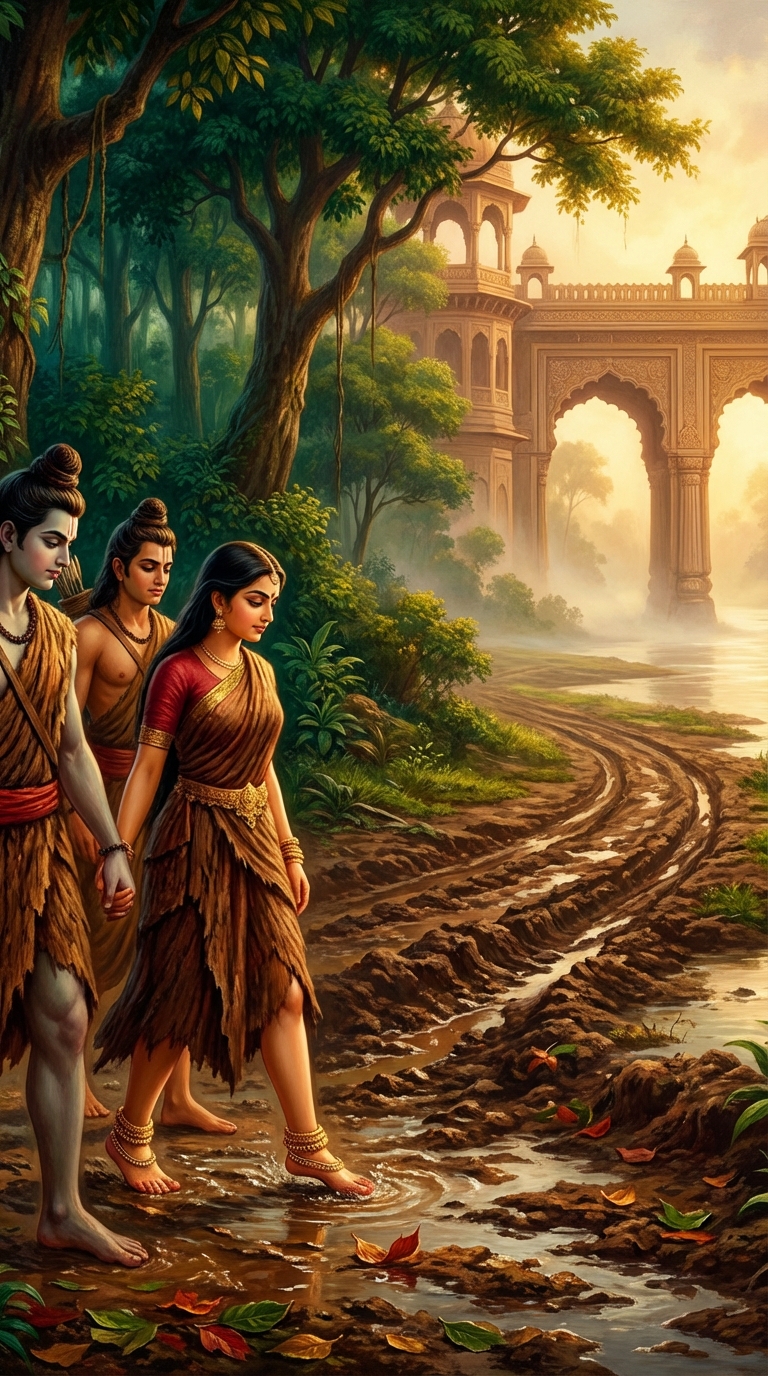
Pressured by his wife Kaikeyī, King Daśaratha exiles Rāma for fourteen years, and soon dies of grief. Rāma, accompanied by Sītā and Lakṣmaṇa, goes into the forest. There, Sītā is abducted by the demon king Rāvaṇa. Rāma forms an alliance with the monkey-king Sugrīva, invades Laṅkā, kills Rāvaṇa, and rescues Sītā.
The Sarayu river exhales a thick, cold mist smelling of wet silt, crushed lotus stems, and the distant, metallic tang of slaughter-blood from the morning rituals. It is the hour before dawn in Ayodhya. The heavy wooden wheels of grain-carts grind against the basalt paving stones, pulled by white oxen whose flanks heave under the yoke, their breath blooming in the chill air. The city operates as a flawless machinery of prosperity, oiled by custom and sweat. Gold merchants unroll their silk awnings. Temple bells strike a single, resonant note that shivers through the damp courtyards, startling the peacocks on the parapets. Everything remains exact, rigorously ordered, and deeply rooted in the heavy, black soil of Kosala.
Inside the private chambers of the palace, King Daśaratha sits entirely still, trapped in the center of this vast perfection. The marble floor radiates a creeping cold that settles deep into his joints. He sits as an old man suffocating under the weight of his own unyielding promises. In the shadows near the balcony, Queen Kaikeyī watches him. She does not speak, nor does she need to. Her stillness operates as a physical pressure, pressing against his throat like the flat edge of a blade. The oil lamps flicker in the drafts, casting long, warped shadows across the bright frescoes of his victorious, long-dead ancestors.
He feels the precise grain of his disaster. Two boons, granted long ago in the heat of a forgotten battle, are now called in to sever his bloodline. He must crown his son Bharata. He must banish his eldest, Rāma, to the Dandaka forest for fourteen years. Daśaratha presses his palms against the heavy gold embroidery of his robes, seeking some anchor in the material wealth of his station. His lungs rattle with a shallow, panicked rhythm. He realizes, with a sudden terror tasting of copper in the back of his throat, that absolute power functions merely as the capacity to be absolutely destroyed by one’s own spoken word.
The decree manifests not in grand pronouncements, but in the rough, fibrous weave of bark-cloth. The servant who carries the unrefined garments into the chamber keeps his eyes fixed on the floor, his bare hands trembling as he offers up the drab uniform of a forest ascetic. Rāma reaches out and takes the cloth. The courtiers hold their breath, creating a vacuum of silence in the great hall. The pristine silk robes of the crown prince slide to the stone floor with a soft, hissing whisper. Rāma wraps the coarse bark around his waist. The rigid wood-fibers scrape against his skin, leaving faint red welts across his collarbone. This embodies the texture of duty—abrasive, sudden, and entirely irreversible.
Beside him, Lakṣmaṇa’s knuckles drain of color as he grips his ivory-backed bow, the polished wood groaning under the pressure of unreleased violence. But Sītā seals the fracture in the world. She steps forward, her heavy gold ankle-bells striking a crystalline chime that cuts cleanly through the suffocating silence, and reaches for her own ascetic dress. She strips away the sheer muslin, the rubies, and the pearls without a downward glance. The rustle of dead wood fibers rubbing against her bare shoulders rings out as the loudest sound in the room. The kingdom does not shatter; it simply passes over the threshold, out of the manicured courtyards, and into the brutal indifference of the wild.
The Dandaka forest swallows them in a canopy of bruised greens and suffocating shadows. The soil beneath their feet runs black and spongy with rot, vibrating constantly with the manic, deafening screech of cicadas. When the golden deer flashes through the dense teak trees, it explodes as a burst of impossible, hypnotic light against the gloom. Sītā points. Rāma draws his bow, the taut string singing a high, fatal note as he steps deep into the foliage, leaving her alone by the hut. The trap snaps shut. A colossal shadow obliterates the afternoon sun across the hermitage threshold. Rāvaṇa descends. Sītā struggles, her jasmine garland tearing, the white petals scattering like dropped pearls into the violent, churning dust as she is dragged bodily into the sky.
The aftermath distills into cold, kinetic motion. Rāma reads the violence in the crushed ferns and the severed, bleeding wing of the great vulture Jatayu. His grief hardens into iron. An alliance is sealed with cold water scooped from the muddy banks of Lake Pampa. Soon, a million monkeys march to the coastline, hurling shattered mountain peaks and uprooted sal trees into the churning, black ocean. The coastal air reeks of sea-salt, crushed limestone, and wet fur. The bridge forms, rock by jagged rock, slicing a violent path through the foaming waves. The army marches across the spine of the sea, bare feet and rough paws slipping on stone slick with sea-foam, heading straight toward the fortified basalt walls of Laṅkā.
The invasion unfolds as a deafening symphony of butchery. Bronze shatters against bone. Rāma’s chariot wheels grind fiercely over the discarded armor of demons, churning the earth into a slick mire of blood and shattered gold. Rāvaṇa charges out, unleashing a terrifying tempest of arrows and fury, but Rāma’s final shaft tears through the shrieking air, burying itself deep inside the demon king's chest. The tyrant falls, and the earth shudders violently under the impact. When the dense smoke finally clears, Sītā steps forward from the falling ash. Her face remains pale, her dress heavily stained with the soot of long captivity, but her dark eyes remain entirely unblinking, locking onto Rāma across the corpse-strewn field.
But the towering architecture of their victory builds itself upon the foundation of an earlier, quieter collapse. Miles away and months before, back in the silent halls of Ayodhya, the king who set this massive machinery into motion had finally succumbed to his isolation. The narrative does not look away from the precise, devastating mechanics of a broken heart. It renders Daśaratha’s final moment alone in his royal chambers with a luminous, surgical clarity, reducing the end of a vast reign to a single, breathless image:
nirviṣṭaviṣayasnehaḥ sa daśāntamupeyivān āsīdāsannanirvāṇaḥ pradīpārcirivoṣasi
Having burned entirely through the slick oil of earthly attachments, the old king reaches the charred end of his wick. He flickers in the dark and goes out, exactly like the pale, struggling flame of a lamp facing the overwhelming, obliterating light of dawn. The genius of the simile lies in its quiet inevitability. Daśaratha does not die in a glorious storm of tragic violence; he simply runs out of fuel. The kingdom’s new dawn obliterates the small, exhausted flame of a man who traded his life for a promise. The war in Laṅkā screams with brass and blood, but the truest devastation happens in the total silence of a dying lamp.
The mechanics of power remain eternally brutal, constantly demanding the sacrifice of the personal upon the altar of the political. We still bind ourselves to impossible promises that tear our lives apart, mistaking stubbornness for honor, and pride for duty. The wilderness is never truly an external geography. It operates as the dark space we enter the precise moment we strip away the protective silks of our given lives and face the raw consequences of our loyalties. Sītā’s sudden abduction, Rāma’s relentless march across the raging sea, the burning of a towering demon city—all of it functions as the agonizing labor required to reclaim what slips away in a single moment of weakness.
Yet, what is rescued rarely matches exactly what was taken. The fire that burns down an empire also burns the gentle innocence out of love. We build impossible bridges across unfathomable waters, we slaughter our personal demons, and we stand victorious in the settling ashes of our enemies. But we are always left staring at the people we love through a thick veil of smoke, wondering exactly how much of ourselves we had to destroy to get them back.