Chapter 11 of 19
The sage Viśvāmitra takes the young princes Rāma and Lakṣmaṇa to his hermitage to protect his sacrifices from demons. After they succeed, Viśvāmitra takes them to Mithilā for the svayaṃvara of Princess Sītā. There, Rāma effortlessly breaks the divine bow of Śiva, a feat no other king could accomplish, and wins Sītā as his bride.
Rāma watches the smoke from Viśvāmitra’s altar drift through the canopy of sal trees, a gray thread against the bruising purple of the twilight sky. The heat of the sacrificial flame bakes the damp earth, releasing the sharp scent of crushed pine needles and clarified butter. For three days, the young prince grips his bowstring. His fingers, accustomed to the oiled sandalwood of the palace columns in Ayodhya, now carry the hardening yellow calluses of the wilderness. He breathes in the smoke, tasting the bitter edge of burnt barley. The forest presses close, thick with the clicking of cicadas and the erratic rustle of things moving through the underbrush. He listens for the snap of a twig that will signal the demons’ return.
He shifts his weight, the silver anklets of his childhood long removed, his bare feet planted in the loam. Lakṣmaṇa stands ten paces away, a silhouette against the firelight, his jaw clenched so tightly the muscle flickers like a pulse. They are boys thrust into the brutal geometry of adult obligations. Viśvāmitra sits entirely motionless by the fire, his eyes closed, his breathing indistinguishable from the wind in the upper branches. The sage demands perfection in the ritual, absolute silence, and a violence so swift it leaves no stain on the ritual ground. Rāma feels the heavy drag of the damp air in his lungs. He waits.
When the canopy violently thrashes, bringing down a shower of torn green leaves and the stench of raw, spoiling meat, Rāma does not flinch. He draws the bowstring back to his ear, feeling the hemp bite into his blistered thumb. The release is a single, clean vibration that sings through the bones of his forearm. The plunging shadow shrieks once, a sound like tearing silk, and crashes into the thicket beyond the firelight. Viśvāmitra pours another ladle of ghee onto the flames. The fire surges higher, illuminating the unblinking, dark eyes of the prince. The sacrifice is safe. The boys have become men, and the sage finally opens his eyes, turning his gaze toward the northeast. Toward Mithilā.
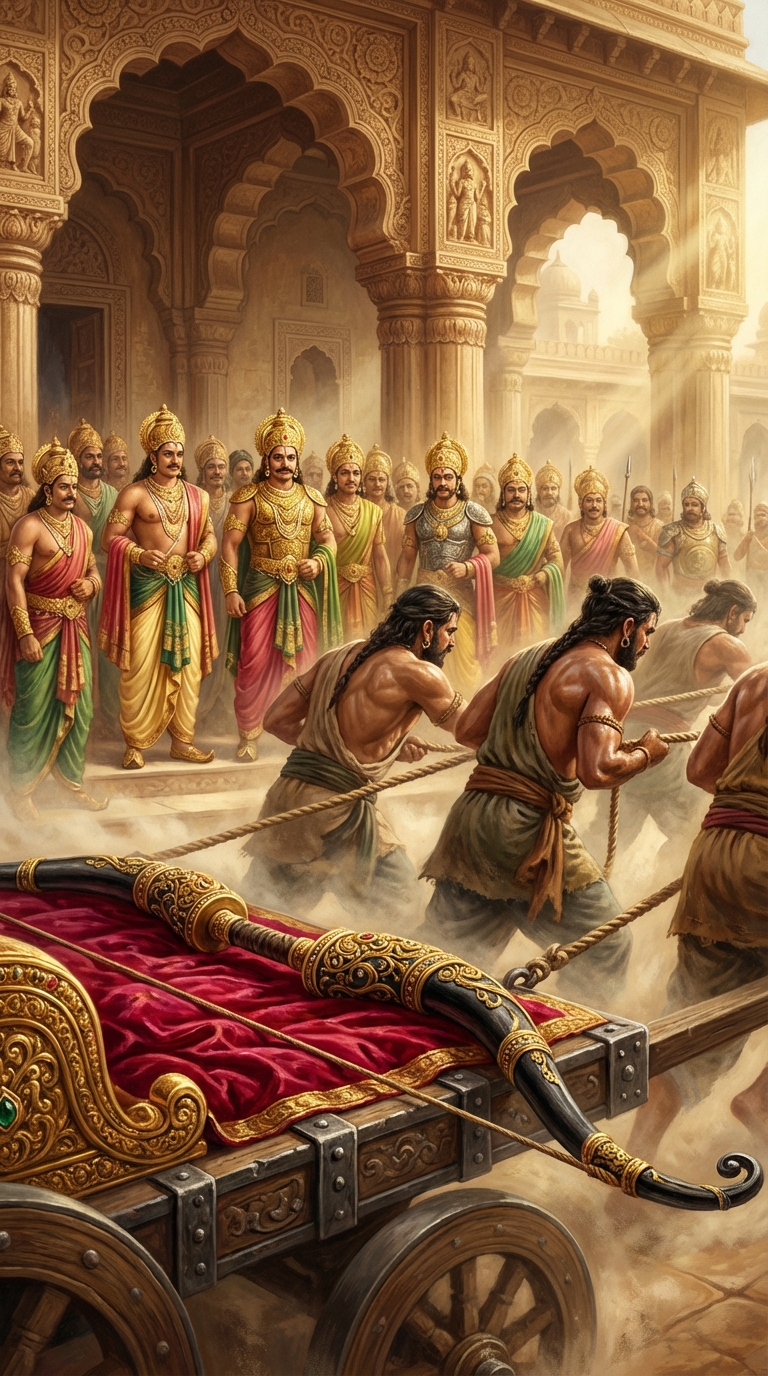
King Janaka stares at the object strapped to the chassis of the iron cart resting in the center of the flagstone courtyard. Its eight iron wheels sink slightly into the grooves worn by generations of failing kings. The bow of the destroyer is not merely a weapon; it is a geological fact, dark as a monsoon cloud and thick as the trunk of a banyan. It radiates a cold, metallic lethargy. Janaka traces the intricate silver filigree at the grip, feeling the chill bite into his fingertips. The scent of crushed marigolds and wet dust rises from the arena floor, where fifty princes have already dragged their boots in frustration. The king’s oath hangs in the heavy morning air: only the man who can bend this mass of horn will marry his daughter.
On the shaded limestone balcony above, Sītā watches the procession of disgraced suitors. The heavy garland of blue lotuses rests across her forearms, the petals already bruising from the heat of her skin. She is trapped by her father’s piety, anchored to this brutal spectacle of masculine inadequacy. She observes a king from the western provinces step up to the cart, his face slick with sweat, his chest expanding under heavy brocade. He grasps the upper horn of the bow. The veins in his neck bulge, coloring his skin a deep, mottled crimson. He pulls. His leather sandals slip on the flagstones with a sharp, humiliating squeak. The bow remains utterly inert, mocking the physics of his exertion.
Janaka closes his eyes, listening to the collective exhale of the assembly as the western king steps back, rubbing his torn palms. The king of Mithilā feels the weight of his own decree pressing down upon his shoulders, heavy as the unyielding bow. He had gambled his daughter’s future on a legend, hoping the earth would provide a son capable of matching the girl he had yielded from the furrow. Instead, the courtyard smells of sour sweat, bruised egos, and the creeping rot of a dynasty without a future. If no man can bend the horn, Sītā remains unwed, a living monument to an oath that will suffocate them both.
The murmur of the crowd abruptly ceases when Viśvāmitra strides into the courtyard, followed by the two slender youths from Ayodhya. Rāma moves with a quiet, devastating economy of motion. He does not glare at the competing kings or puff his chest for the balcony; he simply walks to the iron cart as if approaching a familiar horse. The dust settles around his ankles. He stops, looking down at the immense weapon. He does not smell the panic of the other suitors; he smells only the cold iron and the faint, dusty scent of the blue lotuses drifting down from the balcony above. Sītā leans forward against the limestone balustrade, her knuckles white, her breath catching in her throat.
Viśvāmitra halts at the edge of the crushed marigolds, locking eyes with the prince. He speaks a single, flat command that cuts through the murmuring crowd: String. Rāma reaches out. He does not brace his legs or widen his stance. He slips his hand around the dark, filigreed grip. The crowd leans in, a thousand bodies shifting on the wooden bleachers, the rustle of their silk garments sounding like a sudden gust of wind. Rāma lifts the heavy horn. The iron wheels of the cart groan in protest as the immense weight leaves the chassis. He holds it vertically, letting the sheer mass of it rest in his palm. The kings in the front row stop breathing. He slides his left hand to the upper curve, placing his right hand on the heavy silken cord, and applies pressure.
The curvature yields. The impossible, calcified horn bends inward, a smooth, terrifying arc of submission. Rāma pulls the string toward his chest. The tension builds, a physical force that sucks the air from the courtyard. And then, the flaw in the fabled weapon betrays itself. The breaking of the bow is not a crack, but a deafening, percussive detonation that slams into the chests of every man present. A shockwave of sound shatters the silence, echoing off the stone walls like a lightning strike on a mountain peak. The two halves of the shattered bow drop from Rāma’s hands, clattering uselessly against the flagstones. He stands amidst the reverberation, perfectly still, looking up at the balcony.
līlayā sa babhañja kārmukaṃ bālakuñjara ivākṣukāṇḍakam
With effortless grace he shatters the great bow, snapping the petrified horn just as a young elephant calf playfully crunches through a thick stalk of sugarcane. The image captures the devastating lightness of absolute strength. It refuses to speak of sweating muscle, gritted teeth, or desperate exertion, relying instead on a terrifying, natural inevitability. The young elephant does not strategize against the sugarcane, nor does it summon a grand cosmic will to conquer the fibrous stalk; it merely acts according to the reality of its own body, entirely unaware of its overwhelming power. The destruction of the unbreakable object is casual, almost innocent, completely devoid of malice or pride. The universe simply yields to the boy because he is exactly who he is.
The physical truth of the metaphor lies in its stark contrast with the preceding failures. The other kings approached the bow as a bitter adversary, treating the dark horn as a fortress to be besieged through pure kinetic fury. Rāma approaches it as a child in a garden. The world-anchoring weight of a god's wrath shrinks to a sweet, brittle reed in the hands of this quiet prince. He does not conquer the weapon; he outgrows it in a single motion. When the wood splinters and the dust rises, the assembly understands they have not merely witnessed a feat of strength, but a fundamental realignment of the physical world. The boy dismantles the past without a drop of sweat.
Every act of union begins with a fracture. To claim a future, the rigid architectures of the past must be definitively broken. The breaking of the bow is the sound of childhood ending, the violent threshold between the boy who follows his master and the king who must eventually face the forest alone. It is the paradox of duty: the very strength required to protect the world is the same force that continually shatters it. The fragments of the archaic weapon on the courtyard floor are the price of passage, the inevitable wreckage left behind when human will strikes against the immovable demands of history.
We haul these inherited weights into the center of our lives, challenging ourselves to string the unstringable, believing our worth is measured by the strain in our muscles and the blood on our palms. Yet true sovereignty never announces itself with a struggle. It arrives as a quiet alignment of breath and bone, a momentary grace that snaps the impossible in half without a second thought. The future is not wrestled from the earth by the loudest exertion; it is simply lifted by those who understand that the crushing weight of history is just a brittle reed, waiting for the right hands to break it.