Chapter 31 of 126
The tusk and the trumpet—the lethal management of the war-elephant, the biological tank of the ancient world that shatters the enemy's resolve.
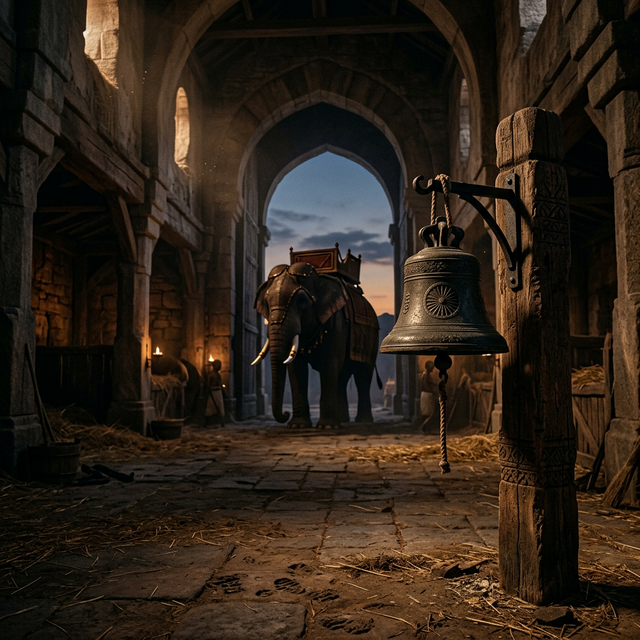
The royal elephant stables of Pataliputra are a world of deep shadows and the low, vibrational rumble of giants shifting in their stalls. Here, the Hastyadhyakshah, the Superintendent of Elephants, presides over an environment where the titans of the empire are strictly audited. This is "The Tusk and the Trumpet," a place where the state’s massive power is literalized in the volume of a flank. Kautilya leads the Prince past the high, arched entrances where the scent of crushed sugarcane and the earthy musk of wet hide hang heavy in the air. In this stable, the state does not just house beasts; it maintains engines of fortification. The "standard of the double-height stable" is the measure of the state’s forensic and colossal control.
A single, heavy bronze bell, its surface engraved with the royal chakra and its tongue silent but ready to chime, rests on a wooden post. This object is the stake of the empire’s control over the "siege-craft of the subject": it is the "Vessel of Immensity." Kautilya explains that the state is the ultimate master of the "destroyer of enemy's forts." He points to the geometric precision of the construction: the stable is built to be "twice as broad and twice as high as the length of an elephant," with separate apartments for the females.
To Kautilya, an elephant is not just a beast but a "node of immovable siege." The stability of the Maurya vanguard is built upon this "titan ledger." A superintendent who allows the "urine and dung" to pile up or who neglects the "remove of the waste" is a man who is rotting the King’s strength.
The action of the stable is a forensic monitoring of hygiene and care. Kautilya walks the Prince through the square courtyards where the posts are "smooth and paved with wooden planks" to protect the giants' feet. They watch as the elephant-doctors (hastivaidya) prepare the medical rations and the trainers (hastipaka) practice the warlike feats. It is a world of strict logistical liability: "The space where an elephant lies down shall be as broad as the length of an elephant." They see the specialized labor: the "drivers, binders, and grooms" who manage the "accoutrements and ornaments." It is a technical, industrial discipline: the state measures the "rhythm of the giant" as precisely as it measures the "weight of the grain," ensuring that the corps is a source of awe as much as labor.
But the stable is also a center of total surveillance and forest protection. Kautilya points to the "separate apartments for female elephants," explaining that the state must manage even the "reproduction of the titans" to ensure the continuity of the corps. The Prince realizes that "The Tusk and the Trumpet" is the ultimate expression of the "Duties of Government Superintendents"—the place where the state’s power to "engineer and protect" is literalized in the height of a stable wall. The King’s power is the power to "appoint the best elephant-doctor" and to ensure that the "readiness for the charge" is as regulated as the price of iron. "The Tusk and the Trumpet" is the formidable conscience of the state, captured in the "rumble of the shadows" that binds the forest to the Crown.
There shall be constructed an elephant stable twice as broad and twice as high as the length of an elephant... provided with holes for the removal of urine and dung. The space where an elephant lies down shall be as broad as the length of an elephant... provided with a flat form raised to half the height of an elephant for leaning on.
This is the rule of the mega-fauna regulation, the documentation for a world where "unmonitored giants" are the enemy of the state. It says that the "Superintendent of Elephants" must be a scientist of scale, and that the "separate apartments" are as strategic as a mountain pass. It recognizes that "bells" and "smooth posts" are the nodes of a network of immensity that connects the King to "The Tusk and the Trumpet." The state stable, with its "projected entrances" and its "Superintendent of Elephants," is the physical evidence of this discipline. The men who need such a rule are those who have understood that the state's strength is first housed, then deployed.
The logic of the tusk is the logic of the "Duties of Government Superintendents." It completes the transition from the architecture of the stallion to the architecture of the immovable siege. It assumes that if you can master the "titans of the subcontinent" and the "geometric precision of the stall," you can master the breaking of any wall in the world. The state is no longer a master of the pace; it is a master of the presence.
The canto concludes on the image of a war-elephant having its massive tusks capped with heavy iron bands in the torchlight of the courtyard. A large bronze bell is hung from a leather strap around its neck, chime-less in the stillness but resonant with the promise of the march. The giant elephant rumbles, a vibration that shakes the very ground of Pataliputra, a resonant, colossal echo of the state's will. Kautilya looks at the "net balance" of the evening’s grooming and sees the resilient power of the Mauryas written in the shadows of the stable.
Outside, the moon rises over the elephant-forests on the horizon. But inside "The Tusk and the Trumpet," the world is categorized, engineered, and secure. The Prince walks back from the stalls, his mind full of heights and rumbles. He has seen the bronze bells, and he has heard the lowing of the giants. He now knows that the empire is held together not just by gold or iron, but by the "uniform texture" of the presence and the unblinking eye of the man who knows exactly what it means to be an elephant in the King's stable.