Chapter 32 of 126
The training of the Great—a pedagogical guide to preparing the royal animals for the chaos of the battlefield and the ceremony of the court.
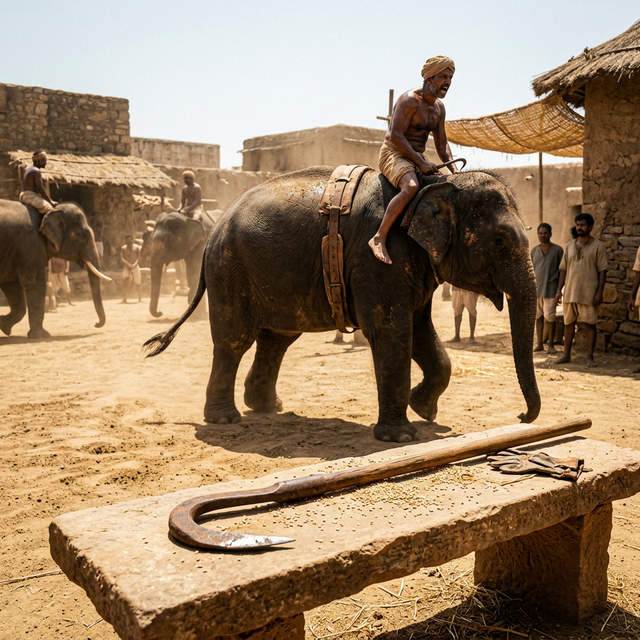
The training grounds of the Mauryan elephant corps at midday are a world of rhythmic shouting and the heavy, bone-deep thud of giants practicing the "turning." Here, under the watchful eye of the Hastyádhyaksha, the wild power of the forest is systematically broken and reassembled into the power of the state. This is "The Training of the Great," a place where the elephant’s biology is literalized into an engine of siege. Kautilya leads the Prince past the wide, dusty arenas where young elephants are being put through their paces, the air thick with the smell of kicked-up earth and the copper tang of sweat. In this field, the state does not just own strength; it manufactures obedience. The "discipline of the seven modes" is the measure of the state’s forensic and kinetic control.
A single, heavy iron hook (totra), its point sharpened to a needle-precision and its wooden handle worn smooth by the grip of a thousand mahouts, rests on a stone bench. This object is the stake of the empire’s control over the "will of the behemoths": it is the "Vessel of Compliance." Kautilya explains that the state is the ultimate master of the "warfare of the giants." He points to the systematic classification of movements: the "advancing," the "trampling down," and the "assailing of forts." To Kautilya, an elephant is not just an animal but a "unit of calculated devastation." The stability of the Maurya border is built upon this "lethal ledger." A trainer who cannot teach the "turning" or the "fighting with other elephants" is a man who is blunting the King’s primary weapon.
The action of the training ground is a forensic monitoring of progress. Kautilya walks the Prince through the drill where elephants are taught to "suffer a man to mount" in seven distinct groups. They watch as the "kunjaropaváhya" giants learn to stand still while a rider climbs over them, their massive flanks quivering but held in check by the "binding of the girths." It is a world of strict technical liability: every movement, from the "trotting" to the "moving by a staff," is categorized and timed. They observe the "warlike feats": the systematic practice of "killing" and the simulated "assailing of cities." It is a technical, military discipline: the state measures the "precision of the charge" as precisely as it measures the "weight of the grain," ensuring that the giants are a source of terror as much as order.
But the training is also a center of psychological conditioning. Kautilya points to the "putting on of collars" and the "working in company with the herds," explaining that the state must manage even the "social psychology of the behemoths" to ensure peak tactical performance. The Prince realizes that "The Training of the Great" is the ultimate expression of the "Duties of Government Superintendents"—the place where the state’s power to "discipline and deploy" is literalized in the weight of a giant's foot. The King’s power is the power to "appoint the best mahout" and to ensure that the "readiness for siege" is as regulated as the price of iron. "The Training of the Great" is the calculated conscience of the state, captured in the "heavy thud of the practice-charge" that binds the frontier to the Crown.
Binding the elephants with girths, putting on collars, and making them work in company with their herds are the first steps... Elephants trained for riding fall under seven groups: that which suffers a man to mount over it... that which is taught trotting... that which can be made to move by using an iron hook.
This is the rule of the colossal conditioning, the documentation for a world where "unmanaged strength" is the enemy of the state. It says that the "Training of Elephants" must be a science of coercion, and that the "iron hook" is as strategic as a mountain pass. It recognizes that "girths" and "collars" are the nodes of a network of force that connects the King to "The Training of the Great." The state training ground, with its "shouting mahouts" and its "Superintendent of Elephants," is the physical evidence of this discipline. The men who need such a rule are those who have understood that the state's strength is first broken, then directed.
The logic of the training is the logic of the "Duties of Government Superintendents." It completes the transition from the architecture of the giant's stable to the architecture of the imperial assault. It assumes that if you can master the "behemoths of the subcontinent" and the "forensic precision of the drill," you can master the conquest of any horizon. The state is no longer a master of the presence; it is a master of the motion.
The canto concludes on the image of a massive war elephant standing perfectly still in the center of the arena, its training complete for the day. A shower of blunt practice-arrows falls around it, some bouncing off its thick, grey hide, yet the beast does not flinch, its eyes calm and focused on the mahout's hook. The giant breathes—a resonant, rhythmic vibration that echoes the heartbeat of the empire. Kautilya looks at the "net balance" of the day’s drills and sees the resilient reach of the Mauryas written in the discipline of the beast.
Outside, the sun begins to set over the practice fields, casting long, giant shadows across the dust. But inside "The Training of the Great," the world is categorized, disciplined, and secure. The Prince walks back from the arena, his mind full of hooks and girths. He has seen the iron hooks, and he has heard the rumbles of the behemoths. He now knows that the empire is held together not just by gold or iron, but by the "uniform texture" of the discipline and the unblinking eye of the man who knows exactly what it means to be a trained giant in the King's service.