Chapter 30 of 126
The rhythm of the stallion—how the training and care of the royal cavalry turns a beast of burden into a decisive engine of war.
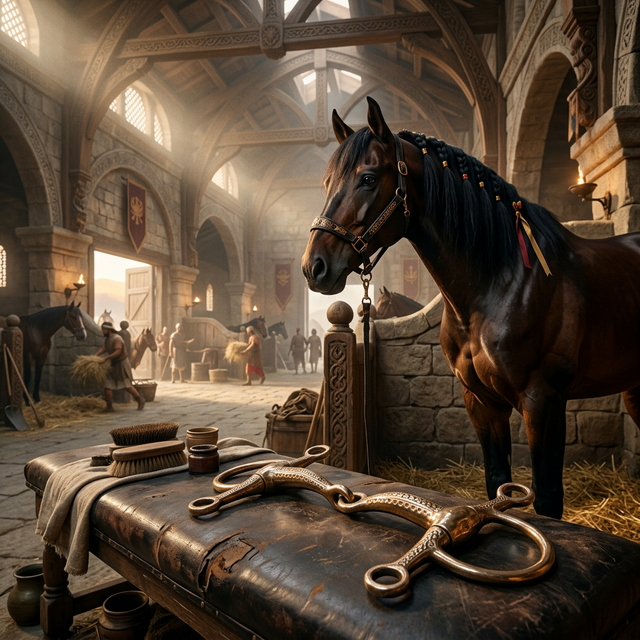
The royal stables of Pataliputra at dawn are a world of rhythmic breathing and the sharp, clean scent of fresh hay and crushed linseed. Here, the Ashvadhyakshah, the Superintendent of Horses, presides over an environment where the speed of the empire is strictly audited. This is "The Rhythm of the Stallion," a place where the state’s reach is literalized in the power of a gallop. Kautilya leads the Prince past the long, stone-lined stalls where stallions are being groomed, the air thick with the sound of hooves on packed earth and the rhythmic thud of a curry-comb. In this stable, the state does not just own horses; it manufactures pace. The "standard of the thirty-two angula face" is the measure of the state’s forensic and kinetic control.
A single, finely balanced bronze bit, its surface polished to a mirror-sheen and its joints moving with a silent, oiled precision, rests on a leather bench. This object is the stake of the empire’s control over the "velocity of the subject": it is the "Vessel of Response." Kautilya explains that the state is the ultimate master of the "horses from Kamboja, Sindhu, and Aratta." He points to the systematic classification: those of "best, medium, and lower sizes." To Kautilya, a horse is not just an animal but a "unit of imperial distance." The stability of the court is built upon this "equine ledger." A superintendent who cannot account for the "measurement of the shank" or the "rations of clarified butter" is a man who is slowing the King’s command.
The action of the stable is a forensic monitoring of health. Kautilya walks the Prince through the feeding-ground where every horse is provided with a "drink of clarified butter and flour" according to its size. They watch as the colts are fed a "kudumba of flour mixed with milk" till they become three years old.
It is a world of strict medical liability: whenever a horse is "diseased or infirm," the Superintendent must provide "medicine for ten nights." They observe the "physical standards": the face of the best horse must measure "32 angulas," its length "5 times its face," and its height "4 times its shank." It is a technical, biometric discipline: the state measures the "rhythm of the gallop" as precisely as it measures the "depth of the coffer," ensuring that the cavalry is a source of swiftness as much as strength.
But the stable is also a center of strategic coordination. Kautilya points to the "training of the colt" and the "grooming of the stallion," explaining that the state must manage even the "meadow grass" to ensure peak performance. The Prince realizes that "The Rhythm of the Stallion" is the ultimate expression of the "Duties of Government Superintendents"—the place where the state’s power to "measure and accelerate" is literalized in the length of a horse's stride. The King’s power is the power to "appoint the best groom" and to ensure that the "readiness for battle" is as regulated as the price of grain. "The Rhythm of the Stallion" is the kinetic conscience of the state, captured in the "beat of the hooves" that binds the frontier to the Crown.
The face of the best horse measures 32 angulas; its length is 5 times its face; its shank is 20 angulas; and its height is 4 times its shank. For the first three days... it shall be fed with a prastha of flour and made to drink oil mixed with medicine. A colt, ten days old, shall be given a kudumba of flour mixed with clarified butter.
This is the rule of the equine regulation, the documentation for a world where "unmonitored inertia" is the enemy of the state. It says that the "Superintendent of Horses" must be a scientist of momentum, and that the "32 angula face" is as strategic as a mountain pass. It recognizes that "bits" and "linseed rations" are the nodes of a network of speed that connects the King to "The Rhythm of the Stallion." The state stable, with its "lofty ceilings" and its "Superintendent of Horses," is the physical evidence of this discipline. The men who need such a rule are those who have understood that the state's strength is first measured, then unleashed.
The logic of the stallion is the logic of the "Duties of Government Superintendents." It completes the transition from the architecture of the biological reserve to the architecture of the imperial response. It assumes that if you can master the "steeds of the subcontinent" and the "medical precision of the ration," you can master the time it takes for justice to reach the edge of the world. The state is no longer a master of the pulse; it is a master of the pace.
The canto concludes on the image of a messenger disappearing into the dusk on a horse of the "best measurement," the dust of his departure settling slowly in the cooling air. The horse’s hooves strike the stone road with a rhythmic, disciplined clarity, a resonant, metallic vibration that echoes the heartbeat of the empire. Kautilya looks at the "net balance" of the day’s training and sees the resilient reach of the Mauryas written in the silence of the road.
Outside, the stars are beginning to bloom over Pataliputra. But inside "The Rhythm of the Stallion," the world is categorized, measured, and secure. The Prince walks back from the stalls, his mind full of shanks and butter. He has seen the bronze bits, and he has heard the breathing of the colts. He now knows that the empire is held together not just by gold or iron, but by the "uniform texture" of the speed and the unblinking eye of the man who knows exactly what it means to be a horse in the King's stable.