Chapter 33 of 126
The chariot's path—the technical regulation of the King's transport, ensuring his movement is as swift and steady as the cosmic order.
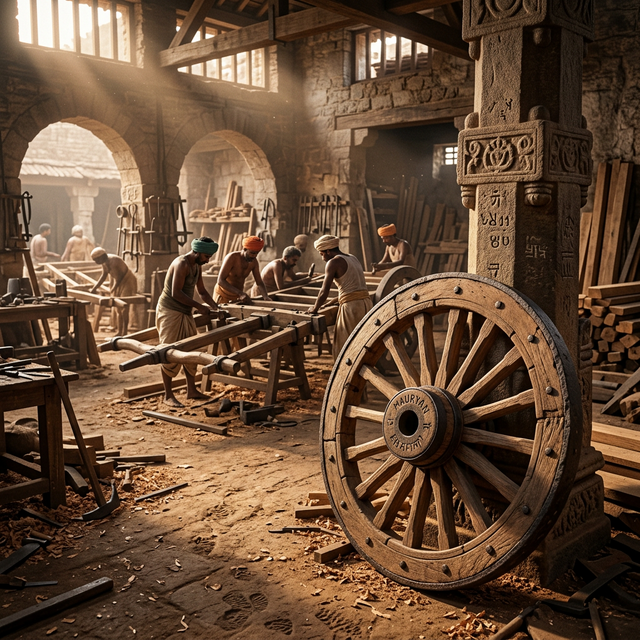
The chariot workshops of Pataliputra at dawn are a world of seasoned timber and the sharp, rhythmic ringing of hammers against iron rims. Here, the Rathádhyaksha, the Superintendent of Chariots, presides over an environment where the mobility of the state is strictly audited. This is "The Chariot's Path," a place where the King’s velocity is literalized in the spin of an axle. Kautilya leads the Prince past the long aisles of half-assembled frames, the air thick with the scent of boiled wood and the fine dust of sawdust. In this workshop, the state does not just build vehicles; it engineers momentum. The "standard of the ten-hand height" is the measure of the state’s forensic and mechanical control.
A single, perfectly balanced chariot wheel, its iron tire bound tightly to the spokes and its hub hollowed for a copper axle, rests against a workshop pillar. This object is the stake of the empire’s control over the "friction of the subject": it is the "Vessel of Balance." Kautilya explains that the state is the ultimate master of the "war-chariot, the travel-chariot, and the training-chariot." He points to the geometric hierarchy: the best chariot is built to be "ten hands in height and twelve purushas in width," with seven more sizes decreasing successively down to six hands.
To Kautilya, a chariot is not just a carriage but a "mobile altar of power." The stability of the Maurya charge is built upon this "vehicular ledger." A superintendent who cannot account for the "wages of the carpenters" or the "efficiency of the shoot" is a man who is derailing the King’s path.
The action of the workshop is a forensic monitoring of construction and drill. Kautilya walks the Prince through the open courtyard where crews are being trained in "shooting arrows and hurling clubs" while seated on the moving platforms. They watch as the "battle-chariots" (sángrámika) are tested for their response to the reins and the "festal chariots" (pushyaratha) are inspected for their balance. It is a world of strict logistical liability: the Superintendent must "attend to the accounts of provision" for both the permanent and temporary labor. They observe the "training of the troops": the systematic practice of "controlling chariot horses" and "fighting seated." It is a technical, tactical discipline: the state measures the "precision of the wheel-span" as precisely as it measures the "depth of the coffer," ensuring that the corps is a source of speed as much as siege.
But the workshop is also a center of social and strategic coordination. Kautilya points to the "maintenance of the employed," explaining that the state must keep the artisans "contented and happy by adequate reward" to ensure the reliability of the machines. The Prince realizes that "The Chariot's Path" is the ultimate expression of the "Duties of Government Superintendents"—the place where the state’s power to "engineer and motivate" is literalized in the smoothness of a ride. The King’s power is the power to "ascertain the distance of roads" and to ensure that the "readiness for the march" is as regulated as the price of grain. "The Chariot's Path" is the kinetic conscience of the state, captured in the "spinning of the iron rims" that binds the center to the frontier.
He shall also construct chariots of gods, festal chariots, battle chariots, travelling chariots, chariots used in assailing an enemy's strong-holds, and training chariots... decreasing by one purusha successively down to a chariot of 6 purushas in width... maintain the employed contented and happy by adequate reward.
This is the rule of the vehicular regulation, the documentation for a world where "mechanical failure" is the enemy of the state. It says that the "Superintendent of Chariots" must be a scientist of balance, and that the "successive decrease in width" is as strategic as a mountain pass. It recognizes that "axles" and "iron tires" are the nodes of a network of speed that connects the King to "The Chariot's Path." The state workshop, with its "contented artisans" and its "Superintendent of Chariots," is the physical evidence of this discipline. The men who need such a rule are those who have understood that the state's strength is first manufactured, then unleashed.
The logic of the chariot is the logic of the "Duties of Government Superintendents." It completes the transition from the architecture of the elephant's stall to the architecture of the imperial assault. It assumes that if you can master the "width of the purusha" and the "forensic precision of the bowshot," you can master the navigation of any terrain in the world. The state is no longer a master of the presence; it is a master of the path.
The canto concludes on the image of a massive war-chariot, its twelve-purusha width spanning the workshop floor, standing ready in the deepening dusk. Its iron tires are cold and hard, and its wooden frame stands with a silent, heavy balance. The workshop falls quiet, the only sound the distant, low rattle of a single wheel being rolled into storage. Kautilya looks at the "net balance" of the day’s labor and sees the resilient reach of the Mauryas written in the geometry of the machine.
Outside, the first stars reflect in the river Gange. But inside "The Chariot's Path," the world is categorized, engineered, and secure. The Prince walks back from the floor, his mind full of purushas and axles. He has seen the balanced wheels, and he has heard the training of the bowmen. He now knows that the empire is held together not just by gold or iron, but by the "uniform texture" of the path and the unblinking eye of the man who knows exactly what it means to be a chariot in the King's corps.