Chapter 21 of 126
The invisible walls of the frontier, where the collection of tolls and the oversight of merchants protect the state's economic integrity.
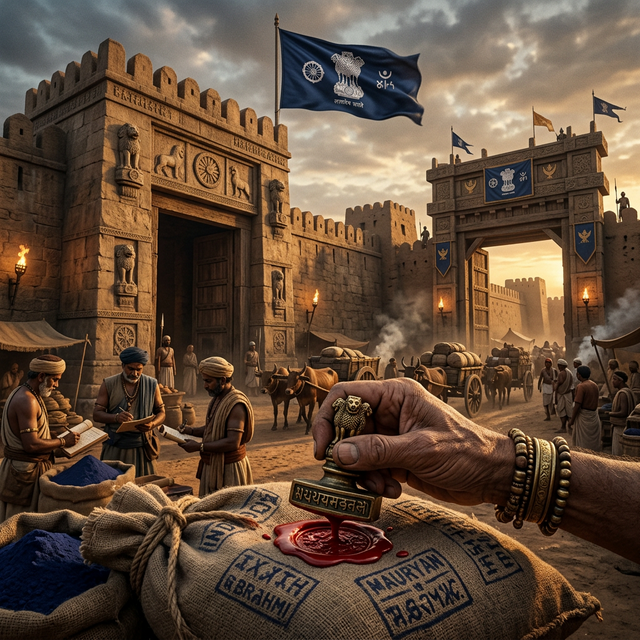
The custom house, the Sulkasálá, sits like a stone sentinel just to the east of the great city gate. Above its heavy timber doors, a flag snaps in the dry Magadha wind, its silk surface marked with the heraldry of the Mauryas. This is the "Threshold of Customs," the mandatory bottleneck where the commerce of the world must surrender its anonymity and its taxes to the state. The air here is filled with the smell of dust, sweat, and the faint, expensive scent of foreign resins. Kautilya leads the Prince past a line of heavy, ox-drawn carts, each one draped in coarse hemp. This is the place where the King's revenue is extracted not from the earth, but from the transaction itself.
In this building, silence is replaced by the "triple cry" of the auctioneer, and the merchant’s profit is audited grain by grain.
A single, sealed bag of North-Western wool, its surface stamped with the merchant’s own mark, rests on a stone bench near the flag-post. This object is the stake of the state’s fiscal order: it is the primary evidence of the declaration. Kautilya explains that the toll-house is a theater of honesty enforced by terror. If a merchant lowers the price of his goods to avoid a "heavy toll," the state does not merely demand the difference; it takes the excess profit or levies an "eightfold fine." The stability of the treasury is measured in the "standard of the declaration." To Kautilya, the merchant is a partner whose loyalty is as volatile as the market itself.
A superintendent who cannot spot "valuable merchandise covered over with a layer of an inferior one" is a man who is allowing the King’s life-blood to leak away.
The action of the custom house is a forensic auction. Kautilya walks the Prince through the ritual of the entry. Every merchant must place his goods near the flag and "declare its quantity and price." Then comes the three-fold cry: "Who will purchase this quantity of merchandise for this amount of price?" It is a psychological test. If a bidder offers more, the "enhanced amount together with the toll" goes directly to the King. The state is not just a tax-collector; it is a predator that captures the market’s surplus. They watch an auditor as he cuts open a sample bag of rice, looking for the "hidden valuables" that Kautilya warns about. The detection of a "sample of inferior sort" used to hide a higher quality is met with the immediate "punishment of theft."
But the custom house is also a center of logistical control. Kautilya points to the "four or five collectors" who record the "names of the merchants," the "place from which they come," and the "seal-mark" on their goods. The state ensures that "no merchandise is sold in the place where it is produced" and that "all goods are brought to the toll-gate." The Prince realizes that the custom house is the ultimate expression of the "Duties of Government Superintendents"—the place where the state’s power to "examine and audit" is literalized in the flow of trade. The King’s power is the power to "fix the toll" and to "punish the misrepresentation of cubic measures." The "Threshold of Customs" is the gateway to the treasury, captured in the "bronze seal" being applied to a ledger.
The merchandise being placed near the flag of the toll-house, the merchants shall declare its quantity and price, cry out thrice 'Who will purchase this quantity of merchandise for this amount of price?'... When under the fear of having to pay a heavy toll, the quantity or the price of merchandise is lowered, the excess shall be taken by the king... valueless merchandise covered over with a layer of an inferior one... merchants shall pay a fine of 1¼ panás for each load.
This is the rule of the forensic declaration, the documentation for a world where "tax evasion" and "smuggling" are the variables of economic war. It says that the "Superintendent of Tolls" must be a scientist of suspicion, and that the "triple cry" is as strategic as a diplomatic envoy. It recognizes that "inferior samples" and "hidden valuables" are the nodes of a network of fraud that connects the King to the "Threshold of Customs." The toll-house, with its "flag-post" and its "Superintendent of Tolls," is the physical evidence of this discipline. The men who need such a rule are those who have understood that the state's strength is first declared, then verified.
The logic of customs is the logic of the "Duties of Government Superintendents." It completes the transition from the architecture of measurement to the architecture of the gate. It assumes that if you can master the "declaration of quantity" and the "detection of smuggling," you can master the financial flow of an entire subcontinent. The state is no longer a definer of truth; it is an enforcer of contribution.
The canto concludes on the image of the seal being applied to a bag of high-value indigo at dusk. The Auditor takes a heavy, bronze signet and presses it into the wax on the hempen bag. The image is of a wheel with spokes—the signature of the "Circle of Kings." The caravans move on into the city, their bells ringing in the cooling evening air as they pass the stone threshold. Kautilya looks at the "net balance" of the day’s tolls and sees the fiscal resilience of the Mauryas written in the silence of the ledgers.
Outside, the first torches are being lit along the city walls. But inside the "Threshold of Customs," the world is categorized, auctioned, and secure. The Prince walks out into the starlight, his mind full of declarations and penalties. He has seen the snapping flag, and he has heard the triple cry. He knows now that the empire is held together not just by gold or iron, but by the "uniform texture" of the toll and the unblinking eye of the man who knows exactly how to spot the silk hidden beneath the wool.