Chapter 22 of 126
A masterclass in taxation and levies, ensuring the Treasury stays full without draining the lifeblood of the hard-working subjects.
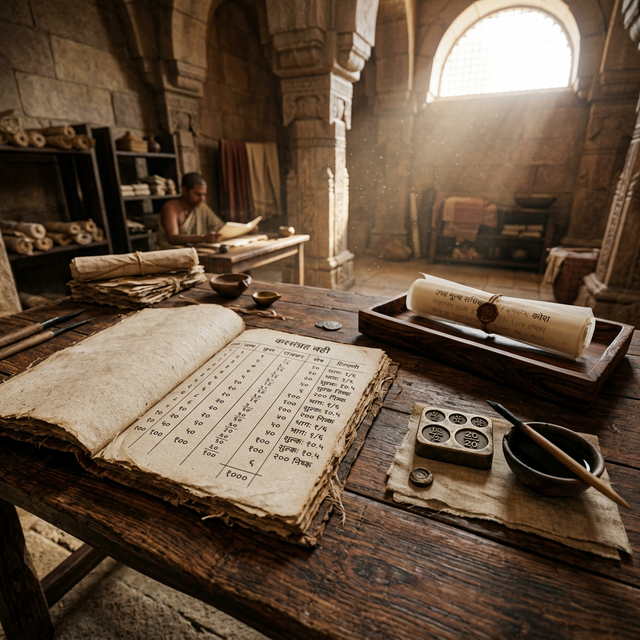
The Auditor’s desk in the Pataliputra administrative complex is a battlefield of ink and arithmetic. Here, the "Ledger of Levies" lies open, its long, fibrous pages filled with the columns of the state's entitlement. This is the place where the Sulka-vyavahárah, the regulation of toll-dues, is literalized. The room is quiet, save for the dry scratch of a stylus and the distant, muffled sound of merchants in the courtyard below, their voices raised in the rhythmic counting of copper coins. Kautilya leads the Prince to the edge of the desk, where a series of small, bronze weights represent the various fractions of the empire's take: the tenth, the fifteenth, the twentieth, and the twenty-fifth. This is the code of the silent shareholder.
In this ledger, Kautilya has defined exactly how much of a man’s labor belongs to the Crown, and he has ensured that no commodity can escape the eye of the taxman.
A single, translucent scroll of high-value silk from the northern borders, its surface shimmering like water, rests on a tray of dark wood. This object is the stake of the empire’s luxury revenue: it is the "High Toll." Kautilya explains that the state is a master of categorization. For "silks, wool, and products yielded by worms," the state claims a tenth or a fifteenth. For the "common threads, cotton, and bipeds," the fraction drops to a twentieth or a twenty-fifth. The stability of the treasury is built upon this "graduated scale." To Kautilya, the market is a machine that must be tuned with forensic precision. A state that taxes too heavily destroys the trade; a state that taxes too lightly destroys its own ability to protect that trade.
The action of the ledger is the enforcement of the central marketplace. Kautilya traces his finger along a line of text that prohibits the sale of commodities "where they are grown or manufactured." It is a radical centralization. A merchant cannot buy minerals directly from a mine or flowers from a garden without incurring a "fine of 600 panás." The state demands that all trade pass through the toll-gate, where it can be measured, declared, and taxed. They watch as an auditor records the "gate-dues" (dvárádeya), a separate fraction that represents the five-percent fee for the privilege of entering the city. It is a world where "circumstances necessitate favour" or remission, but where the "fine of 54 panas" for bypassing a garden is always lurking in the shadows.
But the ledger is also a center of economic discipline. Kautilya points to the "categories of scents, medicines, and wood," explaining that the "Superintendent of Tolls" must be an encyclopedist of value. The Prince realizes that the "Ledger of Levies" is the ultimate expression of the "Duties of Government Superintendents"—the place where the state’s power to "collect and categorize" is woven into the very fabric of daily life. The King’s power is the power to "fix the toll-due" and to ensure that "clay-pots and cooked rice" each contribute their twentieth share to the imperial machine. The "Ledger of Levies" is the financial heartbeat of the state, captured in the "column of fractions" that dictates the destiny of every merchant.
For products yielded by worms (krimijáta); and of wool... he shall receive 1/10th or 1/15th as toll. Of cloths, quadrupeds, bipeds... salt, liquor, cooked rice and the like, he shall receive 1/20th or 1/25th as toll. Commodities shall never be sold where they are grown or manufactured. When minerals and other commodities are purchased from mines, a fine of 600 panás shall be imposed.
This is the rule of the codified levy, the documentation for a world where "unregulated trade" is the enemy of the state. It says that the "Superintendent of Tolls" must be a scientist of fractions, and that the "gate-dues" are as strategic as a defensive wall. It recognizes that "silk" and "clay-pots" are the nodes of a network of contribution that connects the King to the "Ledger of Levies." The administrative complex, with its "stylus and ink" and its "Superintendent of Tolls," is the physical evidence of this discipline. The men who need such a rule are those who have understood that the state's strength is first calculated, then collected.
The logic of the levy is the logic of the "Duties of Government Superintendents." It completes the transition from the architecture of the gate to the architecture of the treasury. It assumes that if you can master the "categorization of goods" and the "enforcement of the market," you can master the prosperity of an entire civilization. The state is no longer an enforcer of contribution; it is the ultimate partner in every exchange.
The canto concludes on the image of a merchant handing over the twentieth part of his grain to the state official at the city gate as night falls. The Official takes a small wooden measurement box, fills it with the merchant's grain, and pours it into the state's granary-bag. It is a precise, mechanical exchange. The merchant nods, his face a mask of acceptance, and leads his oxen into the city. Kautilya looks at the "net balance" of the day’s fractions and sees the economic resilience of the Mauryas written in the silence of the Auditor's desk.
Outside, the city is humming with the commerce of the night-markets. But inside the "Ledger of Levies," the world is categorized, fractioned, and secure. The Prince walks back to his quarters, his mind full of tenths and twentieths. He has seen the dark wood trays, and he has heard the scratch of the stylus. He knows now that the empire is held together not just by gold or iron, but by the "uniform texture" of the levy and the unblinking eye of the man who knows exactly how much a clay-pot is worth to the King.