Chapter 20 of 126
The definition of reality itself—establishing the standard weights and the water-clock to ensure the King defines time and space for his people.
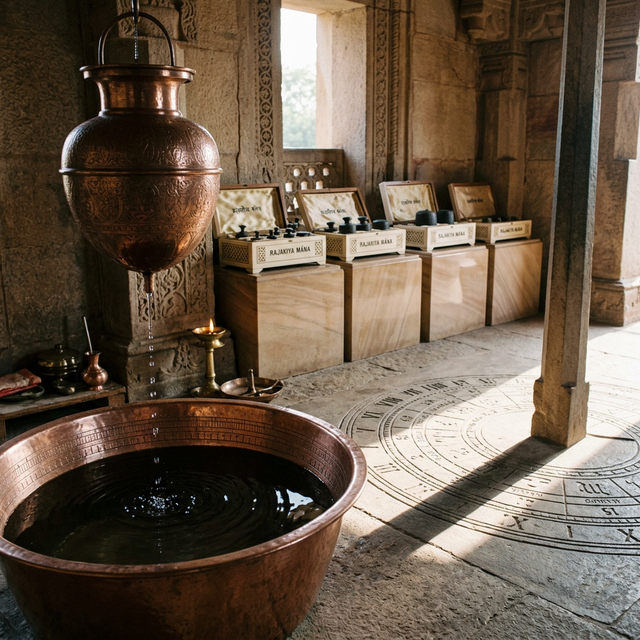
The office of the Pautavádhyakshah, the Superintendent of Weights and Measures, is the most silent and most dangerous room in the Mauryan administration. Here, in a chamber of polished stone where the air is as still as a tomb, the master weights of the empire are kept in ivory boxes lined with silk. There are no sounds of industry here, only the periodic, rhythmic drip of the water-clock in the courtyard and the long, sharp shadow of the gnomon as it cuts across the sundial. This is the "Architecture of Measurement," the place where the state’s absolute standards are stored. Kautilya leads the Prince into this sanctuary of precision, where the raw, chaotic reality of the world is disciplined into the units of the state.
In this room, a gram of difference is a treason, and a second of error is a crack in the foundation of the throne.
A single, iron-rimmed weight of ten palas, its surface stamped with the royal seal of the peacock, rests on a pedestal of black basalt. This object is the stake of the empire’s forensic integrity: it is the "Master Weight." Kautilya explains that if the King does not define the weight, the merchant will. If the King does not define the hour, the thief will. The stability of the Mauryan state is built upon the invisible grid of the "standard." To Kautilya, measurement is the primary engineering of reality. He traces the hierarchy of units back to the very edge of human perception: the paramánu, the atom, and the "particle of dust" seen in a sunbeam.
From these infinitesimal seeds, the state constructs its "Architecture of Measurement," expanding outward to the angula (finger-breadth), the dhanus (bow-length), and the yojana—the ten-mile heartbeat of the imperial roads.
The action of the measurement hall is the relentless enforcement of the absolute. Kautilya walks the Prince through the definitions of space and time. They watch the "sawyers and blacksmiths" as they align their tools with the kishku—the standard cubit. They observe the Paurusha, the measurement of time, where the day is divided into "sixty nálikás." The náliká is defined by the "perforation of a gold leaf" through which a certain weight of water must pass. It is a technical, cold-blooded science: time is not a flow, but a "quantity of water" that symbolizes the life-blood of the King’s schedule. The state classifies the "eight subdivisions of a day" and the "fifteen days of a fortnight," ensuring that the "wear and tear" of existence is captured in the "standard of the second."
But measurement is also the tool of the strategic map. Kautilya points to the "measures of roads and fort-walls," explaining that the "Superintendent of Weights and Measures" must be the cartographer of the state’s physical limits. The Prince realizes that the gnomon and the water-clock are the ultimate instruments of social control. The King’s power is the power to "ascertain the shadow of the gnomon at mid-day" and to "calculate the length of the yojana." The "Architecture of Measurement" is the skeleton of the state, ensuring that the "units of the grain" and the "units of the road" are identical from the Himalayas to the Indian Ocean. The King's authority is the authority of the "True Weight."
10 units of atoms are equal to 1 particle of dust... 8 angulas are equal to 1 dhanurmushti... 2 vitastis are equal to 1 aratni. A nálika is the time during which one ádhaka of water drains out of a pot... the shadow of the gnomon at mid-day... the Superintendent of Weights and Measures shall precisely ascertain the demand and supply of master-weights.
This is the rule of the absolute standard, the documentation for a world where "subjective reality" is replaced by the "Master Weight." It says that the "Superintendent of Weights and Measures" must be a scientist of the scale, and that the "perforation of the gold leaf" is as strategic as the perforation of an enemy line. It recognizes that "atoms" and "yojanas" are the nodes of a network of precision that connects the King to the "Architecture of Measurement." The hall, with its "balances and counterweights" and its "Superintendent of Space and Time," is the physical evidence of this discipline. The men who need such a rule are those who have understood that the state's strength is first measured, then enforced.
The logic of measurement is the logic of the "Duties of Government Superintendents." It completes the transition from the architecture of the arsenal to the architecture of the mind. It assumes that if you can master the "measurement of the hour" and the "weighing of the pala," you can master the perception of every subject in the empire. The state is no longer an engineer; it is the definer of truth.
The canto concludes on the image of the water-clock dripping in the absolute silence of the palace at midnight. Each drop is a crystalline unit of Mauryan time, falling into the copper basin with a precise, resonant ring. The Prince stands alone in the courtyard, watching the moonlight crawl across the gnomon of the sundial. The shadow is a sharp, black line that points toward the future. Kautilya looks at the "net balance" of the day’s measures and see the invisible resilience of the Mauryas written in the silence of the standards.
Outside, the world is dreaming in the dark. But inside the "Architecture of Measurement," the universe is categorized, weighted, and secure. The Prince walks back to his chambers, his mind full of atoms and yojanas. He has seen the iron-rimmed weights, and he has heard the dripping of the clock. He knows now that the empire is held together not just by gold or iron, but by the "uniform texture" of the standard and the unblinking eye of the man who knows exactly how heavy the world should be.