Chapter 25 of 126
The spirit's shadow—the regulation of liquor and intoxicants, where the state keeps a watchful eye on the people's vices and their virtues.
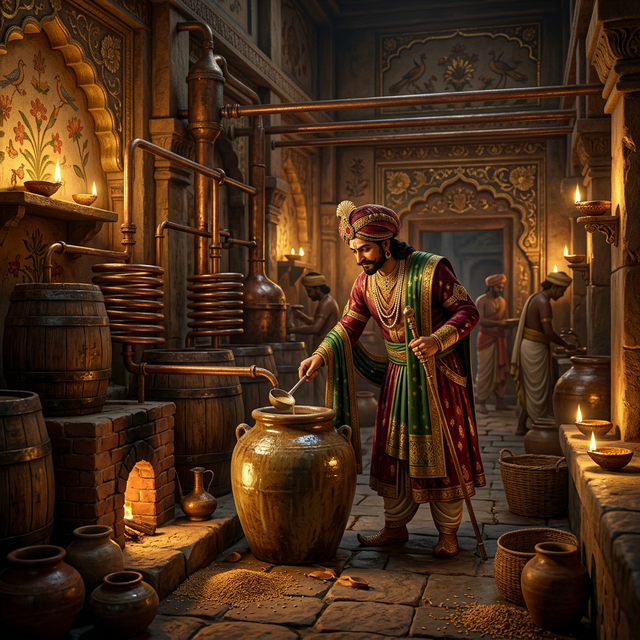
The state tavern (pánágára) in the Pataliputra market is a world of low ceilings and the thick, cloying sweetness of fermented grain. Here, the Surádhyakshah, the Superintendent of Liquor, presides over an environment where pleasure is strictly audited. This is "The Spirit's Shadow," a place where vice is not ignored but harnessed as a site of fiscal capture and intelligence gathering. Kautilya leads the Prince past long, half-shadowed rooms where high-status customers lie on low couches, their conversations muffled by the heavy tapestries. In this hall, the state does not just sell spirits; it monitors the very soul of the city. The "standard of the drink-hall" is the measure of the state’s unblinking eye.
A single, glazed ceramic jar of Medaka, its surface cool to the touch and its contents a murky, high-ferment liquid, rests on a heavy wooden counter. This object is the stake of the empire’s control over the "spirit of the subject": it is the "Standard of Intoxication." Kautilya explains that the tavern is the state's most specialized laboratory of human behavior. He points to the varieties of liquor being served—Medaka from water and rice, Prasanná spiced with bark and fruit, and the high-value Madhu grape-juice from the western borders. The stability of the Treasury is built upon this "hierarchy of spirits." To Kautilya, the tavern is a place where the King must "ascertain the value of the dress and ornaments" of the intoxicated.
A superintendent who cannot balance the "sale of liquor" with the "surveillance of the stranger" is a man who is blind to the dangers of the night.
The action of the tavern is a forensic monitoring of the intoxicated. Kautilya walks the Prince through the surveillance grid. They watch as spies, disguised as servants or merchants, move through the "half-closed rooms," observing the "expenditure incurred by customers" and whether they are "local or foreign." It is a world of strict liability: if a customer loses their ornaments while intoxicated, the "merchants of the shop shall make good the loss." They observe the "categorization of customers," where the Superintendent ensures that liquor is only sold to those of "known character" in small quantities to avoid "unrestrained behavior." It is a technical, predatory discipline: the state measures the "minutes of intoxication" as precisely as it measures the "dronas of rain," ensuring that the drink-hall is a source of information as much as revenue.
But the tavern is also a center of economic and social discipline. Kautilya points to the "beautiful mistresses" and the "Aryas in false guise" who frequent the halls, explaining that the state must monitor their interactions to detect "latent criminals." The Prince realizes that the "Spirit's Shadow" is the ultimate expression of the "Duties of Government Superintendents"—the place where the state’s power to "observe and regulate" is literalized in the dim light of a tavern lamp. The King’s power is the power to "fix the price of the spirit" and to ensure that the "manufacture of kinva-ferment" is as controlled as the minting of coins. The "Spirit's Shadow" is the psychic pulse of the state, captured in the "clink of the jar" that binds the intoxicated to the Crown.
Merchants seated in half-closed rooms shall observe the appearance of local and foreign customers who, in real or false guise of Aryas lie down in intoxication along with their beautiful mistresses. They shall also ascertain the value of the dress, ornaments, and gold of the customers lying there under intoxication. When customers under intoxication lose any of their things, the merchants... shall not only make good the loss, but also pay an equivalent fine.
This is the rule of the spirit regulation, the documentation for a world where "unmonitored vice" is the enemy of the state. It says that the "Superintendent of Liquor" must be a scientist of surveillance, and that the "half-closed room" is as strategic as a border fort. It recognizes that "Medaka" and "gold ornaments" are the nodes of a network of intelligence that connects the King to the "Spirit's Shadow." The state tavern, with its "fermenting jars" and its "Superintendent of Liquor," is the physical evidence of this discipline. The men who need such a rule are those who have understood that the state's strength is first observed, then secured.
The logic of the spirit is the logic of the "Duties of Government Superintendents." It completes the transition from the architecture of the farm to the architecture of the human appetite. It assumes if you can master the "intoxication of the subcontinent" and the "surveillance of the tavern," you can master the secrets of every subject in the empire. The state is no longer a master of life; it is a master of the shadow.
The canto concludes on the image of a spy noting down a conversation in the flickering light of a tavern lamp as the night deepens. The spy’s stylus moves quickly over a small birch-bark scroll, capturing the drunken admissions of a merchant who has traveled from the borderlands. The tavern hums with low voices and the heavy scent of spices, a resonant, predatory vibration that echoes the clink of the state's coins. Kautilya looks at the "net balance" of the evening’s intelligence and sees the forensic resilience of the Mauryas written in the silence of the shadow.
Outside, the city is lost in the darkness of the night. But inside the "Spirit's Shadow," the world is categorized, monitored, and secure. The Prince walks out into the cool air, his mind full of jars and ornaments. He has seen the glazed ceramic jars, and he has heard the muffled voices of the tavern. He knows now that the empire is held together not just by gold or iron, but by the "uniform texture" of the drink and the unblinking eye of the man who knows exactly what a man will say when he has had enough of the King’s spirit.