Chapter 24 of 126
The sacred contract with the soil, detailing how the state's agriculture turns the breath of the furrow into the strength of the nation.
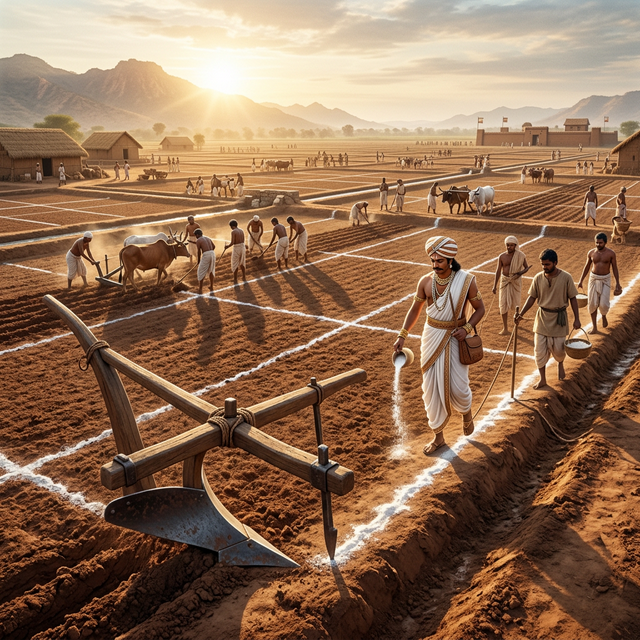
The air over the vast state-farms of Magadha is heavy with the scent of damp, turned earth and the electric promise of the monsoon. Here, the Sítádhyakshah, the Superintendent of Agriculture, stands on a low stone embankment, his gaze fixed on the darkening horizon. This is "The Breath of the Furrow," the place where the state’s industrial mastery meets the biological rhythm of the soil. Kautilya leads the Prince past long, dead-straight lines of irrigation channels that cut through the landscape like the veins of a giant. In this world, agriculture is not a peasant’s hope, but a state’s science. The stability of the Mauryan empire is measured in the "dronas of rain" that fall into the Superintendent's gauges, and the "standard of the furrow" is the ultimate insurance against the chaos of famine.
A single, iron-tipped plough, its surface polished by years of friction with the black soil, rests against a granary wall. This object is the stake of the empire’s caloric survival: it is the "Instrument of the Furrow." Kautilya explains that the state is the master of the seasonal cycle. He points to the specialized labor force working the fields—slaves, prisoners (dandapratikartṛbiḥ), and "free laborers" (karmantikas) who have been integrated into a massive agrarian machine. The stability of the "Circle of Kings" depends on the "precise knowledge of the seeds." To Kautilya, the earth is a laboratory where the King must "calculate the rainfall" and "sow the seeds which require either more or less water." A superintendent who cannot predict the harvest from the "formations of the clouds" is a man who is inviting the collapse of the social order.
The action of the state-farm is a forensic coordination of the seasons. Kautilya walks the Prince through the hierarchy of sowing. They watch as the specialized seeds—Sáli rice, vríhi, and sesame—are distributed according to the "commencement of the rainy season." It is a world of total logistical synchronization: mudga and másha in the middle, and barley and wheat at the end. They observe the "measurement of rain" (varshamánam), where the Superintendent records the sixteen dronas of the jángala country and the twenty-three of avantí. It is a технический, unblinking discipline: the state measures the "number of drops" and the "sunshine" that appearance with the clouds, ensuring that the "reaping of good harvest" is a statistical certainty rather than a prayer.
But the state-farm is also a center of industrial assistance. Kautilya points to the "blacksmiths, carpenters, and ropemakers" who must be provided to the laborers without delay, explaining that the state must ensure that no "plough or instrument" is allowed to fail. The Prince realizes that the "Breath of the Furrow" is the ultimate expression of the "Duties of Government Superintendents"—the place where the state’s power to "organize and produce" is literalized in the sprouting of a billion green shoots. The King’s power is the power to "fix the fines for neglect" and to ensure that the "collection of all kinds of grains" is as efficient as the collection of taxes. The "Breath of the Furrow" is the biological pulse of the state, captured in the "rhythmic turning of the earth" that binds the earth to the Crown.
Where rain, free from wind and unmingled with sunshine, falls so as to render three turns of ploughing possible, there the reaping of good harvest is certain. The superintendent shall sow the seeds which require either more or less water... Sáli, vríhi, kodrava... are to be sown at the commencement of the rainy season. Blacksmiths, carpenters, borers, ropemakers... shall not be any delay in procuring to them the assistance... Any loss due to the above persons shall be punished with a fine equal to the loss.
This is the rule of the agricultural mastery, the documentation for a world where "seasonal instability" is the enemy of the state. It says that the "Superintendent of Agriculture" must be a scientist of the sky, and that the "three turns of ploughing" are as strategic as a Triple-Alliance. It recognizes that "Sali rice" and "rainfall dronas" are the nodes of a network of security that connects the King to the "Breath of the Furrow." The state-farm, with its "irrigation channels" and its "Superintendent of Agriculture," is the physical evidence of this discipline. The men who need such a rule are those who have understood that the state's strength is first sowed, then reaped.
The logic of the furrow is the logic of the "Duties of Government Superintendents." It completes the transition from the architecture of the factory to the architecture of the ecosystem. It assumes that if you can master the "rainfall of the subcontinent" and the "synchronization of the seeds," you can master the destiny of every hunger in the empire. The state is no longer an organizer of purpose; it is a master of life itself.
The canto concludes on the image of a vast expanse of emerald-green rice shoots sprouting across the horizon as the first stars appear. The shoots are arranged in perfect, industrial rows, a mark of Mauryan discipline that stretches to the edge of the world. The fields hum with the sound of evening insects, a resonant, biological vibration that echoes the clatter of the city’s looms. Kautilya looks at the "net balance" of the rainfall and sees the agrarian resilience of the Mauryas written in the silence of the sprouting earth.
Outside, the first monsoon winds are beginning to stir the trees. But inside the "Breath of the Furrow," the world is categorized, sowed, and secure. The Prince walks back toward the palace, his mind full of seeds and dronas. He has seen the iron-tipped ploughs, and he has heard the silent breathing of the earth. He knows now that the empire is held together not just by gold or iron, but by the "uniform texture" of the rain and the unblinking eye of the man who knows exactly when the first shoot will break the soil.