Chapter 26 of 126
The cold ethics of the slaughterhouse, where the regulation of meat and the protection of cattle balance the needs of life with the necessity of law.
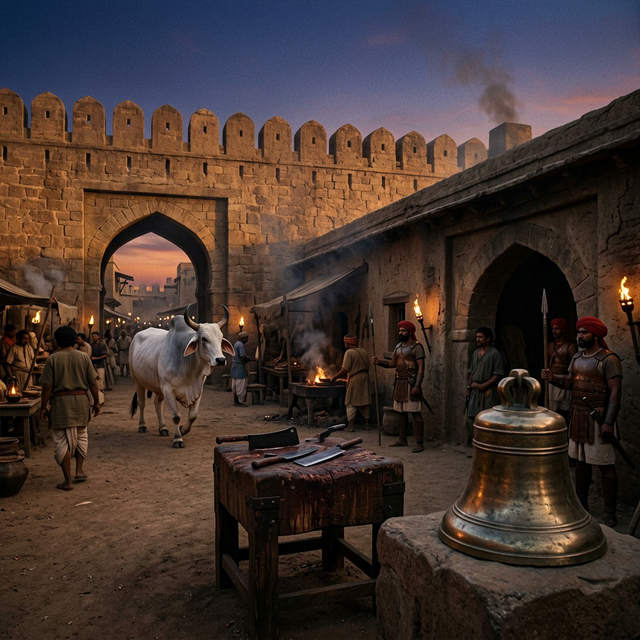
The state slaughterhouse in the shadows of the Pataliputra perimeter-wall is a world of sharp iron and the rhythmic sound of heavy bells. Here, the Súnádhyakshah, the Superintendent of the Slaughterhouse, presides over an environment where the transition from life to utility is strictly monitored. This is "The Blade of the Altar," a place where industrial regulation meets a sophisticated code of animal protection. Kautilya leads the Prince past the high stone stalls where cattle are inspected, the air thick with the smell of wet hide and the metallic tang of cold iron. In this hall, the state does not just regulate the meat trade; it defines the boundary of what is permissible to consume. The "standard of the auspicious animal" is the measure of the state’s moral and economic discipline.
A single, heavy bronze bell, its surface polished and its tone a resonant, deep ring, rests on a table near the entrance. This object is the stake of the empire’s protection of the sacred: it is the "Bell of the Auspicious." Kautilya explains that the state is the ultimate guardian of the "blessed creature." He points to the animals marked for protection—calves, bulls, milch cows, and "birds or beasts which have become auspicious." To Kautilya, these are not just animals but symbols of the state's cosmic order. The stability of the Mauryan society is built upon this "absolute protection." A superintendent who allows the "slaughter or torture" of a milch cow is a man who is inviting a "fine of 50 panas" and the collapse of the agrarian foundation.
The action of the slaughterhouse is a forensic regulation of the flesh. Kautilya walks the Prince through the inspection grid. They watch as the butchers (súna) prepare the meat, careful to provide only "fresh and boneless flesh of beasts just killed." It is a world of strict quality control: the sale of "bony flesh," "headless flesh," or "rotten flesh" is met with immediate fines. They observe the "eight-fold fine" for diminution in weight, where the Superintendent uses his "standard balance" to ensure that the merchant is not cheating the subject. It is a técnicos, unblinking discipline: the state measures the "integrity of the flesh" as precisely as it measures the "purity of gold," ensuring that the marketplace is a site of trust as much as consumption.
But the slaughterhouse is also a center of biological assistance. Kautilya points to the "fish and beasts living in forests under State protection" that have become "vicious," explaining that the state must manage even the "molestation" of the wild. The Prince realizes that "The Blade of the Altar" is the ultimate expression of the "Duties of Government Superintendents"—the place where the state’s power to "preserve and regulate" is literalized in the protection of a Brahman bull. The King’s power is the power to "prohibit the slaughter of the protected" and to ensure that the "compensation for loss" is as precise as the tax on grain. "The Blade of the Altar" is the biological conscience of the state, captured in the "unmolested walk" of an auspicious animal that binds the world to the Crown.
Cattle such as a calf, a bull, or a milch cow shall not be slaughtered. He who slaughters or tortures them to death shall be fined 50 panas. Auspicious animals, whether birds or beasts, shall be protected from all kinds of molestations. (Butchers) shall sell fresh and boneless flesh... If they sell bony flesh, they shall give an equivalent compensation. If there is any diminution in weight... they shall give eight times the diminution.
This is the rule of the animal regulation, the documentation for a world where "unauthorized killing" is the enemy of the state. It says that the "Superintendent of the Slaughterhouse" must be a scientist of life-cycles, and that the "boneless flesh" is as strategic as a diplomatic treaty. It recognizes that "milch cows" and "auspicious birds" are the nodes of a network of preservation that connects the King to "The Blade of the Altar." The state slaughterhouse, with its "iron-bladed knives" and its "Superintendent of the Slaughterhouse," is the physical evidence of this discipline. The men who need such a rule are those who have understood that the state's strength is first protected, then consumed.
The logic of the blade is the logic of the "Duties of Government Superintendents." It completes the transition from the architecture of the tavern to the architecture of the sanctuary. It assumes that if you can master the "consumption of the subcontinent" and the "protection of the auspicious," you can master the moral equilibrium of an entire civilization. The state is no longer a master of the shadow; it is a master of mercy.
The canto concludes on the image of a massive Brahman bull walking unmolested through the market at dusk, its neck draped with a garland and its gait slow and heavy. The merchants pull their carts aside to let it pass, and children reach out to touch its white hide. It is a mark of Mauryan peace that stretches through the heart of the city. The slaughterhouse falls into silence as the evening lamps are lit, its iron gates locked and its auditors departing for the night. Kautilya looks at the "net balance" of the day’s protection and sees the resilient mercy of the Mauryas written in the silence of the market.
Outside, the city is settling into the night, the sounds of bells still echoing from the distant temples. But inside "The Blade of the Altar," the world is categorized, protected, and secure. The Prince walks back toward the administrative complex, his mind full of cattle and amercements. He has seen the heavy bronze bells, and he has heard the silent gait of the bull. He now knows that the empire is held together not just by gold or iron, but by the "uniform texture" of the protection and the unblinking eye of the man who knows exactly what it means to be an auspicious bird in the King's land.