Chapter 72 of 126
The seven elements—a deeper study in the structural integrity of the empire, where every weakness in a neighbor is a lethal opportunity.
A vast, circular chamber at the highest point of the palace at Pataliputra, where the midday sun pours through a central oculus and illuminates a giant bronze diagram set into the floor—a complex, analytical schema mapping the seven constituent parts of the kingdom—is a world of forensic sovereignty and the sight of various sectors of the diagram, representing the fort, the treasury, and the army, being highlighted by the play of light. Here, the Prince and Kautilya observe the forensic logic of "The Seven Elements," where the state’s existence is literalized in the architecture of the schema. This is a place where the social pulse is measured in the synergy of the parts.
Kautilya leads the Prince around the perimeter of the diagram to where the state-philosopher determines the "integrity of the element" and the master-architect ensures the "purity of the sovereign structure." In this forensic sphere, the state does not just rule; it anchors the absolute definition of the whole. The "suppression of the sovereign thorn" is the measure of the state’s elemental and moral control.
A giant bronze diagram of the kingdom, its surface etched with the characters for the seven limbs of sovereignty—the King, the Minister, the Territory, the Fort, the Treasury, the Army, and the Ally—rests as the foundational map of the chamber. This object is the stake of the empire’s control over the "chaos of the disorganized": it is the "Vessel of the Saptanga." Kautilya explains that the state is the ultimate master of "The Elements of Sovereignty" (Prakritisampadah). He points to the central hub, representing the Swami (the King): "The King is the head, but he is only as strong as the elements that support him...
for the state to endure, each limb—the minister, the territory, the fort, the treasury, the force, and the ally—must possess the qualities of excellence." To Kautilya, a weakness in any one element is not just a flaw but a "forensic rot" that invites collapse. The stability of the Maurya machine is built upon this "systemic accounting." A King who "lacks self-control" or a treasury that "holds only lead" is a part that is rusting the King’s internal strength.
The action of the chamber is a forensic monitoring of quality and synergy. Kautilya walks the Prince through the mapping of the "legal excellence," explaining the precise qualities required for a "territory rich in resources" and the "rules for the recruitment of an army of hereditary loyalty." They watch as a senior advisor evaluates the "integrity of the fort's defenses," checking the "purity of the elemental alignment." It is a world of total informational liability: the law details the "qualities of an ideal minister" and the precise "rights of the state to discard any element that has become a source of friction." They observe the "rules of the limbs," ensuring that the "integrity of the sovereign body" is as respected as the King’s own standard.
It is a technical, structural discipline: the state measures the "rhythm of the synergy" as precisely as it measures the "depth of the border," ensuring that the subject remains a source of strength as much as service.
But the seven elements are also a center of total strategic architecture. Kautilya points to the "Elemental Ledger," explaining that the state must ensure that the "engines of sovereignty" are never paralyzed by the "friction of the disintegrated." The Prince realizes that "The Seven Elements" is the ultimate expression of the "Source of Sovereign States"—the place where the state’s power to "define and defend" is literalized in the etchings of a bronze map. The King’s power is the power to "ascertain the honesty of the limbs" and to ensure that the "determination of the elemental truth" is as regulated as the weight of a gold coin. "The Seven Elements" is the enduring conscience of the state, captured in the "bronze diagram" that binds the part to the unified peace.
Prakritisampadah (Qualities of Sovereignty)... The King (Swami), the Minister (Amatya), the Territory (Janapada), the Fort (Durga), the Treasury (Kosha), the Army (Danda), and the Ally (Mitra) are the seven elements of the state... A King must be high-born, wise, and possessed of enthusiasm and self-control... A territory must be capable of supporting residents and defending against enemies... A treasury must be filled with gold and silver and acquired justly... An army must be hereditary, loyal, and brave... An ally must be constant and share the same interests... The excellence of these elements is the root of power and success.
This is the rule of the structural regulation, the documentation for a world where "state architecture" is the survival of the kingdom. It says that the "Ledger of the Limbs" must be a scientist of synergy, and that the "protection of the elemental balance" is as strategic as the defense of a state-owned fort. It recognizes that "bronze diagrams" and "elemental etchings" are the nodes of a network of power that connects the King to "The Seven Elements." The chamber, with its "vows of scrupulous quality" and its "scrupulous systemic-keeping," is the physical evidence of this discipline. The men who need such a rule are those who have understood that the state's strength is first architected, then secured.
The logic of the elements is the logic of the "Source of Sovereign States." It completes the transition from the contract of the courtier to the contract of the essential nature. It assumes that if you can master the "form of the limb" and the "forensic precision of the structural record," you can master the stability of any civilization in the world. The state is no longer a master of the Permanence; it is a master of the Essence.
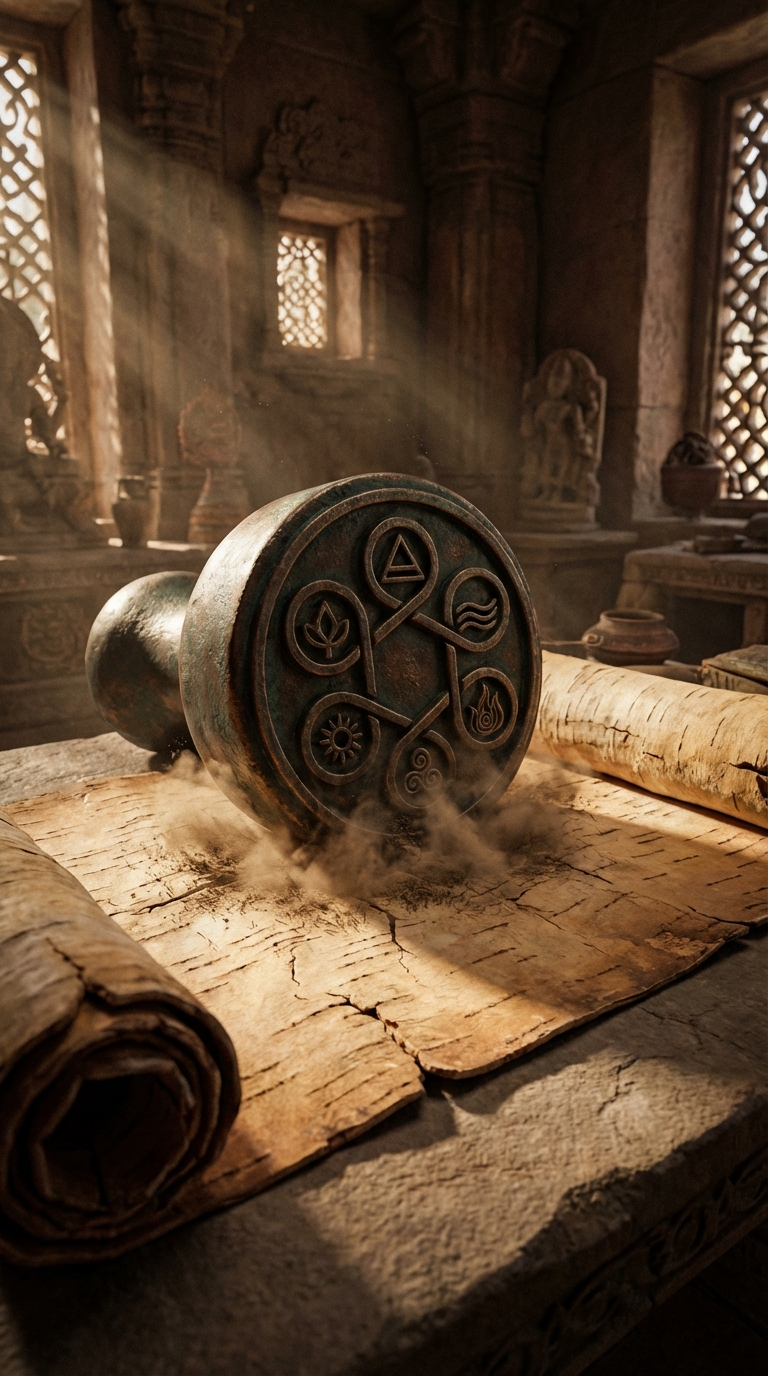
The canto concludes on the image of a giant bronze seal, depicting the stylized symbols of the seven elements in a circular knot, being pressed firmly onto a thick, final scroll of sun-bleached birch bark, the sound of the metal meeting the bark a resonant, final thud that echoes through the sun-lit chamber. The fine bronze dust of the sealer's powder catches the midday light as the elemental analysis is completed. Kautilya looks at the "net balance" of the kingdom's elements and sees the resilient reach of the Mauryas written in the synergy of the seal.
Outside, the palace shadows begin to lengthen. But inside "The Seven Elements," the world is categorized, architected, and secure. The Prince walks back from the diagram, his mind full of limbs and essences. He has seen the map etched, and he has heard the seal strike. He now knows that the empire is held together not just by laws or walls, but by the "uniform texture" of the essence and the unblinking eye of the man who knows exactly what it means to be elemental in the King's account.