Chapter 73 of 126
The rhythm of state—the strategic management of diplomacy and peace, where the King's hand is as steady as the flow of a river.
A vast, emerald-green agricultural field stretching toward the horizon at dawn, where the moist earth is being methodically tilled by teams of heavy-shouldered oxen and the only sound is the rhythmic, wet slice of the plow through the soil, is a world of forensic productivity and the sight of a long line of Mauryan soldiers marching silently along a distant, sun-lit ridge. Here, the Prince and Kautilya observe the forensic logic of "The Rhythm of State," where the kingdom’s prosperity is literalized in the movement of the plow and the spear. This is a place where the social pulse is measured in the balance of effort.
Kautilya leads the Prince along the irrigation channel to where the state-economist determines the "integrity of the exertion" and the commander ensures the "purity of the peace." In this forensic sphere, the state does not just grow; it anchors the absolute liability of the cycle. The "suppression of the rhythmic thorn" is the measure of the state’s industrial and moral control.
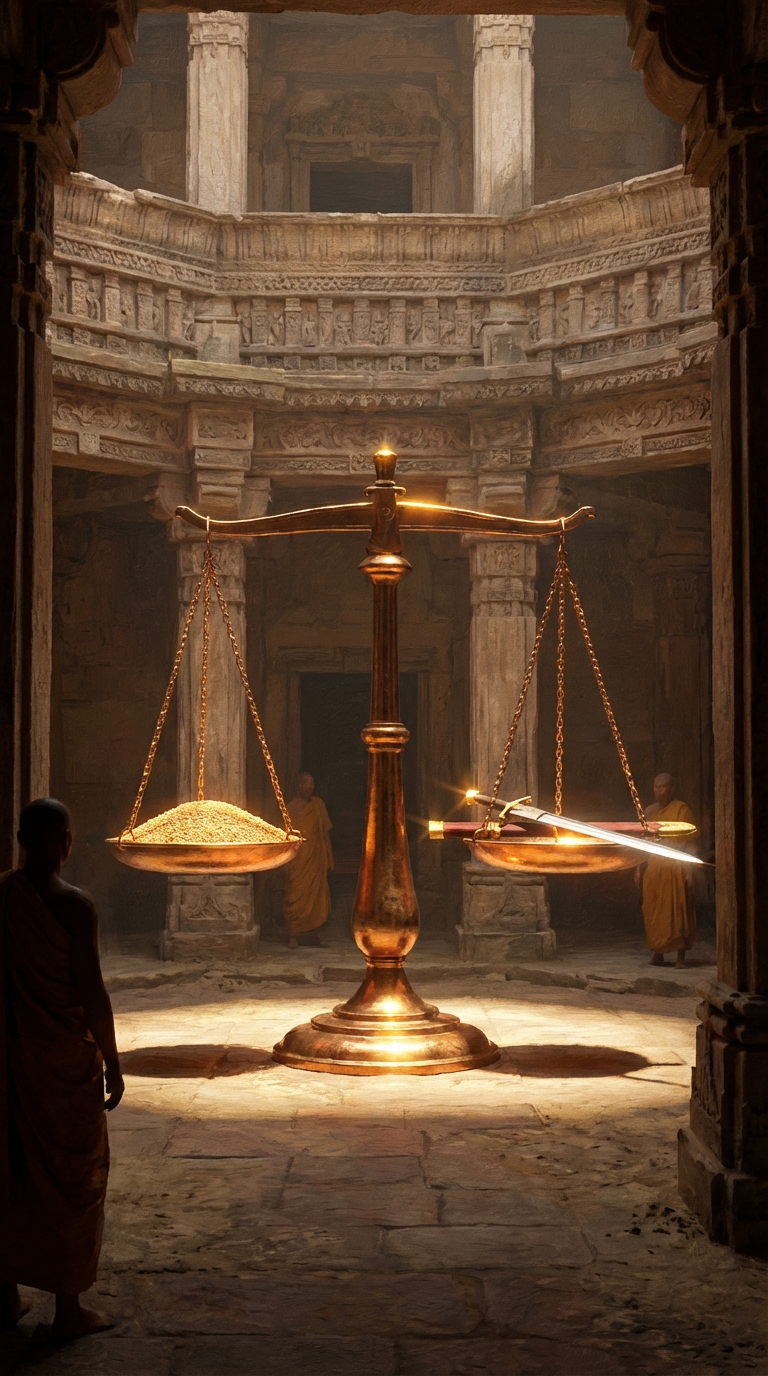
A balanced set of bronze scales, their chains taut and their beam perfectly horizontal, sits in the center of a quiet temple courtyard overlooking the fields. One pan holds a generous handful of golden grain, while the other holds a heavy, unsheathed iron sword. This object is the stake of the empire’s control over the "chaos of the stagnant": it is the "Vessel of Yoga-Kshema." Kautilya explains that the state is the ultimate master of "Peace and Exertion" (Samadhi-Vyayama). He points to the twin pans: "Exertion is the industry that produces what we do not have...
while Peace is the security that preserves what we have already acquired." To Kautilya, a state that exerts without peace is a "forensic leak," and a state that rests without exertion is a "forensic rust." The stability of the Maurya machine is built upon this "rhythmic accounting." A farmer who "leaves the field fallow" or a soldier who "sleeps during the watch" is a man who is rusting the King’s internal strength.
The action of the field is a forensic monitoring of output and defense. Kautilya walks the Prince through the mapping of the "legal exertion," explaining the precise methods for "calculating the yield of a province" and the "rules for the deployment of the six-fold policy—peace, war, neutrality, marching, alliance, and double-policy." They watch as an overseer evaluates the "integrity of the labor," noting the "completion of the irrigation trench" alongside the "readiness of the garrison." It is a world of total informational liability: the law details the "penalties for administrative lethargy" and the precise "rights of the state to mobilize the population for public works." They observe the "rules of the rhythm," ensuring that the "integrity of the national effort" is as respected as the King’s own standard.
It is a technical, cyclical discipline: the state measures the "rhythm of the plow" as precisely as it measures the "depth of the border," ensuring that the subject remains a source of prosperity as much as order.
But the rhythm of state is also a center of total strategic timing. Kautilya points to the "Rhythm Ledger," explaining that the state must ensure that the "engines of the kingdom" are never paralyzed by the "friction of the imbalanced." The Prince realizes that "The Rhythm of State" is the ultimate expression of the "Source of Sovereign States"—the place where the state’s power to "strive and stay" is literalized in the balancing of a scale. The King’s power is the power to "ascertain the honesty of the exertion" and to ensure that the "determination of the rhythmic truth" is as regulated as the weight of a gold coin. "The Rhythm of State" is the enduring conscience of the state, captured in the "bronze scales" that bind the citizen to the productive peace.
Samadhi-Vyayama (Peace and Exertion)... The source of prosperity is exertion (Vyayama), and the source of security is peace (Samadhi)... Exertion is the effort to achieve what is not yet achieved (Yoga), while Peace is the enjoyment of what is achieved (Kshema)... The six-fold policy—Sándhi (peace), Vigraha (war), Ásana (neutrality), Yána (marching), Samśraya (alliance), and Dvaidhibháva (double policy)—is the means to these ends... A King who masters the timing of peace and exertion shall overcome all enemies and achieve the welfare of his people.
This is the rule of the cyclical regulation, the documentation for a world where "industrial drive" is the security of the kingdom. It says that the "Ledger of the Effort" must be a scientist of balance, and that the "protection of the harvest" is as strategic as the defense of a state-owned fort. It recognizes that "bronze scales" and "iron plows" are the nodes of a network of strength that connects the King to "The Rhythm of State." The field, with its "vows of scrupulous labor" and its "scrupulous security-keeping," is the physical evidence of this discipline. The men who need such a rule are those who have understood that the state's strength is first balanced, then secured.
The logic of the rhythm is the logic of the "Source of Sovereign States." It completes the transition from the contract of the essence to the contract of the function. It assumes that if you can master the "form of the exertion" and the "forensic precision of the rhythmic record," you can master the stability of any civilization in the world. The state is no longer a master of the Essence; it is a master of the Pulse.
The canto concludes on the image of a balanced set of bronze scales, the pan of grain and the pan of the sword remaining perfectly still in the center of the temple courtyard, while the midday sun reflects off both with an equal, blinding intensity. The sword does not tip the grain; the grain does not outweigh the sword. The silence of the scales is a resonant, final sound that echoes the collective stabilization of the kingdom's prosperity. Kautilya looks at the "net balance" of the book’s functional syntheses and sees the resilient reach of the Mauryas written in the stillness of the scales.
Outside, the kingdom hums with the noise of the market and the drill. But inside "The Rhythm of State," the world is categorized, balanced, and secure. The Prince walks back from the field, his mind full of plows and scales. He has seen the earth turned, and he has heard the scales settle. He now knows that the empire is held together not just by laws or walls, but by the "uniform texture" of the pulse and the unblinking eye of the man who knows exactly what it means to be rhythmic in the King's account.