Chapter 71 of 126
The pillar of state—a masterclass in the seven elements of sovereignty, showing how the King, the Minister, and the Land form an unbreakable whole.
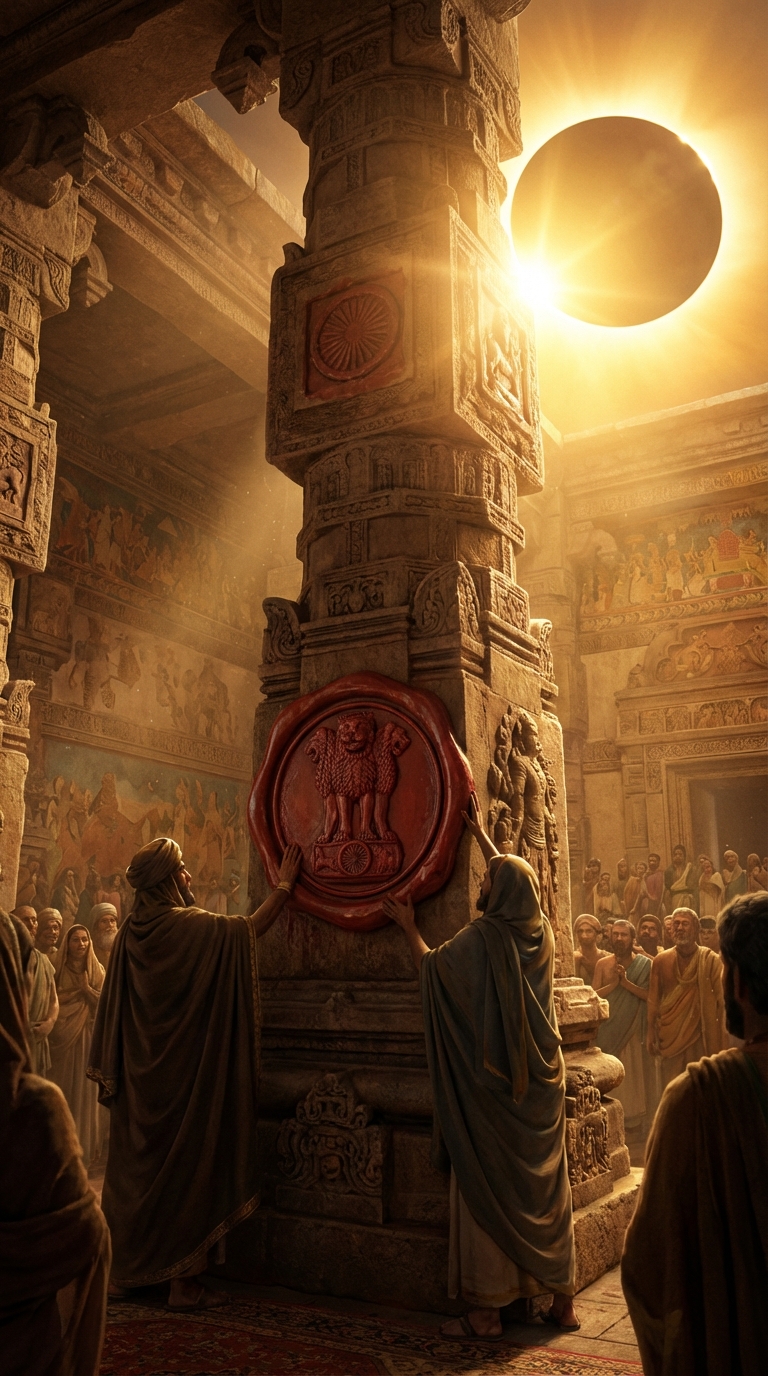
A high, sun-drenched audience chamber directly beneath the central palace dome in Pataliputra, where the morning light during a solar eclipse or a significant cosmic alignment creates a dramatic play of shadows on the polished stone pillars and the sound of traditional chanting by state priests resonates through the vast hall, is a world of forensic unity and the sight of a set of royal regalia—the crown, the scepter, and the canopy—being ceremonially polished. Here, the Prince and Kautilya observe the forensic logic of "The Pillar of State," where the empire’s consolidation is literalized in the marking of the central column. This is a place where the social pulse is measured in the stability of the throne.
Kautilya leads the Prince past the offering-altars to where the senior minister determines the "integrity of the realm" and the collector-general ensures the "purity of the total order." In this forensic sphere, the state does not just survive; it anchors the absolute consolidation of the core. The "suppression of the final palace thorn" is the measure of the state’s administrative and moral synthesis.
A heavy stone pillar at the very center of the audience chamber, its surface freshly carved with the royal seal and the names of the conquered provinces, stands as the immovable anchor of the hall. This object is the stake of the empire’s control over the "chaos of the fragmented": it is the "Vessel of the Consolidation." Kautilya explains that the state is the ultimate master of "Consolidation of the Kingdom" (Rájyapratisandhána). He points to the systematic regulation of the royal pillar: "The senior minister must act as the Pillar of State during the transition, securing the heir and removing those who would rust the kingdom's unity... for the empire is a single body that must never be severed." To Kautilya, a divided kingdom is not just a problem but a "forensic failure" that invites total collapse.
The stability of the Maurya machine is built upon this "unitary accounting." A rival prince who "plots in the shadow of a dying King" or a minister who "fails to seal the administrative legacy" is a man who is rusting the King’s internal strength.
The action of the chamber is a forensic monitoring of line and legacy. Kautilya walks the Prince through the mapping of the "legal consolidation," explaining the precise methods for "holding the state during the King's absence" and the "rules for the psychological reinforcement of the royal authority through 'miracles' and secret agents." They watch as a regent evaluates the "integrity of the court's loyalty," requiring each official to "mark the stone of the covenant" beneath the solar eclipse. It is a world of total informational liability: the law details the "penalties for regional rebellion" and the precise "rights of the state to use 'silent' means to eliminate any threat to the crown." They observe the "rules of the pillar," ensuring that the "integrity of the royal lineage" is as respected as the King’s own standard.
It is a technical, consolidating discipline: the state measures the "rhythm of the chant" as precisely as it measures the "depth of the border," ensuring that the subject remains a source of unity as much as order.
But the pillar of state is also a center of total strategic synthesis. Kautilya points to the "Consolidation Scroll," explaining that the state must ensure that the "engines of the kingdom" are never paralyzed by the "friction of the fragmented." The Prince realizes that "The Pillar of State" is the ultimate expression of the "Conduct of Courtiers"—the place where the state’s power to "unify and uphold" is literalized in the marking of a stone. The King’s power is the power to "ascertain the honesty of the empire" and to ensure that the "determination of the national truth" is as regulated as the weight of a gold coin. "The Pillar of State" is the enduring conscience of the state, captured in the "stone pillar" that binds the official to the consolidated peace.
Rájyapratisandhána (Consolidation of the Kingdom)... The senior minister shall act with the strength of a pillar to preserve the state during the King's illness or the transition of power... Spies and secret psychological measures shall be used to reinforce the King's authority and suppress all regional or internal thorns... The consolidation of the administrative legacy through clear records and secured heir-apparents is the highest duty of the courtier... A unified empire is the only defense against the chaos of the world... The Pillar of Order shall stand forever.
This is the rule of the total regulation, the documentation for a world where "imperial unity" is the security of the state. It says that the "Ledger of the Legacy" must be a scientist of consolidation, and that the "protection of the smallest province" is as strategic as the defense of a state-owned fort. It recognizes that "stone pillars" and "royal regalia" are the nodes of a network of strength that connects the King to "The Pillar of State." The chamber, with its "vows of unyielding unity" and its "scrupulous legacy-keeping," is the physical evidence of this discipline. The men who need such a rule are those who have understood that the state's strength is first consolidated, then secured.
The logic of the pillar is the logic of the "Conduct of Courtiers." It completes the transition from the contract of the cycle to the contract of the permanent core. It assumes that if you can master the "form of the consolidation" and the "forensic precision of the legacy record," you can master the stability of any civilization in the world. The state is no longer a master of the Continuity; it is a master of the Permanence.
The canto concludes on the image of a heavy stone pillar at the center of the palace being ceremonially marked with the large royal seal in red wax, while the sun finally emerges from the eclipse, illuminating the entire hall in a final, brilliant and golden light. The sound of the seal being struck is a resonant, final sound that echoes the collective stabilization of the kingdom's foundations. Kautilya looks at the "net balance" of the book’s administrative syntheses and sees the resilient reach of the Mauryas written in the silence of the pillar.
Outside, the empire stands quiet and united beneath the noon sun. But inside "The Pillar of State," the world is categorized, consolidated, and secure. The Prince walks back from the throne, his mind full of pillars and seals. He has seen the stone marked, and he has heard the sun return. He now knows that the empire is held together not just by laws or walls, but by the "uniform texture" of the permanence and the unblinking eye of the man who knows exactly what it means to be consolidated in the King's account.