Chapter 29 of 126
The strategic stewardship of the herds, ensuring that the biological wealth of the nation—its cattle and horses—is managed with forensic precision.
The royal pastures of Pataliputra at high noon are a world of shimmering heat and the persistent, lowing vibration of a thousand cattle. Here, the Godhyakshah, the Superintendent of Cows, presides over an environment where the biological wealth of the empire is strictly audited. This is "The Keeper of the Herds," a place where the state’s prosperity is literalized in the health of the kine. Kautilya leads the Prince past the long, shaded stalls where calves are being classified, the air thick with the smell of dry hay, warm milk, and the sharp, acrid scent of branding irons. In this pasture, the state does not just own cattle; it manages the very life-cycle of the herd. The "standard of the royal brand" is the measure of the state’s forensic and pastoral control.
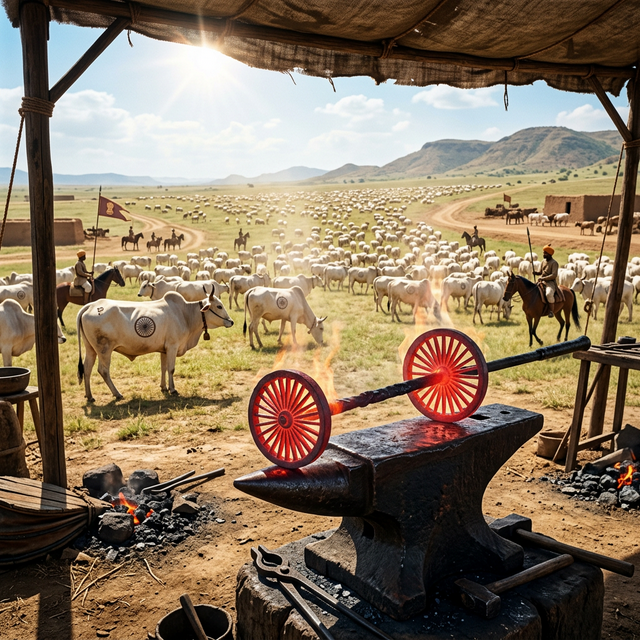
A single, heavy iron branding-iron, its tip glowing a dull cherry-red in the shadows of a forge-tent, rests on an anvil. This object is the stake of the empire’s control over the "wealth of the subject": it is the "Seal of the Herd." Kautilya explains that the state is the ultimate master of the "milch cows, bulls, and calves." He points to the systematic classification: those that are "to be milked," those that are "churners," and those that are "infirm." To Kautilya, a cow is not just an animal but a "unit of dairy production." The stability of the Treasury is built upon this "bovine ledger." A superintendent who cannot account for the "measurement of ghee" or the "branding of a calf" is a man who is blind to the pulse of the land.
The action of the pasture is a forensic monitoring of existence. Kautilya walks the Prince through the branding-ground where every animal is marked with the "King’s brand" to ensure its identity. They watch as the cowherds (gopálaka) prepare the dairy, careful to provide the "standard quantity of ghee" (one-sixth of the milk).
It is a world of strict biological liability: whenever an animal is "caught hold of by a thief, a tiger, or a snake," the herdsman must "make a report of it," or be "compelled to make good the loss." They observe the "forensic surrender" of the dead: when a cow dies a natural death, the herdsman must surrender the "skin with the brand mark," the "fat," the "bile," and even the "teeth and hoofs." It is a technical, predatory discipline: the state measures the "bones of the dead" as precisely as it measures the "coins of the live," ensuring that nothing is lost to the shadow.
But the pasture is also a center of biological assistance. Kautilya points to the "buttermilk given as drink to dogs," explaining that the state must manage even the "coagulated milk" to ensure nothing is wasted. The Prince realizes that "The Keeper of the Herds" is the ultimate expression of the "Duties of Government Superintendents"—the place where the state’s power to "classify and preserve" is literalized in the marking of a calf. The King’s power is the power to "fix the price of the ghee" and to ensure that the "protection of the herd" is as regulated as the defense of a fort. "The Keeper of the Herds" is the biological conscience of the state, captured in the "royal mark on the hide" that binds the pasture to the Crown.
Whenever an animal is caught hold of by a thief, a tiger, a snake, or a crocodile... they shall make a report of it; otherwise they shall be compelled to make good the loss. When an animal dies a natural death, they shall surrender the skin with the brand mark... besides the above, the fat, bile, marrow, teeth, hoofs, horns, and bones.
This is the rule of the pastoral regulation, the documentation for a world where "unaccounted life" is the enemy of the state. It says that the "Superintendent of Cows" must be a scientist of the herd, and that the "skin with the brand mark" is as strategic as a census record. It recognizes that "milch cows" and "iron brands" are the nodes of a network of wealth that connects the King to "The Keeper of the Herds." The state pasture, with its "low stalls" and its "Superintendent of Cows," is the physical evidence of this discipline. The men who need such a rule are those who have understood that the state's strength is first branded, then milked.
The logic of the keeper is the logic of the "Duties of Government Superintendents." It completes the transition from the architecture of the water-ways to the architecture of the biological reserve. It assumes that if you can master the "pastures of the subcontinent" and the "forensic surrender of the dead," you can master the continuity of the state across generations. The state is no longer a master of the flow; it is a master of the pulse.
The canto concludes on the image of the royal brand glowing on the hide of a thousand cattle as they are driven back to the stalls under the setting sun. The herds move in a massive, lowing wave, their white skins catching the last of the golden light, and the marks of the Maurya seal visible on every flank. It is a resonant, pastoral vibration that echoes the clink of the state's gold. Kautilya looks at the "net balance" of the day’s branding and sees the resilient prosperity of the Mauryas written in the dust of the pasture.
Outside, the horizon is lost in the darkness of the night. But inside "The Keeper of the Herds," the world is categorized, branded, and secure. The Prince walks back from the stalls, his mind full of ghee and skins. He has seen the cherry-red irons, and he has heard the report of the tiger. He now knows that the empire is held together not just by gold or iron, but by the "uniform texture" of the life and the unblinking eye of the man who knows exactly what it means to be a calf in the King's herd.