Chapter 17 of 126
The biological fuel of the state, where the management of granaries turns the harvest into a strategic asset of life-and-death importance.
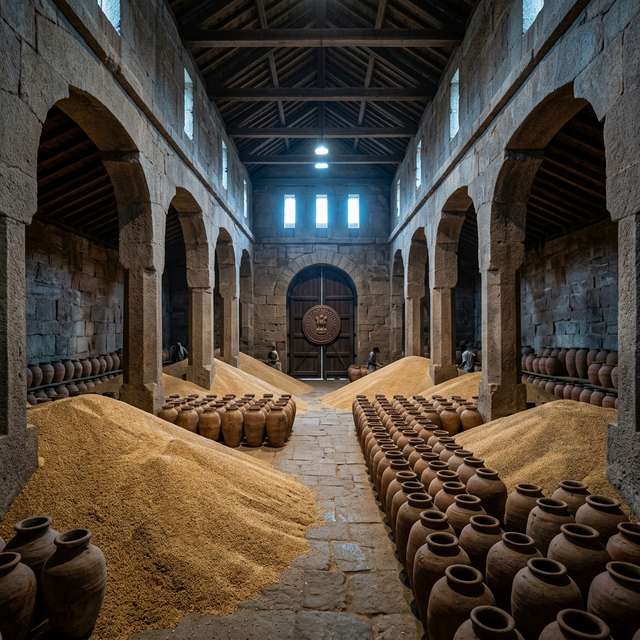
The air in the proximity of the royal storehouses is thick and heavy, a narcotic blend of sun-dried grain, the sharp tang of rock-salt, and the cloying sweetness of raw sugar. These are not merely buildings; they are the caloric lungs of the empire. Massive, shadow-filled halls of timber and stone, they rise like fortresses against the Pataliputra sky, their entrances guarded by men whose only duty is to protect the grain from fire, rot, and the desperate fingers of the hungry. Kautilya leads the Prince into the cool, silent interior of the central granary. Here, the low light reveals mountains of Sítá—the agricultural produce of the crown lands—and the Kupya, the forest products that sustain the state’s industrial and biological needs.
This is the "Pulse of the Harvest," the place where the raw energy of the earth is captured and converted into the steady rhythm of Mauryan life.
A single, dried ear of rice, its husk still golden from the fields of Magadha, rests on a counting-table. This object is the stake of the state’s permanence: it is the primary unit of the Koshthágárádhyakshah, the Superintendent of Storehouses. Kautilya explains that while the sword wins an empire, the grain-heap keeps it. If the storehouses are empty, the King is nothing more than a beggar in purple. The stability of the throne is measured in dronas and prasthas. To Kautilya, the harvest is an abacus where every kernel must be accounted for. A superintendent who cannot tell the difference between "rice prepared for frying" and "rice for pounding" is a man who is inviting famine and rebellion.
The action of the storehouse is a relentless symphony of measurement and conversion. Kautilya walks the Prince through the hierarchy of rations—the precise caloric fuel required for the Mauryan machine. There are the measures for the "bullocks," the "buffaloes," and the "elephants"—one drona of masha or barley, ten ádhakas of bran, and a tula of oilcakes. Then there are the rations for the men: "one sixth of a prastha of salt, one sixteenth of a prastha of oil" for a single meal of a gentleman. They watch the "pounding of grains," where the raw seed is stripped of its husk to become the white wealth of the state.
The process is industrial and forensic: they calculate the "proportion of oil" to the grain, the "sugar from the juice of sugar-canes," and the "scented substances" that preserve the flesh of dried fish.
But the storehouse is also a center of strategic preservation. Kautilya points to the massive jars of salt and oil, explaining that "one-half of the store" must be kept in reserve for "the distress of the people." The state is not just a consumer; it is an insurer against the climate. The Superintendent must manage the transition of the "forest products" into "vessels and ropes," ensuring that the caloric energy of the harvest is matched by the material energy of the workshop. The Prince realizes that the storehouse is the ultimate logistical hub, the place where "food and spices" are transformed into "biological fuel." The King's power is the power to feed, to ratio, and to endure.
One-half shall be kept as a provision against distress... a prastha of rice, one-fourth prastha of supa, and one-sixth prastha of salt... for bullocks, one drona of masha or one drona of barley cooked with other things... half a drona for asses and red spotted deer. Measures of rations for elephants and horses will be described in connection with the duties of their respective superintendents.
This is the rule of the caloric ledger, the documentation for a world where "punge substances" and "proportional increases" are the variables of social order. It says that the "State Storehouse" must be a fortress of mathematics, and that the "cooking of vegetables" is as strategic as the deployment of a phalanx. It recognizes that "one pala of sugar" and "half a prastha of curd" are the nodes of a network of survival that connects the King to the "Pulse of the Harvest." The granary, with its "scented barks" and its "Superintendent of Storehouses," is the physical evidence of this discipline. The men who need such a rule are those who have understood that the state's strength is calculated in the gut.
The logic of the harvest is the logic of the "Duties of Government Superintendents." It completes the transition from the architecture of the artisan’s bench to the architecture of the state's pantry. It assumes that if you can master the "rations for buffaloes" and the "pounding of rice," you can master the loyalty of any man whose belly is full. The state is no longer an investigator; it is a provider of reality.
The canto concludes on the image of the storehouse seal being inspected at dusk. The Superintendent takes a heavy, bronze seal and presses it into the wax on the massive wooden doors. The image is of a grain-stalk intertwined with a sword—the dual signature of Mauryan authority. The bolts slide home with a heavy, resonant thud that echoes in the cooling evening air. Kautilya looks at the "net balance" of the stored grain and see the caloric resilience of the Mauryas written in the silence of the granary.
Outside, the city is settling into the night, the smell of woodsmoke rising from a thousand kitchens. But inside the "Pulse of the Harvest," the world is categorized, rationed, and safe. The Prince walks out into the starlight, his mind full of numbers and the scent of salt. He has seen the grain-mountains, and he has heard the pounding of the rice. He knows now that the empire is held together not just by gold or iron, but by the "uniform texture" of the harvest and the unblinking eye of the man who knows exactly how much salt is required to keep a kingdom from rot.