Chapter 16 of 126
The master goldsmith's vigil, detailing the rigorous audit required to protect the crown's brilliance from the deceptions of the workshop.
The workshop of the Sauvarnika, the State Goldsmith, is a place of microscopic precision and oceanic silence. Here, the raw, heavy ingots of gold from the alchemical furnaces are transformed into the Kañchana—the delicate, shimmering ornaments that define the King’s public prestige. The air is filtered through screens of fine cloth to catch the invisible mist of gold dust that rises from the bickern and the blowpipe. In this room, the state’s wealth is measured not in tons, but in grains (masha). Kautilya leads the Prince into the forge, where the master artisans sit under the unblinking eye of the Superintendent. This is the "Goldsmith’s Forge," the place where the King's authority is literalized in jewelry, and where the threat of deception is as thin and sharp as a gold leaf.
A single, ornate necklace, its gold glowing with a deep, red luster known as Jatara, rests on a black testing-stone. This object is the stake of the crown’s aesthetic order: it is the primary evidence of the artisan’s skill and, potentially, his treason. Kautilya explains that gold is the most intimate of the state’s assets, and therefore the most prone to the "ingenious deceptions" of the men who work it. The Superintendent must be a master of the eight kinds of artisan work—the "compact," the "hollow," the "soldering," and the "gilding." If the avalepya (amalgamation) is not perfect, if the weight has been shifted by a single grain of lead hidden in the "hollow work," the prestige of the Mauryas is compromised.
The action of the forge is a forensic war between the auditor and the artisan. Kautilya speaks of the eight types of false balances that the goldsmiths use to "deceive the public." There is the sannámini, with its bending arms; the bhinnamastaka, with its broken head; and most chillingly, the ayaskánta—the balance that is "combined with a magnet" to subtly pull the scale in favor of the thief. The audit hall is a laboratory of suspicion, where every "weighing balance and counterweight" must be purchased from the state and strictly controlled. The Prince watches as an artisan is caught "folding" a piece of gold—a technique called petaka used to hide an inferior core. The punishment is immediate: the cutting off of the fingers or a fine of two hundred panás.
The state is protecting not just the gold, but the "standard of fineness" that makes the gold valuable.
The Prince watches as a master goldsmith applies a layer of gold leaf to a copper core—the art of vásitakam, or gilding. The man’s hands move with the grace of a musician, but Kautilya sees only the potential for "dropping" or "removal" of the metal. The state goldsmith’s office is a theater of mutual surveillance, where "chiefs, when many, are under the fear of betrayal from each other." The Prince realizes that the King's crown is held together not by love, but by the "soldering" of suspicion and the "amalgamation" of power. To be a master of the state is to be a master of the "hollow neck" and the "bad strings" of the human heart.
Compact work, compact and hollow work, soldering, amalgamation, enclosing, and gilding are the various kinds of artisan work. False balances are—that of bending arms, that of high helm or pivot... and that which is combined with a magnet... dropping, folding, and confounding are the several means employed by goldsmiths to deceive the public.
This is the rule of the micro-audit, the documentation for a world where "confounding" is the primary art of the enemy. It says that the "State Goldsmith" must be a scientist of the scale, and that the "weighing of the gold" is as strategic as the weighing of an army's chances. It recognizes that "bad cups or pans" are the nodes of a network of fraud that can drain the treasury grain by grain. The forge, with its specialized "helm and pivot" and its "Superintendent in charge of counterweights," is the physical evidence of this discipline. The men who need such a rule are those who have understood that the state is only as honest as its smallest weights.
The logic of the forge is the logic of the "Duties of Government Superintendents." It completes the transition from the architecture of the industrial gear to the architecture of the artisan’s bench. It assumes that if you can map the "eight false balances" of the goldsmith, you can map the deceptions of the most sophisticated diplomat. The state is no longer a manufacturer; it is a forensic investigator of beauty.
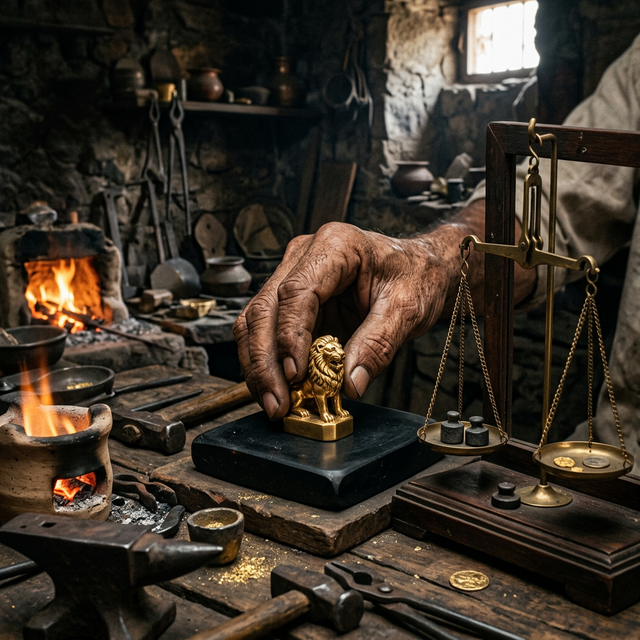
The canto concludes on the image of the perfect ornament—a golden lion-seal—being weighed on a true, state-certified balance at sunset. The arms of the scale are perfectly aligned, the counterweights of dark stone sitting in the pans like frozen omens. The Sauvarnika nods, his face illuminated by the dying orange light of the forge fires. He places the ornament into an ivory box and locks it with a gold-plated key. Kautilya looks at the "net balance" of the artisan’s output and see the prestige of the Mauryas written in the silence of the polished metal.
Outside, the bards are still singing of the King's glory. But inside the goldsmith's forge, the world is measured, soldered, and secure. The Prince walks out into the cool evening air, his shadow a long line of black against the workshop stone. He has seen the magnet pulling the scale, and he has felt the weight of the "compact work." He knows now that the empire is held together not just by the sword or the word, but by the "uniform texture" of the gold and the unblinking eye of the man who knows how to spot a "broken head" in the balance.