Chapter 18 of 126
The heartbeat of the Mauryan economy—the marketplace, where the regulation of trade ensures that the Favor of the People is never sold.
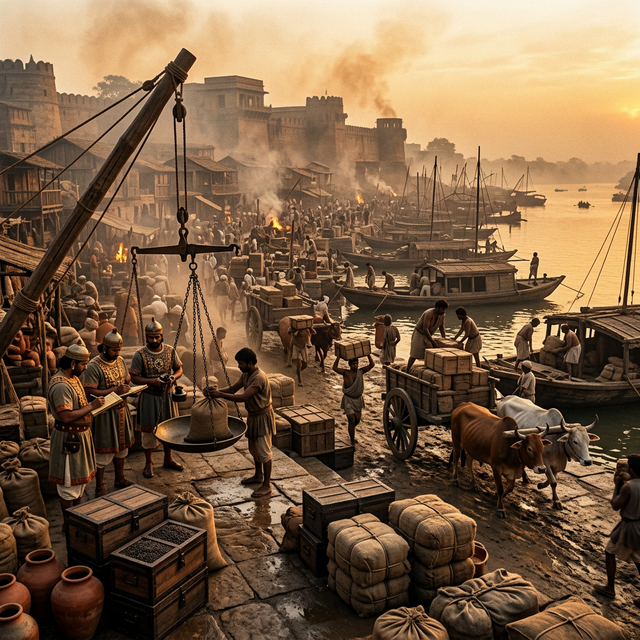
The marketplace of Pataliputra at dawn is a chaotic, breathing map of the world. Even before the "shadow-clock" has marked the first hour, the air is thick with the sound of flat-bottomed boats bumping against the stone wharves and the low, rhythmic groans of the heavy carts as they are unloaded. There is the scent of damp wool from the northern mountains, the metallic tang of copper from the southern mines, and the sharp, medicinal aroma of forest resins. Kautilya leads the Prince through the widening aisles of the panya, where the goods of the empire are being laid out in a grid of state-controlled commerce. This is the "Market's Pulse," the place where the state’s wealth transitions from the silence of the storehouse to the noise of the transaction.
A single, iron-bound chest of Malabar pepper, its surface marked with the seal of the Superintendent, sits on the edge of a merchant's stall. This object is the stake of the state’s commercial reputation: it is the primary unit of the Panyádhyakshah, the Superintendent of Commerce. Kautilya explains that the market is a "theater of trust." If the price is too high, the people suffer; if it is too low, the state’s capital rots. The stability of the Mauryan economy is measured in the "favour of the people." To Kautilya, a merchant who hoards goods to drive up the price is not just a thief; he is a saboteur who is dismantling the "Circle of Kings" from within. A superintendent who allows "large profits" to "harm the people" is failing his primary duty of "avoiding unprofitable markets."
The action of the market is a deliberate, strategic regulation of flow. Kautilya walks the Prince through the categorization of merchandise—the Rájapanyam (state-owned goods) and the Parapanyam (foreign goods). They watch the Superintendent fix the prices of "commodities" to ensure that the "sale of goods" is centralized and "favourable to the people." There is no room for the "volatility of the fair price" here; the state mandates that goods must be sold at a "fixed rate" by "many authorized persons" to prevent the concentration of wealth. They observe the "foreign traders," who are encouraged with "remissions of taxes" and "protection from the distress of law-suits." Kautilya's strategy is to make Pataliputra a "profitable market" for the world, a place where "even the foreign trader feels the favour of the people."
But the market is also a machine for the "prevention of hoarding." Kautilya points to a merchant being fined for "centralizing goods" and "selling them at higher prices." The state ensures that "the sale of the king’s merchandise" is carried out in a way that "avoids large profits." The Prince realizes that the marketplace is the ultimate social stabilizer, the place where the King's authority is tested by the common man's ability to buy salt and grain. The King's power is the power to "ascertain the demand or absence of demand for various kinds of merchandise" and to "concentrate local goods" in a single place. The "Market's Pulse" is the rhythm of social order, captured in the "fixed rate" of the Pana.
The Superintendent of Commerce shall ascertain the demand or absence of demand for various kinds of merchandise... He shall avoid such large profits as will harm the people... He shall show favour to those who import foreign merchandise... [foreigners] shall be exempted from being sued for money.
This is the rule of the total regulation, the documentation for a world where "negotiation and bribery" are countered by the "centralized sale of goods." It says that the "Superintendent of Commerce" must be a psychologist of the crowd, and that the "fixing of prices" is as strategic as the fixing of a border. It recognizes that "tax remissions" and "protection from law-suits" are the nodes of a network of international trade that connects the King to the "Market's Pulse." The marketplace, with its "authorized persons" and its "Superintendent of Commerce," is the physical evidence of this discipline. The men who need such a rule are those who have understood that the state's strength is calculated in the common transaction.
The logic of the market is the logic of the "Duties of Government Superintendents." It completes the transition from the architecture of the storehouse to the architecture of the stall. It assumes that if you can master the "flow of merchandise" and the "fixing of prices," you can master the loyalty of both the merchant and the consumer. The state is no longer a manufacturer; it is a regulator of reality.
The canto concludes on the image of a merchant's caravan disappearing into the dusty horizon at sunset. The carts are heavy with state-certified goods—silks, salt, and spices—moving toward the distant frontiers. The Superintendent watches from the northern gate, his hands resting on the stone railing, his eyes sharp for any "misrepresentation of cubic measures" in the outgoing load. The dust settles as the last cart vanishes, and the heavy iron gates of the market are closed for the night. Kautilya looks at the "net balance" of the day’s trade and see the commercial resilience of the Mauryas written in the silence of the empty stalls.
Outside, the city is settling into the night, the noise of the transaction replaced by the quiet of the home. But inside the "Market's Pulse," the world is categorized, priced, and safe. The Prince walks out into the evening air, his mind full of the "flow of goods" and the "favour of the people." He has seen the pepper-chests, and he has heard the fixers of the Pana. He knows now that the empire is held together not just by gold or iron, but by the "uniform texture" of the market and the unblinking eye of the man who knows exactly how to balance the profit of the King with the peace of the people.