Chapter 70 of 126
The art of time—the strategic use of the calendar and the clock to ensure the King's actions are always aligned with the celestial rhythm.
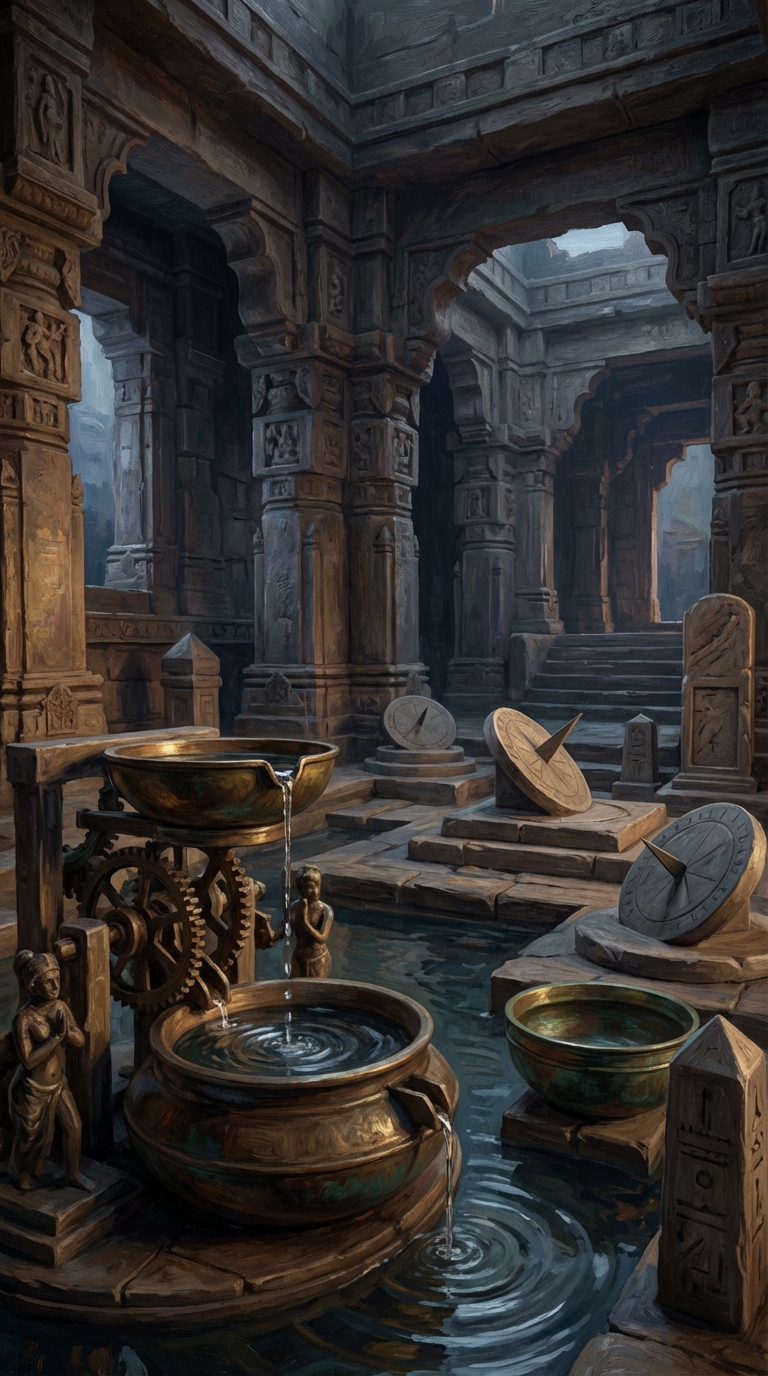
A high, moonlit portico overlooking the silent palace gardens, where the cool night air is still and the only sound is the rhythmic, dry skittering of a single fallen leaf across the marble floor as the seasons begin to shift, is a world of forensic strategy and the sight of an ivory hour-glass being slowly turned by a grey-haired advisor. Here, the Prince and Kautilya observe the forensic logic of "The Art of Time," where the state’s survival is literalized in the management of the transition. This is a place where the social pulse is measured in the continuity of the crown.
Kautilya leads the Prince past the shadow-drenched columns to where the senior minister determines the "integrity of the succession" and the collector-general ensures the "purity of the interregnum." In this forensic sphere, the state does not just endure; it anchors the absolute liability of the change. The "suppression of the temporal thorn" is the measure of the state’s strategic and moral control.
An ivory hour-glass, its frame carved with the figures of the rising and setting sun and its fine, golden sand falling with a silent, mathematical precision, rests on a stone pedestal in the center of the portico. This object is the stake of the empire’s control over the "chaos of the transition": it is the "Vessel of the Cycle." Kautilya explains that the state is the ultimate master of "Time-serving" (Samayácharikah). He points to the systematic regulation of the royal transition: "A courtier must behave with the foresight of a sage during the King's illness, ensuring that the heir-apparent is secured before the final breath... for the state must never be paralyzed by the void between two suns." To Kautilya, a transition of power is not just a change but a "forensic crisis" that invites civil war.
The stability of the Maurya lineage is built upon this "temporal accounting." A minister who "seals the palace gates before the King has died" or an official who "whispers of a new alliance while the old one still breathes" is a man who is rusting the King’s internal strength.
The action of the portico is a forensic monitoring of phase and pulse. Kautilya walks the Prince through the mapping of the "legal continuity," explaining the precise methods for "concealing the King's death until the successor is seated" and the "rules for the 'silent' consolidation of the district's loyalty." They watch as a senior advisor evaluates the "integrity of the court's patience," noting the "moment when the sand has almost run out." It is a world of total informational liability: the law details the "penalties for premature mourning" and the precise "rights of the state to use secret agents to prevent the gathering of a coup." They observe the "rules of the time," ensuring that the "integrity of the royal transition" is as respected as the King’s own standard.
It is a technical, strategic discipline: the state measures the "rhythm of the sand" as precisely as it measures the "depth of the border," ensuring that the subject remains a source of stability as much as order.
But the art of time is also a center of total strategic foresight. Kautilya points to the "Succession Ledger," explaining that the state must ensure that the "engines of order" are never paralyzed by the "friction of the uncertain." The Prince realizes that "The Art of Time" is the ultimate expression of the "Conduct of Courtiers"—the place where the state’s power to "wait and win" is literalized in the turning of an hour-glass. The King’s power is the power to "ascertain the honesty of the era" and to ensure that the "determination of the temporal truth" is as regulated as the weight of a gold coin. "The Art of Time" is the enduring conscience of the state, captured in the "ivory hour-glass" that binds the official to the stable peace.
Samayácharikah (Time-serving)... The courtier shall observe the King's life with patience and foresight, adapting his conduct to the phases of youth, maturity, and age... In the event of the King's illness or death, the senior minister shall ensure a silent and undisputed transition of power to the heir-apparent... All measures, including the concealment of the King's condition, shall be used to prevent civil unrest or the gathering of enemies... The continuity of the state is the highest law... The courtier is the guardian of the cycle.
This is the rule of the temporal regulation, the documentation for a world where "political transition" is the vulnerability of the state. It says that the "Ledger of the Era" must be a scientist of patience, and that the "protection of the succession" is as strategic as the defense of a state-owned fort. It recognizes that "hour-glasses" and "moonlit terraces" are the nodes of a network of stability that connects the King to "The Art of Time." The portico, with its "vows of scrupulous waiting" and its "scrupulous continuity-keeping," is the physical evidence of this discipline. The men who need such a rule are those who have understood that the state's strength is first timed, then secured.
The logic of the time is the logic of the "Conduct of Courtiers." It completes the transition from the contract of the presence to the contract of the cycle. It assumes that if you can master the "form of the transition" and the "forensic precision of the temporal record," you can master the stability of any civilization in the world. The state is no longer a master of the Dignity; it is a master of the Continuity.
The canto concludes on the image of an ivory hour-glass being placed back on a dark wood shelf by a silent advisor, while the first faint light of dawn touches the distant palace spires, signaling the start of a new day and a new era of administrative control. The sound of the glass meeting the wood is a resonant, final sound that echoes the collective stabilization of the kingdom's future. Kautilya looks at the "net balance" of the night’s transitions and sees the resilient reach of the Mauryas written in the silence of the hour-glass.
Outside, the city awakens to a world that believes the King is eternal. But inside "The Art of Time," the world is categorized, timed, and secure. The Prince walks back to his chamber, his mind full of sand and shadows. He has seen the hour-glass turned, and he has heard the dawn bell. He now knows that the empire is held together not just by laws or walls, but by the "uniform texture" of the cycle and the unblinking eye of the man who knows exactly what it means to be eternal in the King's account.