Chapter 55 of 126
The merchant's vigil—the laws of commerce and the protection of the trader, ensuring the flow of wealth is never interrupted by greed.
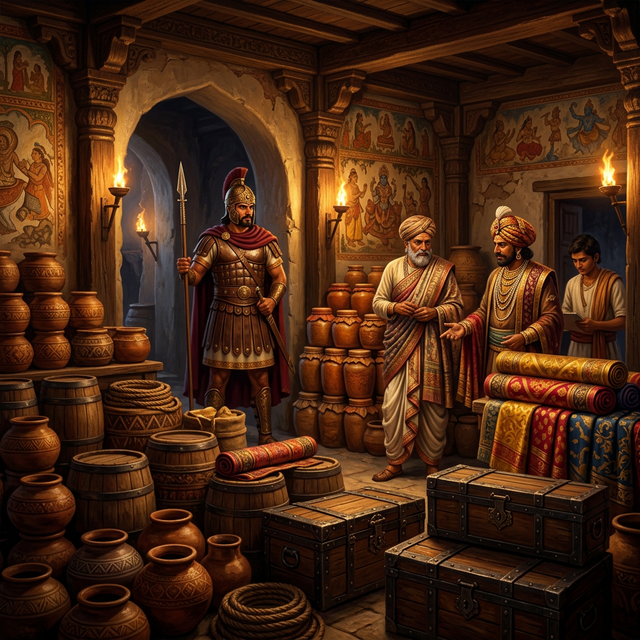
The interior of a bustling metropolitan bazaar at high noon, where the air is a dense fabric of shouting traders, the heavy scent of spices, and the persistent, metallic clink of copper coins changing hands over wide wooden counters, is a world of forensic commerce and the sight of a market superintendent inspecting a merchant's weights with a set of master bronze measures. Here, the Prince and Kautilya observe the forensic logic of "The Merchant's Vigil," where the state’s economic equity is literalized in the oversight of the bazaar. This is a place where the social pulse is measured in the fairness of the price.
Kautilya leads the Prince past the crowded stalls to where the officials record the "outlay of the goods" and the judges ensure the "purity of the profit." In this forensic sphere, the state does not just permit trade; it anchors the absolute integrity of the market. The "suppression of the commercial thorn" is the measure of the state’s preventive and moral control.
A set of balanced bronze scales, their pivots fine and their pans polished to a mirror sheen, rests on a stone podium in the center of the market. This object is the stake of the empire’s control over the "chaos of the hoard": it is the "Vessel of the Vigil." Kautilya explains that the state is the ultimate master of the "Protection of Merchants" (Vaidehakasodhana). He points to the systematic regulation of the price: "The Superintendent shall fix the price of merchandise with due regard to the outlay, the quantity manufactured, and the interest... and shall centralize the sale of goods to prevent the exploitation of the people." To Kautilya, a price-strike or a hidden hoard is not just a greedy act but a "forensic violation" of the national flow.
The stability of the Maurya prosperity is built upon this "commercial accounting." A merchant who "hoards to inflate the price" or a trader who "adulterates the grain" is a man who is rusting the King’s internal strength.
The action of the bazaar is a forensic monitoring of line and value. Kautilya walks the Prince through the mapping of the "legal market," explaining the precise penalties for "cornering the market" and the "rules for the sale of imported goods." They watch as an official evaluates the "honesty of the measure," requiring a spice merchant to "adjust the scale to the state standard." It is a world of total informational liability: the law details the "fines for obstructing traffic" and the precise "rights of the consumer to a fixed rate." They observe the "rules of the vigil," ensuring that the "integrity of the transaction" is as respected as the King’s own standard.
It is a technical, social discipline: the state measures the "rhythm of the trade" as precisely as it measures the "depth of the coffer," ensuring that the subject remains a source of wealth as much as order.
But the merchant's vigil is also a center of total strategic deterrence. Kautilya points to the "Extraction of the Surplus," explaining that the state must ensure that the "engines of the economy" are never paralyzed by the "friction of the monopolistic." The Prince realizes that "The Merchant's Vigil" is the ultimate expression of the "Removal of Thorns"—the place where the state’s power to "centralize and stabilize" is literalized in the sealing of a scale. The King’s power is the power to "ascertain the honesty of the trade" and to ensure that the "determination of the profit" is as regulated as the weight of a gold coin. "The Merchant's Vigil" is the enduring conscience of the state, captured in the "bronze scales" that binds the citizen to the commercial peace.
Vaidehakasodhana (Protection of Merchants)... The Superintendent shall fix prices considering outlay and production costs... Merchants shall sell centralized supplies at fixed rates... Hoarding or cornering the market to increase prices is strictly forbidden... Deception in weights or measures shall be punished with heavy fines... The state ensures a fair profit for the merchant while protecting the people from exploitation.
This is the rule of the market regulation, the documentation for a world where "monopolistic greed" is the enemy of the state. It says that the "Ledger of Prices" must be a scientist of balance, and that the "protection of a grain-measure" is as strategic as the defense of a state-owned mine. It recognizes that "bronze scales" and "centralized warehouses" are the nodes of a network of equity that connects the King to "The Merchant's Vigil." The bazaar, with its "vows of fairness" and its "scrupulous price-keeping," is the physical evidence of this discipline. The men who need such a rule are those who have understood that the state's strength is first balanced, then secured.
The logic of the merchant is the logic of the "Removal of Thorns." It completes the transition from the contract of the craft to the contract of the commerce. It assumes that if you can master the "form of the price" and the "forensic precision of the market record," you can master the stability of any civilization in the world. The state is no longer a master of the Output; it is a master of the Value.
The canto concludes on the image of a merchant's bronze scale being balanced and then sealed with a wax impression of the royal seal by a market official, the red wax hardening into a final, unyielding mark of state approval. The sound of the seal pressing into the wax is a resonant, firm sound that echoes the collective stabilization of the kingdom's trade. Kautilya looks at the "net balance" of the day’s transactions and sees the resilient reach of the Mauryas written in the fairness of the measure.
Outside, the bazaar continues its chaotic, productive motion. But inside "The Merchant's Vigil," the world is categorized, priced, and secure. The Prince walks back from the market, his mind full of outlays and centralizations. He has seen the scale sealed, and he has heard the price fixed. He now knows that the empire is held together not just by laws or walls, but by the "uniform texture" of the value and the unblinking eye of the man who knows exactly what it means to be balanced in the King's account.