Chapter 56 of 126
The cloud of calamity—the strategic management of national disasters, where the King's leadership turns tragedy into a display of state power.
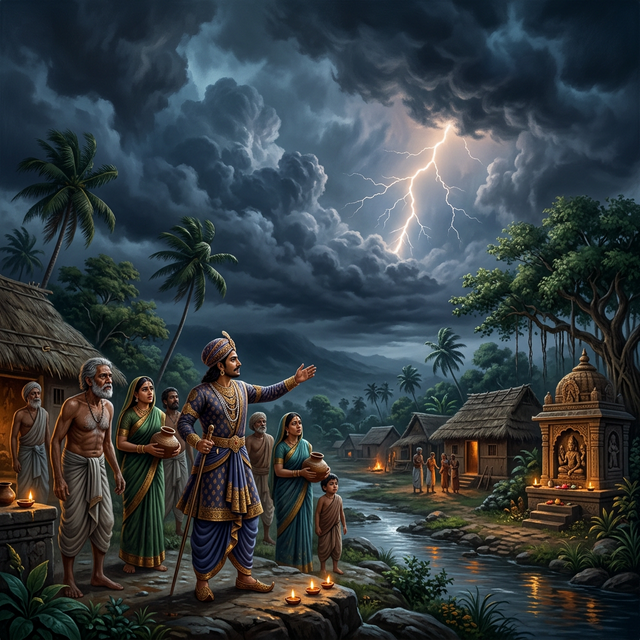
The edge of a massive stone embankment overlooking a swelling, silt-heavy river at dawn, where the air is thick with the scent of damp earth and the low, persistent roar of rising water against the granite blocks, is a world of forensic resilience and the sight of a superintendent of the treasury unsealing a massive ceramic grain jar for emergency distribution. Here, the Prince and Kautilya observe the forensic logic of "The Cloud of Calamity," where the state’s survival instinct is literalized in the management of disaster. This is a place where the national pulse is measured in the timing of the relief.
Kautilya leads the Prince past the anxious citizens to where the officials record the "allocation of the grain" and the priests ensure the "purity of the rite." In this forensic sphere, the state does not just suffer a calamity; it anchors the absolute continuity of the life. The "suppression of the atmospheric thorn" is the measure of the state’s preventive and moral control.
A massive unsealed grain jar, its clay sides cool and its mouth spilling over with golden seed, rests on a wooden platform near the riverbank. This object is the stake of the empire’s control over the "chaos of the famine": it is the "Vessel of the Remedy." Kautilya explains that the state is the ultimate master of "Remedies against National Calamities" (Daivapídana-pratikárah). He points to the systematic regulation of the response: "The King shall always protect the afflicted among his people as a father his sons... and during famine, he shall distribute the seed-grain and coordinate the migration of the people." To Kautilya, a disaster is not just an act of nature but a "forensic failure" if the state remains paralyzed.
The stability of the Maurya endurance is built upon this "crisis accounting." A superintendent who "fails to organize the fire-buckets" or a merchant who "hides grain during a flood" is a man who is rusting the King’s internal strength.
The action of the riverbank is a forensic monitoring of line and relief. Kautilya walks the Prince through the mapping of the "legal remedy," explaining the precise duties for "fighting the fire" and the "rules for the worship of the river." They watch as an official evaluates the "integrity of the levee," requiring a labor gang to "reinforce the stonework before the crest." It is a world of total informational liability: the law details the "fines for failing to run to a house-fire" and the precise "rites for warding off demons and pestilence." They observe the "rules of the remedy," ensuring that the "integrity of the survival" is as respected as the King’s own standard.
It is a technical, visceral discipline: the state measures the "rhythm of the flood" as precisely as it measures the "depth of the coffer," ensuring that the subject remains a source of resilience as much as duty.
But the cloud of calamity is also a center of total strategic preservation. Kautilya points to the "Remedy of the King," explaining that the state must ensure that the "engines of the kingdom" are never paralyzed by the "friction of the catastrophic." The Prince realizes that "The Cloud of Calamity" is the ultimate expression of the "Removal of Thorns"—the place where the state’s power to "protect and provide" is literalized in the opening of a jar. The King’s power is the power to "ascertain the honesty of the survival" and to ensure that the "determination of the relief" is as regulated as the weight of a gold coin. "The Cloud of Calamity" is the enduring conscience of the state, captured in the "grain jar" that binds the citizen to the national peace.
Daivapídana-pratikárah (Remedies against National Calamities)... The King shall protect the people from fire, floods, pestilence, and famine... During floods, the people shall be evacuated to higher ground... In times of famine, the hidden hoards of grain shall be seized and distributed... The King shall perform propitiatory rites to ward off demons and divine visitations... He shall always act as a father to his sons in times of distress.
This is the rule of the disaster regulation, the documentation for a world where "uncoordinated panic" is the enemy of the state. It says that the "Ledger of Relief" must be a scientist of preservation, and that the "protection of a seed-bag" is as strategic as the defense of a state-owned treasury. It recognizes that "grain jars" and "stone embankments" are the nodes of a network of resilience that connects the King to "The Cloud of Calamity." The riverbank, with its "vows of safety" and its "scrupulous distribution-keeping," is the physical evidence of this discipline. The men who need such a rule are those who have understood that the state's strength is first shielded, then secured.
The logic of the remedy is the logic of the "Removal of Thorns." It completes the transition from the contract of the commerce to the contract of the survival. It assumes that if you can master the "form of the disaster" and the "forensic precision of the relief record," you can master the endurance of any civilization in the world. The state is no longer a master of the Value; it is a master of the Life.
The canto concludes on the image of a massive ceramic grain jar being emptied of its last grain into a line of wooden bowls, the golden seed shimmering in the early light as it is shared among the citizens. The sound of the grain hitting the wood is a resonant, dry sound that echoes the collective stabilization of the kingdom's hunger. Kautilya looks at the "net balance" of the day’s distribution and sees the resilient reach of the Mauryas written in the fullness of the bowl.
Outside, the river continues its roar against the stone. But inside "The Cloud of Calamity," the world is categorized, protected, and secure. The Prince walks back from the embankment, his mind full of floods and jars. He has seen the grain shared, and he has heard the river roar. He now knows that the empire is held together not just by laws or walls, but by the "uniform texture" of the survival and the unblinking eye of the man who knows exactly what it means to be a son in the King's account.