Chapter 54 of 126
The artisan's shield—the strategic protection of the state's industries from the deceptions and failures of the marketplace.
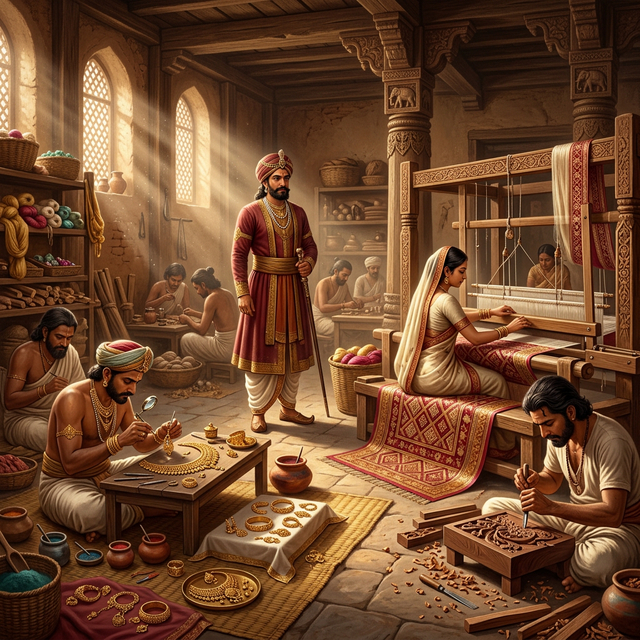
The interior of a massive state-sanctioned weaving hall on the edge of the artisans' quarter, where the air is thick with the scent of raw cotton and the rhythmic, percussive clatter of a hundred wooden looms, is a world of regulated industry and the sight of a superintendent measuring the length of a freshly woven bolt of silk with a bronze rule. Here, the Prince and Kautilya observe the forensic logic of "The Artisan's Shield," where the state’s economic health is literalized in the oversight of the guild. This is a place where the social pulse is measured in the precision of the thread.
Kautilya leads the Prince past the sweating weavers to where the guild-masters account for the "loss of weight" and the inspectors ensure the "purity of the craft." In this forensic sphere, the state does not just protect the artisan; it anchors the absolute reliability of the product. The "suppression of the economic thorn" is the measure of the state’s preventive and moral control.
A silver weaver’s shuttle, its surface polished by the passage of millions of threads and its tip reinforced with a tiny bead of lead to maintain balance, rests on a supervisor's bench. This object is the stake of the empire’s control over the "greed of the guild": it is the "Vessel of the Craft." Kautilya explains that the state is the ultimate master of the "Protection of Artisans" (Kárukantakasodhana). He points to the systematic regulation of the labor: "Three commissioners shall be stationed to protect the artisans... weavers shall increase the weight by one-tenth in the case of wool, and shall be fined for any delay or loss of material." To Kautilya, a craftsman’s error is not just a mistake but a "forensic violation" of the national resource.
The stability of the Maurya economy is built upon this "industrial accounting." A goldsmith who "steals a masha of gold" or a washerman who "wears the customer's clothes" is a man who is rusting the King’s internal strength.
The action of the hall is a forensic monitoring of weight and time. Kautilya walks the Prince through the mapping of the "legal craft," explaining the precise penalties for "changing the form of the article" and the "rules for the delivery of the work." They watch as a commissioner evaluates the "texture of the cloth," requiring the guild-master to "compensate for the deficiency." It is a world of total informational liability: the law details the "fines for delays in washing" and the precise "rights of the artisan to seasonal wages." They observe the "rules of the guild," ensuring that the "integrity of the contract" is as respected as the King’s own standard.
It is a technical, proactive discipline: the state measures the "rhythm of the shuttle" as precisely as it measures the "depth of the coffer," ensuring that the subject remains a source of wealth as much as order.
But the artisan's shield is also a center of total strategic deterrence. Kautilya points to the "Removal of Thorns," explaining that the state must ensure that the "engines of production" are never paralyzed by the "friction of the fraudulent." The Prince realizes that "The Artisan's Shield" is the ultimate expression of the "Removal of Thorns"—the place where the state’s power to "regulate and cleanse" is literalized in the measurement of a thread. The King’s power is the power to "ascertain the honesty of the hand" and to ensure that the "determination of the wage" is as regulated as the weight of a gold coin. "The Artisan's Shield" is the enduring conscience of the state, captured in the "silver shuttle" that binds the citizen to the productive peace.
Kárukantakasodhana (Protection of Artisans)... Three commissioners shall protect the interests of artisans... Weavers, washermen, and goldsmiths shall be overseen... Fines for delays, theft of material, or poor workmanship shall be strictly enforced... The state fixes the wages and ensures the guilds fulfill their contracts... Any deception in the manufacture of articles is a crime against the prosperity of the state.
This is the rule of the craft regulation, the documentation for a world where "industrial negligence" is the enemy of the state. It says that the "Ledger of Labor" must be a scientist of efficiency, and that the "protection of a weaver's yarn" is as strategic as the defense of a mountain pass. It recognizes that "silver shuttles" and "weaving halls" are the nodes of a network of wealth that connects the King to "The Artisan's Shield." The hall, with its "vows of quality" and its "scrupulous weight-keeping," is the physical evidence of this discipline. The men who need such a rule are those who have understood that the state's strength is first measured, then secured.
The logic of the artisan is the logic of the "Removal of Thorns." It completes the transition from the contract of the law to the contract of the security. It assumes that if you can master the "form of the craft" and the "forensic precision of the production record," you can master the vitality of any civilization in the world. The state is no longer a master of the Dharma; it is a master of the Output.
The canto concludes on the image of a weaver’s shuttle being handed back to a guild-master by a state commissioner, while the superintendent records the day's production in a thick birch-bark ledger. The sound of the ledger closing is a resonant, dry sound that echoes the collective stabilization of the kingdom's industry. Kautilya looks at the "net balance" of the day’s labor and sees the resilient reach of the Mauryas written in the uniformity of the weave.
Outside, the weaving hall continues its relentless clatter. But inside "The Artisan's Shield," the world is categorized, regulated, and secure. The Prince walks back from the quarter, his mind full of weights and mashas. He has seen the shuttle pass, and he has heard the ledger close. He now knows that the empire is held together not just by laws or walls, but by the "uniform texture" of the craft and the unblinking eye of the man who knows exactly what it means to be productive in the King's account.