Chapter 19 of 126
The lethal bounty of the forest, showing how timber, bamboo, and poisons are harvested and transformed into the state's arsenal.
The transition from the deep, humid Silence of the Mauryan reserve-forests to the rhythmic, metallic Clang of the Pataliputra armoury is the transition from biological potential to lethal reality. In the first world, the Kupyádhyakshah, the Superintendent of Forest Produce, marks the massive, grey-barked trunks of Sáka (Teak) and Arjuna with the King’s signet, reserving the living earth for the state’s eventual violence. In the second world, the Áyudhághárádhyakshah, the Superintendent of Armoury, sits in a vast hall that smells of cold iron, animal fat, and the resinous sting of seasoned wood. Here, the "Arsenals of the Wild" are organized in a grid of perfect readiness. Kautilya leads the Prince through the rows of finished bows, their curves as elegant as a line of verse, and their power as blunt as a hammer-strike.
This is the place where the chaos of nature is disciplined into the geometry of the kill.
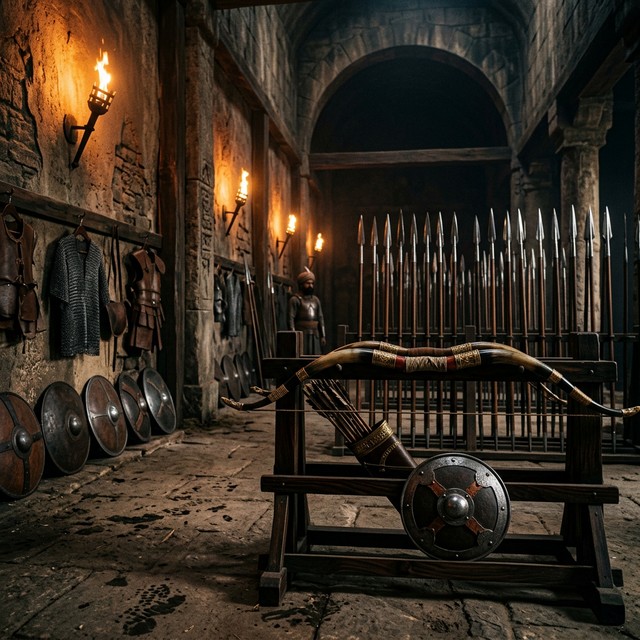
A single, composite bow of Kármuka pattern, its surface darkened by layers of horn and sinew, rests on a rack of dark shisham wood. This object is the stake of the empire’s tactical reach: it is the primary instrument of the Armoury. Kautilya explains that a weapon is only as good as the forest that birthed it. If the Teak is not seasoned, if the Bamboo is not "possessed of fine hair" and uniform texture, the King's aim will falter at the critical moment. The stability of the "Circle of Kings" is measured in the "standard of fineness" of the wood and the "precisely ascertained supply" of arrows. To Kautilya, the armoury is a forensic archive where every "wear and tear, decay and loss" must be documented.
A superintendent who cannot tell the difference between a "long bow" (Dhanusha) and a "staff" (Kodanda) is a man who is inviting defeat.
The action of the arsenal is a relentless, strategic assembly of the earth's most dangerous materials. Kautilya catalogs the woods: the sirisha for its lightness, the simsúpa for its strength, and the fibrous barks like lodhra that bind the world together. They move to the metallurgy of war—the "gloves" (nágodariká) and the "coats of mail" made of iron or skin. They watch the "expert workmen" as they invent new "delusive and destructive contrivances"—siege engines and traps that turn the horizontal plane of the battlefield into a vertical nightmare. The armoury is not just a storehouse; it is a factory of "new inventions" where the "Expert workmen" are encouraged to push the boundaries of lethality.
Every weapon is a "commodity" produced from the "collection of all kinds of revenue," a physical unit of the King's will that can be cleaned, oiled, and deployed.
But the arsenal is also a center of logistical auditing. Kautilya points to the rows of "self-defence instruments"—the charma (shield) and the kitika—explaining that the Superintendent must "precisely ascertain the demand and supply" of weapons. The state ensures that "weapons, their application, and their loss" are always in balance. The Prince realizes that the armoury is the ultimate expression of the "Duties of Government Superintendents"—the place where the "forest products" of the wild become the "instruments of the state." The King’s power is the power to "fix adequate fines" for damaging the productive forests, ensuring that the supply of "timber and other products" is eternal. The "Arsenals of the Wild" are the lethal memory of the earth, captured in the "rows of spears" that reflect the orange torchlight.
The Superintendent of Forest Produce shall collect timber and other products... fixed adequate fines... for those who cause any damage to productive forests. The Superintendent of Armoury shall precisely ascertain the demand and supply of weapons... their application, their wear and tear, as well as their decay and loss. Gloves (nágodariká) are varieties of armour... such other delusive and destructive contrivances together with any other new inventions of expert workmen shall also be kept in stock.
This is the rule of the lethal inventory, the documentation for a world where "timber and bamboo" are the variables of conquest. It says that the "Superintendent of Armoury" must be a scientist of decay, and that the "application of weapons" is as strategic as their manufacture. It recognizes that "expert workmen" and "new inventions" are the nodes of a network of dominance that connects the King to the "Arsenals of the Wild." The armoury hall, with its "goads and hooks" and its "Superintendent of Weights and Measures," is the physical evidence of this discipline. The men who need such a rule are those who have understood that the state's strength is first harvested, then forged.
The logic of the arsenal is the logic of the "Duties of Government Superintendents." It completes the transition from the architecture of the market to the architecture of the machine. It assumes that if you can master the "supply of timber" and the "wear and tear of iron," you can master the destiny of any man who stands against the Mauryan signet. The state is no longer a regulator; it is an engineer of reality.
The canto concludes on the image of a row of spears reflecting the orange light of the night-torches as the Armoury is locked for the evening. The Áyudhághárádhyakshah walks the line, his hand occasionally touching the cold, polished iron of a Charma. He nods to the guards, his face a mask of logistical certainty. The heavy iron doors slide home with a resonant, metallic boom that echoes through the subterranean halls. Kautilya looks at the "net balance" of the weaponry and see the lethal resilience of the Mauryas written in the silence of the iron.
Outside, the city is settling into the night, the bards still singing of the King's glory. But inside the "Arsenals of the Wild," the world is categorized, oiled, and deadly. The Prince walks out into the cool evening air, his mind full of the "composite bow" and the "coat of mail." He has seen the teak-trunks marked with the seal, and he has heard the clang of the armoury. He knows now that the empire is held together not just by gold or grain, but by the "uniform texture" of the iron and the unblinking eye of the man who knows exactly when a spear will break.