Chapter 23 of 126
The industrial loom of the state, where the production of textiles provides both an economic engine and a social safety net for the vulnerable.
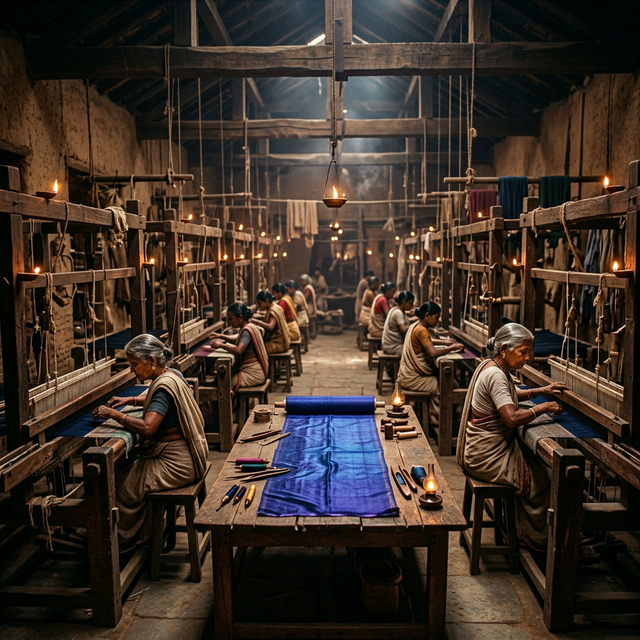
The weaving hall of Pataliputra is a world of rhythmic clatter and floating lint. Here, the Sútrádhyakshah, the Superintendent of Weaving, presides over a vast, humid interior where the air is heavy with the smell of raw wool, damp flax, and the sharp, vegetal scent of bark-fibres being processed. This is "The Loom of the State," a place where industrial production meets social engineering. Kautilya leads the Prince past rows of heavy timber looms, their shuttles moving in a synchronized dance that sounds like the heartbeat of the city. In this hall, the state does not just manufacture cloth; it integrates the most vulnerable members of society into its productive machine. The "standard of the thread" is the measure of the empire's domestic resilience.
A single bolt of Dukúla silk, its surface as smooth as polished jade and its color a deep, royal indigo, rests on a inspection table. This object is the stake of the empire’s aesthetic and economic dominance: it is the "Standard of Manufacture." Kautilya explains that the weaving hall is the state's most sophisticated labor experiment. He points to the women working the looms—widows, the elderly (vṛddha-rájasidbhyaḥ), former temple dancers, and those "who have failed to pay fines." For Kautilya, these are not passive subjects but biological assets to be optimized. The stability of the Mauryan economy is woven from the labor of those who have no other patron but the King. A superintendent who cannot balance "rewards for best manufacture" with the "fines for diminution of quality" is a man who is wasting the state’s human capital.
The action of the weaving hall is the forensic audit of the thread. Kautilya walks the Prince through the hierarchy of materials. They watch as raw cotton, wool, and "fibres yielded by worms" are weighed and distributed to the weavers. It is a world of strict incentive: those who produce more than the required amount receive "extra rewards" (bhaktavetana), while those who delay or produce inferior goods face the "curtailment of their wages." They observe the "lamp-light" audit—a specialized inspection where the Superintendent examines the weave in the flickering shadows, careful to "never look at the face of the women" except when discussing the work. It is a technical, disciplined environment where even the "sending of cotton by those who cannot leave their homes" is organized into a state-managed logistics chain.
But the weaving hall is also a center of moral and industrial protection. Kautilya points to the "middle-men" and "servants" who must be kept in check, explaining that the state must protect its workers from "indecent behavior" or "unnecessary delay." The Prince realizes that the "Loom of the State" is the ultimate expression of the "Duties of Government Superintendents"—the place where the state’s power to "employ and protect" is literalized in the production of every yard of linen. The King’s power is the power to "reward the best workmen" and to ensure that the "manufacture of mail-armour and ropes" is as precise as the weaving of a queen’s sari. The "Loom of the State" is the industrial pulse of the empire, captured in the "rhythmic shuttle" that binds the subject to the Crown.
The Superintendent of Weaving shall employ widows, crippled women, girls, mendicant or ascetic women... those who have failed to pay fines... for the manufacture of threads (sútra), coats, cloths (vastra), and ropes. Those who manufacture a greater quantity shall be presented with oil and myrobalan fruits as a reward... if a woman is found at any other place than the weaving hall... she shall be fined. The Superintendent shall not look at the face of the women... for any other purpose than that of weaving...
This is the rule of the industrial weaving, the documentation for a world where "vulnerable labor" is the variable of imperial strength. It says that the "Superintendent of Weaving" must be a scientist of society, and that the "lamp-light audit" is as strategic as a military inspection. It recognizes that "silk" and "mail-armour" are the nodes of a network of production that connects the King to the "Loom of the State." The weaving hall, with its "rhythmic looms" and its "Superintendent of Weaving," is the physical evidence of this discipline. The men who need such a rule are those who have understood that the state's strength is first spun, then woven.
The logic of the loom is the logic of the "Duties of Government Superintendents." It completes the transition from the architecture of the gate to the architecture of the factory. It assumes that if you can master the "production of thread" and the "integration of the subject," you can master the material comfort of an entire subcontinent. The state is no longer an enforcer of contribution; it is an organizer of purpose.
The canto concludes on the image of a perfectly woven silk cloth being stamped with the royal peacock-seal as the evening lamps are lit. The Superintendent presses the bronze signet into the edge of the fabric, a mark of Mauryan quality that will travel to markets as far as Alexandria and Rome. The weaving hall falls into a temporary silence as the workers begin to depart, their shadows long against the stone walls. Kautilya looks at the "net balance" of the day’s production and sees the industrial resilience of the Mauryas written in the silence of the looms.
Outside, the city is settling into the night, the bards still singing of the King's glory. But inside the "Loom of the State," the universe is categorized, woven, and secure. The Prince walks out into the cool evening air, his mind full of threads and rewards. He has seen the bolts of indigo silk, and he has heard the clatter of the shuttles. He knows now that the empire is held together not just by gold or iron, but by the "uniform texture" of the weave and the unblinking eye of the man who knows exactly how a thread becomes a state.