Chapter 28 of 126
The master of the monsoon—the Admiral's guide to the rivers and seas, where the control of the waters expands the reach of the King's hand.
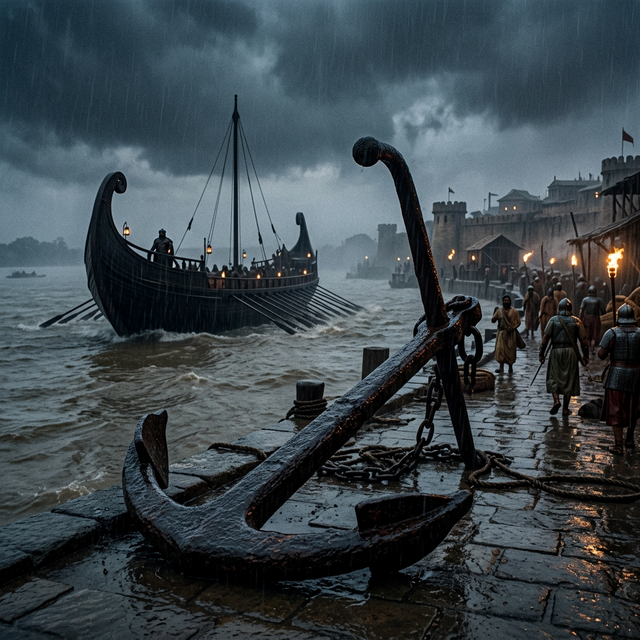
The state docks of Pataliputra during the monsoon are a world of grey water and the heavy, rhythmic thud of salt-soaked timbers. Here, the Návadhyakshah, the Superintendent of Ships, presides over an environment where the liquid borders of the empire are strictly audited. This is "The Admiral of the Monsoon," a place where maritime sovereignty is literalized in the strength of a hull. Kautilya leads the Prince past the high, curved prows of the state galleys, the air thick with the smell of wet hemp, boiling pitch, and the sharp spray of the river. In this port, the state does not just facilitate travel; it defines the conditions of arrival. The "standard of the royal ship" is the measure of the state’s fluid and relentless control.
A single, heavy iron anchor, its fluke caked with river-silt and its chain taut with the tension of the tide, rests on a stone pier. This object is the stake of the empire’s control over the "waters of the subject": it is the "Vessel of Sovereignty." Kautilya explains that the state is the ultimate master of the "navigation of oceans and mouths of rivers." He points to the state-owned fleet that monitors the "conch-shells and pearls" and the merchant vessels that pay the "customary toll." To Kautilya, the water is not a barrier but a "highway of fiscal capture." The stability of the Treasury is built upon this "maritime ledger." A superintendent who allows a "pirate ship" to pass or a "weather-beaten vessel" to sink without state intervention is a man who is leaking the King’s authority.
The action of the docks is a forensic monitoring of the crossing. Kautilya walks the Prince through the checkpoint where the Návadhyakshah enforces the "rules of the shore." They watch as the guards arrest a traveler who has "no baggage" and a "perturbed appearance," and another who is "stealthily carrying valuable things." It is a world of strict security: "Pirate ships, vessels which are bound for the enemy’s country, and those which have violated the customs of port-towns shall be destroyed." Yet, they also see the state’s protective hand: "Vessels which have been weather-beaten... shall be provided with every kind of assistance." It is a technical, dualistic discipline: the state measures the "sailing fee" as precisely as it measures the "depth of the channel," ensuring that the river is a site of order as much as transit.
But the water-edge is also a center of social and political monitoring. Kautilya points to the "pregnant women," the "ascetics," and the "royal messengers" who are provided with "free passes to cross rivers." The Prince realizes that "The Admiral of the Monsoon" is the ultimate expression of the "Duties of Government Superintendents"—the place where the state’s power to "permit and prohibit" is literalized in the boarding of a ship. The King’s power is the power to "fix the fishing license" at "1/6th of the haul" and to ensure that the "arrest of the suspect" is as inevitable as the monsoon rain. "The Admiral of the Monsoon" is the hydrological conscience of the state, captured in the "watchful eye at the port-town" that binds the horizon to the Crown.
Pirate ships, vessels which are bound for the enemy's country, and those which have violated the customs of port-towns shall be destroyed. Whenever a weather-beaten ship arrives... the Superintendent shall show paternal kindness to it. Passengers arriving on board the king's ship shall pay the requisite amount of sailing fees. Fishermen shall give 1/6th of their haul as fees for fishing license. Royal messengers, pregnant women, and children shall be provided with free passes.
This is the rule of the water regulation, the documentation for a world where "unmonitored movement" is the enemy of the state. It says that the "Superintendent of Ships" must be a scientist of the currents, and that the "fishing license" is as strategic as a border fort. It recognizes that "anchors" and "sailing fees" are the nodes of a network of sovereignty that connects the King to "The Admiral of the Monsoon." The state dock, with its "tarred timbers" and its "Superintendent of Ships," is the physical evidence of this discipline. The men who need such a rule are those who have understood that the state's strength is first buoyant, then unyielding.
The logic of the admiral is the logic of the "Duties of Government Superintendents." It completes the transition from the architecture of the gilded cage to the architecture of the imperial reach. It assumes that if you can master the "navigation of the subcontinent" and the "arrest of the stranger at the crossing," you can master the secrets of every soul that enters the empire. The state is no longer a master of allure; it is a master of the flow.
The canto concludes on the image of a state galley patrolling the river-mouth as the sun sets behind the monsoon clouds. The rowers move in a rhythmic, disciplined unison, their blades cutting the dark water with a resonant, predatory splash. The Návadhyakshah stands at the prow, his eyes scanning the horizon for the silhouette of an unauthorized sail. Kautilya looks at the "net balance" of the evening’s patrol and sees the resilient sovereignty of the Mauryas written in the movement of the tide.
Outside, the river flows silently into the darkness of the sea. But inside "The Admiral of the Monsoon," the world is categorized, monitored, and secure. The Prince walks back from the docks, his mind full of anchors and tolls. He has seen the iron-bound galleys, and he has heard the arrest of the suspect. He now knows that the empire is held together not just by gold or iron, but by the "uniform texture" of the water and the unblinking eye of the man who knows exactly what it means to be a ship in the King's monsoon.