Chapter 15 of 126
Where the forge meets the throne—the strategic control of mines and industrial production that fuels the empire's economy and its war machine.
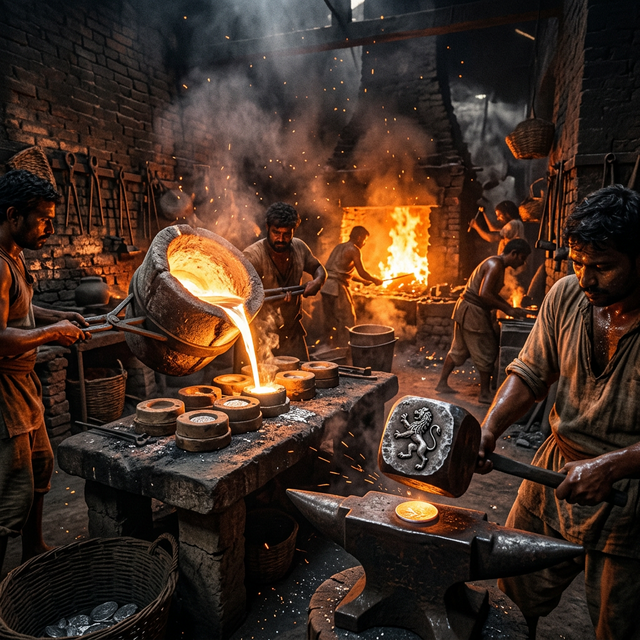
The air in the furnace rooms of the Mauryan mint is not air at all; it is a shimmering, sulfurous soup of heat and orange light. Here, deep beneath the administrative grids of Pataliputra, the state performs its most fundamental alchemy: the transformation of the earth's raw, chaotic bones into the disciplined currency of empire. The roar of the bellows is a constant, rhythmic thunder that rattles the teeth of the supervisors and the shackled "mine-laborers" who feed the fires. Kautilya stands at the threshold of the melting-hall, his shadow flickering long and jagged against the smoke-stained walls. Beside him, the Prince wipes soot from his eyes, watching a stream of molten silver pour into a stone crucible. This is the "Alchemies of the Earth," the process by which the "blood of the state" is pressurized into being.
A single, unpolished lump of ore, heavy with the weight of copper and streaked with the dull red of arsenic, sits on a testing-stone. This object is the stake of the empire’s metabolism: it is the primary ingredient of the Lakshnádhyakshah, the Superintendent of Mint. Kautilya explains that a mine is a "womb of wealth," but a womb that is guarded by the "Superintendent of Metals" and the "Examiner of Coins." If the metal is not pure, if the mercury is not balanced, the very concept of value begins to rot. To Kautilya, the furnace is a court of law where the "standard of fineness" is the only evidence that matters. A coin that is "slippery as a wet surface" or inconsistent in its "redness like the sun" is an act of treason against the economy.
The action of the industrial heart is a relentless, forensic classification of the earth’s interior. Kautilya identifies the different ores: the "vaikrintaka" that smells of sulfur, the "bell-metal" that rings with a hollow clarity, and the "brass" that gleams like a false god. They watch the "purification of metals," where the dross is skimmed away to reveal the "white and soft fabric" of the silver. The minting process is a symphony of hammers and dies, each stroke imprinting the seal of the Mauryan lion into the cold metal. The coins—the Pana, the Mashaka, and the Kakani—are produced in a precise hierarchy of copper, silver, and lead. Every coin is a "commodity" produced from the "collection of all kinds of revenue," a physical unit of the King's will that can be counted, stored, and spent.
But the state’s monopoly on the earth is absolute. Kautilya points to a prisoner working in chains at the heavy crushing-stone—a man caught "carrying on mining operations without license." He is being "caused to work" as a slave of the treasury, his life becoming a direct literalization of the mineral he tried to steal. The state "directly exploits" the mines that can be worked without much outlay, and leases out the deeper, more complex veins for a "fixed share of the output." Internal security is maintained by the "Examiner of Coins," a man who checks the "test marks" and the "cubic measures" of every batch. The Mauryan economy is a closed loop of extraction and manufacture, where even the "theft of mineral products" is calculated as a variable in the "net balance."
Any person who steals mineral products or carries on mining operations without license shall be bound (with chains) and caused to work (as a prisoner)... The superintendent of metals shall carry on the manufacture of copper, lead, tin... and also of commodities from them. The superintendent of mint shall carry on the manufacture of silver coins... a Pana, half a Pana, a quarter Pana, and one-eighth Pana.
This is the rule of the total extraction, the documentation for a world where the "body of expenditure" is fueled by the "manufacture of commodities." It says that the "wise collector-general" is the one who treats the mountains as a laboratory of revenue. It recognizes that "mines which require large outlay" are the high-risk, high-reward pivots of the treasury. The furnace hall, with its specialized "crucibles and pots" and its "Superintendent of Metals," is the physical evidence of this discipline. The men who need such a rule are those who have understood that the crown is forged in the heat, and that survival is a matter of metallurgical purity.
The logic of the alchemy is the logic of the "Duties of Government Superintendents." It completes the transition from the architecture of the gem to the architecture of the industrial gear. It assumes that if you can control the "composition of the Pana" and the "manufacture of bronze," you can control the movement of every man in the "Circle of Kings." The state is no longer a curator; it is a manufacturer of reality.
The canto concludes on the image of the cold, stamped coins being weighed in a massive balance at the end of the shift. The Lakshnádhyakshah watches as the counter-weights are placed, his eyes sharp for the slightest "misrepresentation of cubic measures." The silver clicks against the copper, a dry, metallic music that echoes through the cooling furnace room. The orange light fades to a dull, smoky grey, and the iron doors are locked for the night. Kautilya looks at the "net balance" of the daily output and see the industrial resilience of the Mauryas written in the weight of the metal.
Outside, the city is quiet, the "shadow-clock" long since passed into the night. But inside the alchemical heart, the warmth of the fires still lingers in the stone floors. The Prince looks at his hands, stained with the black of the soot and the red of the ore, and feels the heat of the state’s blood. He has seen the earth being broken and remade, and he has heard the hammer-strike of the mint. He knows now that the empire is held together not just by the word or the sword, but by the "uniform texture" of the metal and the unblinking eye of the man who weighs the gold.