Chapter 27 of 126
A study in the gilded cage of the royal ladies, detailing how to manage the vast household while ensuring the King's safety is never compromised.
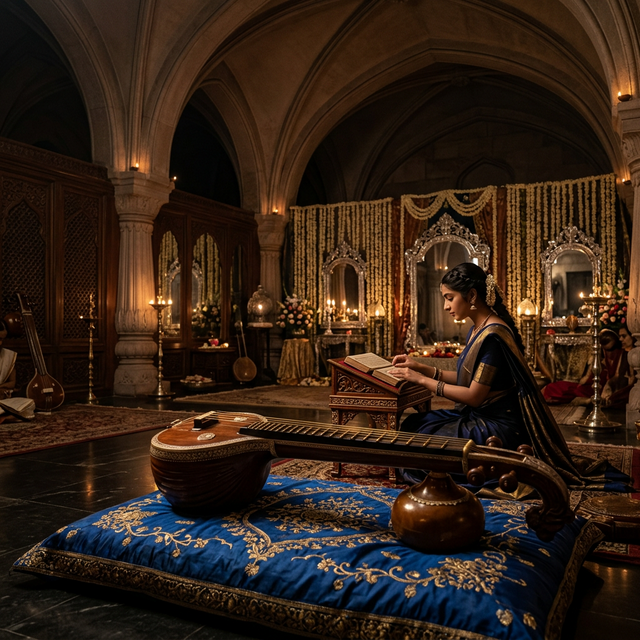
The music hall of Pataliputra is a world of filtered light and the heavy, sweet scent of crushed jasmine. Here, the Ganikádhyakshah, the Superintendent of Prostitutes, presides over an environment where beauty is treated as a strategic asset. This is "The Gilded Cage," a place where the state’s investment in pleasure is as calculated as its investment in iron. Kautilya leads the Prince past a courtyard where a young woman is practicing the veena, her fingers moving with a precision that speaks of years of state-funded training. In this hall, the state does not just regulate desire; it manufactures it as a tool of capture. The "standard of the sixty-four arts" is the measure of the state’s aesthetic and forensic control.
A single, finely tuned veena, its wood dark and its strings taut with resonance, rests on a silk cushion. This object is the stake of the empire’s control over the "arts of the subject": it is the "Vessel of Refinement." Kautilya explains that the state is the ultimate patron of the "aesthetic pulse." He points to the scholars and teachers who are paid by the Treasury to instruct the Ganikas in music, dancing, acting, writing, and even "the arts of logic and forensics." To Kautilya, a prostitute who is skilled in the "sixty-four arts" is not just a performer but a "living node of intelligence." The stability of the court is built upon this "calibration of talent." A superintendent who cannot distinguish between a "first-class Ganika" and one of minor utility is a man who is wasting the King’s gold.
The action of the hall is a forensic monitoring of agency. Kautilya walks the Prince through the ledger-room where the Ganikádhyakshah records the "daily income and expenditure" of every woman in the house. It is a world of strict fiscal capture: the state demands "two days' earnings every month" as a tax on pleasure. They watch as the Superintendent manages the "legal status" of the Ganikas, ensuring they are protected from "excessive demands" while remaining bound to the Crown. It is a technical, predatory discipline: the state measures the "rhythm of the feet" as precisely as it measures the "purity of silver," ensuring that the dance is a source of information as much as artistry.
But the music hall is also a center of high-level surveillance. Kautilya points to the women who act as "messengers and informants" for the King, explaining that the state must use the "intimacy of the chamber" to detect "hidden treachery." The Prince realizes that "The Gilded Cage" is the ultimate expression of the "Duties of Government Superintendents"—the place where the state’s power to "beautify and observe" is literalized in the training of a singer. The King’s power is the power to "appoint the Ganika" and to ensure that the "reward for skill" is as regulated as the price of grain. "The Gilded Cage" is the aesthetic conscience of the state, captured in the "gilded anklets" that bind the dancer to the Majesty.
The Superintendent shall determine the earnings... and shall always keep in check those who seek to cheat the King. The state shall provide for the maintenance of teachers who teach these arts to Ganikas. He who commits rape on a Ganika... shall have his limb cut off or pay a fine. A Ganika shall receive... a salary of 1,000 panas. She shall pay... monthly a tax of two days' earnings.
This is the rule of the pleasure regulation, the documentation for a world where "unmonitored entertainment" is the enemy of the state. It says that the "Superintendent of Prostitutes" must be a scientist of refinement, and that the "sixty-four arts" are as strategic as a mountain pass. It recognizes that "lutes" and "silk scrolls" are the nodes of a network of intelligence that connects the King to "The Gilded Cage." The state hall, with its "scented chambers" and its "Superintendent of Prostitutes," is the physical evidence of this discipline. The men who need such a rule are those who have understood that the state's strength is first refined, then deployed.
The logic of the cage is the logic of the "Duties of Government Superintendents." It completes the transition from the architecture of the slaughterhouse to the architecture of the human spirit. It assumes that if you can master the "pleasures of the subcontinent" and the "education of the artist," you can master the secret desires of every courtier in the empire. The state is no longer a master of mercy; it is a master of allure.
The canto concludes on the image of a dancer’s anklets being weighed against a small gold coin on a bronze scale at midnight. The Ganikádhyakshah records the weight in a heavy ledger, the ink still wet on the page. The anklets chime softly as they are lifted back into their velvet box, a resonant, delicate vibration that echoes the clink of the state's coffers. Kautilya looks at the "net balance" of the evening’s artistry and sees the resilient allure of the Mauryas written in the silence of the hall.
Outside, the moon is high over Pataliputra, and the scent of jasmine persists in the cool air. But inside "The Gilded Cage," the world is categorized, trained, and secure. The Prince walks through the quiet corridors, his mind full of lutes and ledgers. He has seen the dark-wood veenas, and he has heard the chiming of the anklets. He now knows that the empire is held together not just by gold or iron, but by the "uniform texture" of the arts and the unblinking eye of the man who knows exactly what it means to be a dancer in the King's cage.