Chapter 9 of 126
The cold geometry of urban planning, where the layout of the capital becomes a complex machine for both commerce and tactical defense.
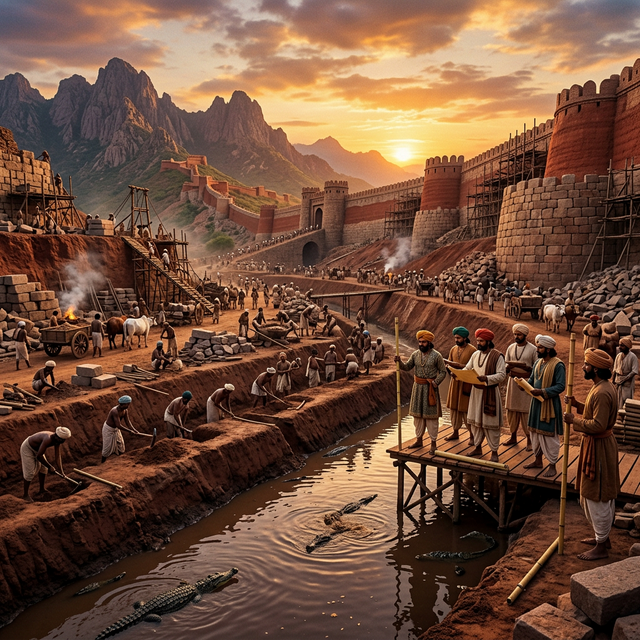
The earth of the frontier is being opened, not by the plow, but by the precise, unrelenting force of a thousand iron-shod spades. At the boundary of the Mauryan kingdom, where the fertile plains of the Ganges meet the volatile periphery of the mountain tribes, a vast foundation is being dug. The ground is a raw, jagged wound, revealing the layers of red clay and grey stone that have sat undisturbed for eons. Architects in white cotton robes move among the laborers, carrying long measuring rods made of seasoned bamboo and scrolls of birch-bark marked with the cold geometry of Kautilya. They do not see a landscape; they see a set of strategic variables that must be constrained by the "Science of Fortification."
A single, hand-hewn stone block, four cubits long and perfectly square, sits at the edge of the excavation. This block is the stake of the new era: it is the first unit of a machine that will transform the natural world into a "Circle of Kings" where safety is a matter of engineering. Kautilya stands on a nearby ridge, his hand resting on the shoulder of the Prince. Below them, the four types of forts are being simulated and built. There is the Audaka, the water-fortification, an island in the midst of a river or a plain surrounded by low ground; the Parvata, the mountain-fort, established on a rocky plateau; the Dhanvana, the desert-fort, located in a waterless tract of salty soil; and the Vanadurga, the forest-fort, hidden in a maze of thorns and swamps.
Each one is a specific response to the geography of the enemy.
The action of the chapter is a detailed, mechanical construction of the "Boundary Gate." The laborers dig three successive ditches around the rampart, each one separated by a space of one danda. The first ditch is filled with water, its banks lined with stone and its depths stocked with crocodiles and sharks—biological weapons designed to devour the unwary. Above them, the ramparts—the Vapra—are built of pressed clay, high enough to exceed the reach of an elephant. And crowning the ramparts are the towers, the Attalakas, placed at intervals of thirty dandas, their tops armed with "top-supports of ornamental arches" that conceal the archers of the guard.
The engineering grows more intimate as they move inside the walls. Kautilya details the construction of the "secret staircase" hidden within the brick walls, a vertical corridor that circumambulates from left to right, allowing the garrison to move like ghosts between the floors. He points to the "four beams to shut the door against elephants" and the "iron-bolt" as long as an aratni. This is not just architecture; it is the anatomy of containment. Every carving of an image, every platform opposite another, and every hall is a calculated exchange of visibility and concealment. The Prince realizes that the empire is no longer a collection of people, but a network of fortified points, a grid of iron and stone that the earth can no longer reclaim.
Of the first floor, five parts are to be taken for the formation of a hall, a well, and a boundary-house... on the left side, a staircase circumambulating from left to right; on the right, a secret staircase hidden in the wall... four beams to shut the door against elephants; and turrets raised up to the height of the face of a man, removable or irremovable, or made of earth in places devoid of water.
This is the rule of the immutable boundary, the technical manual for a state that has decided to survive by freezing the landscape. It says that the environment is a threat that must be countered with the specific dimensions of the sálá and the torana. It recognizes that the "might and energy" of even a low-quality animal or man can be improved by the "suitable training" of the ground they stand upon. The "secret staircase" is the symbol of this new power: a structure that is most effective when it is invisible, just like the King’s internal auditors. The men who need such a rule are those who have understood that a kingdom is not held by love, but by the geometry of the ditch.
The logic of the fort is the logic of the "Duties of Government Superintendents." It marks the transition from the King’s internal discipline to his external management of the material world. It assumes that if you can control the architecture of a man’s movement, you can control the man himself. The state is no longer a person; it is a fortress.
The canto concludes on the image of the completed boundary-gate standing against the horizontal glow of the setting sun. The ramparts are white and unyielding, the iron bolts of the doors gleaming like teeth. In the center of the first floor, the "well and the boundary-house" are finished, providing the life-blood for a garrison that will never leave. The Prince looks up at the towers and see the "carvings of images"—beautiful, decorative forms that mask the lethal efficiency of the turrets.
Outside, the forest is dark and silent, the mountain range a jagged, unmanaged shadow. But inside the geometry of defense, the world is measured, partitioned, and protected. The King stands at the top-most storey, looking out over the ditches where the crocodiles stir the dark water. He feels the weight of the stone beneath his feet, a sensation of absolute stability. The science of discipline has produced a man, and the science of fortification has produced a world. The construction of the Mauryan empire has begun, and its foundations are deep.