Chapter 8 of 126
An architectural study in survival, showing why the construction of a fortress is the physical manifestation of the sovereign's will to endure.
The innermost sanctum of the Mauryan palace is a maze of silence and suspicion. Here, where the wooden walls are thickest and the iron bolts are most frequent, lies the Antarvamsikan, the harem. It is a world of exquisite beauty—of hanging silk, polished copper mirrors, and the constant, low hum of female voices—but to Kautilya, it is a primary theater of war. He walks through the high-arched corridors, his eyes not on the tapestries, but on the staff-bearers and the "bands of Ten Communities" who police the space. He knows that the most dangerous enemy is not the one at the frontier, but the one who shares the King’s bed. In this hall of mirrors, every reflection is a potential assassin.
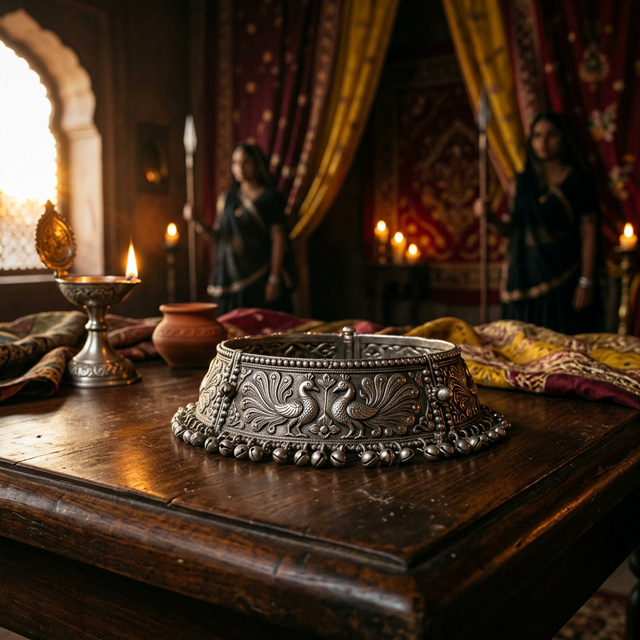
A single, heavy anklet lies on a low wooden table, its silver surface intricately engraved with the forms of peacocks and vines. This object is the stake of the night’s audit: a beautiful ornament that could be "painted with poison" to kill a man in his sleep. Kautilya leads the Prince through the history of the "Fortified Heart," a grim catalog of royal mortality. He speaks of King Bhadrasena, slain by his own brother hidden in a queen’s chamber; of King Karusa, killed by a son hiding under his mother’s bed; and of Kasiraja, poisoned by a queen who mixed "fried rice with poison, as though with honey." This is the lineage of the Mauryas: a history written in the blood of men who forgot that intimacy is a security breach.
The action of the audit is a total isolation of the King’s physical self. Before the King enters the harem, the queen’s personal purity must be "vouchsafed by an old maid-servant." Every woman he touches, every garment he wears, and every gem on his zone must be audited for the "bedaubed poison" that has ended dynasties. The King’s body is no longer his own; it is the property of the state, a machine that must be shielded from the biological and psychological volatility of the family. Even his entertainment—the festive trains, the fairs, and the processions—must be policed by the "Ten Communities," a ring of iron that ensures the public’s love never gets close enough to strike.
The Prince watches as the King prepares to leave the palace, mounting a horse equipped with military array. The street outside has been "well guarded by staff-bearers" and cleared of all "armed persons, ascetics, and the cripple." The city is pushed back, silenced, and made into a void through which the sovereign moves like a ghost. There is no cheering crowd, only the rhythmic thud of the guards’ staffs against the stone. The Prince realizes that the height of power is the depth of loneliness. To be the King is to be the only person in the world who is never allowed to be seen, unless he is armored in the absolute certainty of his own safety.
Hidden in the queen's chamber, his own brother slew king Bhadrasena; hiding himself under the bed of his mother, the son killed king Kárusa; mixing fried rice with poison, as though with honey, his own queen poisoned Kásirája; with an anklet painted with poison, his own queen killed Vairantya; with a gem of her zone bedaubed with poison, his own queen killed... Just as he attends to the personal safety of others through the agency of spies, so a wise king shall also take care to secure his person from external dangers.
This is the rule of the permanent exception, the documentation for a life lived behind a shield. It says that the King is the only true "external" variable—everyone else is a potential container for the enemy’s design. It assumes a world where the most sacred bonds (mother, wife, brother) are the most useful disguises for the assassin. The "wise king" is the one who accepts this nihilism as a technical requirement of the station. He treats his own person as a fortress that must be defended against the very people he is supposed to love. The men who need such a rule are those who have seen the "poisoned rice" and the "hidden brother" and understood that the state has no family.
The logic of the fortified heart is the conclusion of the "Science of Discipline." It completes the transformation of the man into the King, a process that began with the study of the four sciences and ends with the absolute isolation of the soul. Kautilya has built a world where the King is the ultimate auditor, the ultimate schedule-keeper, and now, the ultimate prisoner. The state is a machine of total surveillance, and the King is its most carefully guarded gear.
The canto, and the first book of the retelling, concludes on an image of the King returning to his chamber after the long day. He stands before the tall copper mirror, removing his military dress. He looks at his reflection—thin, tired, and unblinkingly focused—and for a moment, the silence of the Antarvamsikan is absolute. He reaches out to touch the silver anklet on the table, then pulls his hand back before he makes contact. He turns away from the mirror and toward the windowless stone cell of his sleeping quarters, where the iron bolts are already sliding into place.
Outside, the Ganges flows silently past the wooden bastions of Pataliputra, carrying the refuse of the city toward the sea. The bards in the marketplace are singing of the King's glory, of his justice and his power. But inside the fortified heart, the King is alone with the ticking of the water-clock and the weight of the crown. He has secured his person; he has maintained the discipline; and now, in the absolute darkness of the palace core, the sovereign is finally safe. The "Science of Disciplne" is complete. The science of power is just beginning.