Chapter 10 of 126
The internal gears of governance, establishing the departments that breathe life into the state's administration and keep its blood flowing.
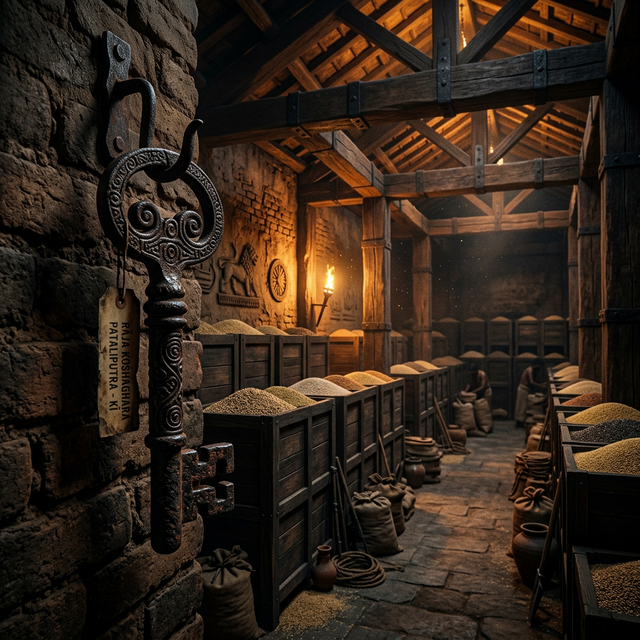
From the height of the Western rampart, the Mauryan capital does not look like a city of men; it looks like a complex, three-dimensional circuit. The high walls of Pataliputra, which the Prince and Kautilya have just finished surveying, do not merely contain the population; they define the internal machine of the state. Below them, the broad avenues are laid out in a grid of perfect right angles, leading toward the central royal palace. But the true power of the fort is not found in its palaces, but in its basements. Kautilya points down toward a cluster of low, windowless buildings made of fire-baked brick and reinforced with iron-strapped beams. These are the storehouses—the iron lungs of the empire—where the wealth, weapons, and food of the "Circle of Kings" are held in a state of permanent readiness.
A single, massive iron key, its bit worn smooth by decades of use, hangs from the belt of the Chamberlain (Sannidhátá). This key is the stake of the internal order: it is the primary instrument of the city’s survival. Kautilya explains that a fort exists for two reasons: to keep the enemy out and to keep the state’s resources in. The Chamberlain is the auditor of this interior world, the man who "ever attends upon the king" to ensure that the treasury is full, the armory is sharp, and the grain-silos are free from rot. To Kautilya, a city that cannot feed itself through a seven-year siege is not a city; it is a trap.
The action of the internal machine is a meticulous partitioning of space. Kautilya leads the Prince through the Koshagriha, the treasury, where "treasure-houses" are built of stone and guarded by sentries who are audited for their greed. They move to the Panyagriha, the trading-house, and then to the Kosthagára, the grain-silo, where the "collection of all kinds of revenue" is processed with bureaucratic silence. Every building is a cell in a larger organism. The grain is not just food; it is "the body of expenditure," a variable that must be tracked against the "royal year, the month, the day, and the dawn." The city is a vast ledger of "work in hand" and "work accomplished," where even the "museum of beasts, deer, birds, and snakes" is a calculated asset of the crown.
But the machine is only as secure as its components. Kautilya points to a group of men being led out of the boundary gate—the Báhirikas. These are the dangerous outsiders, the "cripples, ascetics, and armed persons" whose presence is "dangerous to the well-being of cities." They are being "thrown in country parts" or "compelled to pay taxes" in the periphery. Internal security is achieved not just by building walls, but by purging the city of those who are " scarcely liable to the insinuations and intrigues of an enemy." The Mauryan capital is a closed system, a laboratory of order where every inhabitant has a function and every building has a lock.
The royal year, the month, the paksha, the day, the dawn... the business of upkeeping the government, the routine work, the collection of necessaries of life, the collection and audit of all kinds of revenue—these constitute the work in hand. Never shall báhirikas who are dangerous to the well-being of cities and countries be kept in forts. They may either be thrown in country parts or compelled to pay taxes.
This is the rule of the total inventory, the documentation for a city that is treated as a stockpile. It says that the "body of expenditure" is the ultimate measure of the state’s health, and that the Chamberlain is the physician of that body. It recognizes that "chiefs, when many, are under the fear of betrayal from each other," and thus prescribes a system of mutual surveillance for the "officers of infantry, cavalry, chariots, and elephants." The "work in hand" is never finished; it is a constant, shifting balance of "receipts, expenditure, and net balance." The men who need such a rule are those who have understood that a civilization is built on the ability to count and contain.
The logic of the internal machine is the logic of the "Duties of Government Superintendents." It marks the transition from the architecture of the wall to the architecture of the storehouse. It assumes that if the King can control the "routine work" and the "collection of necessaries," he can control the future. The state is no longer a fortress against the outside; it is a bank of stability for the inside.
The canto concludes on the image of the Chamberlain locking the heavy doors of the grain-storehouse at sunset. The iron bolts slide home with a hollow, metallic resonance that echoes through the quiet courtyard. He turns the massive key and feels the resistance of the lock—a sensation of absolute enclosure. He looks up at the high walls of the city, where the "many chiefs" of the guard are patrolling their sections, their eyes sharp with the "fear of betrayal" that keeps them honest.
Outside, the bards are still singing of the King's conquest. But inside the internal machine, the Chamberlain is simply checking the "net balance." He walks alone through the grid of streets, his shadows long and jagged against the brick walls. He has secured the grains; he has audited the revenue; and now, in the heart of the Mauryan engine, the gears are turning with the silent precision of the shadow-clock. The city is ready for the siege that Kautilya knows is always coming.